
 Worksheets
Introduction to Nervous System
Total questions: 59
Worksheet time: 30mins
The main function of the nervous system is
to transport materials through the body
to exchange oxygen and carbon dioxide
to break apart your food so you can absorb the nutrients/macromolecules in it
to control and coordinate all the body systems
The cells of the nervous system are called...
nuclei
neurons
stimuli
lymphocytes
How are messages sent in the nervous system?
chemical
photosynthesis
electric and chemical
electric
The chemicals that float across the synapse are called
lymphocytes
neurotransmitters
macrophages
hormones
The three types of neurons are (choose all that apply)
muscle neuron
sensory neuron
motor neuron
interneuron
If you step on a tack which type of neuron sends the information to the brain? (a)
What are the neurons called that the brain is made up of which interpret what happened? (a)
Which type of neuron carries a message away from your brain to your leg muscles that causes your foot to rise? (a)
Which part of the neuron picks up a signal and turns it to an electric signal?
dendrites
cell body
axon
synapse
The _____________________________ insulates the axon to speed up the signal.
dendrites
myelin sheath
synapse
cell body

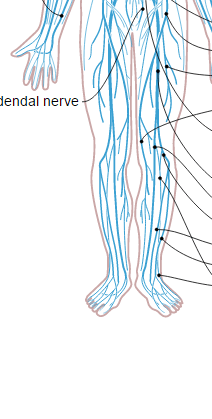


The part of the PNS that controls involuntary actions
autonomic nervous system
somatic nervous system
organic nervous system
reflexive nervous system
What part of the nervous system is responsible for slowing down breathing and pulse?
Spinal Nerves
Sympathetic
Parasympathetic
Spinal Nerves

Neuroglial cells that form the fatty myelin sheath on neurons in the CNS are ___________ in the PNS are ________________?
ganglia and oligodendroglia
astrocytes and schwann cells
schwann cells and oligodendroglia
oligodendroglia and schwann cells
Small cells that engulf and destroy microbes and cellular debris in the CNS
microglia
horns
neuroglia
astrocytes

Produce cerebrospinal fluid in the brain & spinal cord
ependymal cells
oligodendrocytes
microglia
astrocytes
Type of neuron that perceive information about your environment.
Motor Neuron
Interneuron
Sensory Neuron
Type of neuron that sends nerve impulses to muscles and gland, by the command of other neurons.
Motor Neurons
Interneurons
Sensory Neurons
Neurons that only have on process?
Multipolar
Bipolar
Unipolar
Unpolar
Unipolar neurons are always ....
Sensory
Reflex
Visual
Only in the CNS
The Central Nervous System is almost all ....
Unpolar
Bipolar
Multipolar
Unipolar
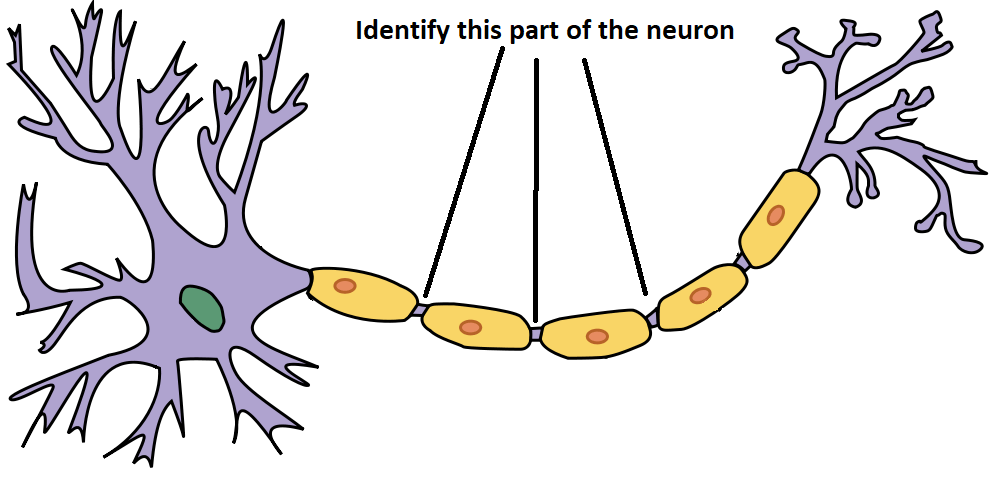
Nucleus
Cell Body
Axon
Node of Ranvier
Carry impulses from from CNS to effectors
afferent/sensory neurons
efferent/motor neurons
dendrites
axon terminals
Carry impulses from from CNS to effectors
afferent/sensory neurons
efferent/motor neurons
dendrites
axon terminals
Carry impulses from from receptors to CNS
afferent/sensory neurons
efferent/motor neurons
dendrites
axon terminals
Carry impulses from from receptors to CNS
afferent/sensory neurons
efferent/motor neurons
dendrites
axon terminals
Transmit impulses away from the cell body
afferent/sensory neurons
axons
dendrites
astrocytes
Transmit impulses toward from the cell body
afferent/sensory neurons
axons
dendrites
astrocytes
Contain vesicles with neurotransmitters (located at the end of axons)
axons
dendrites
axon terminals
synapse
Function(s) of the myelin sheath?
protects
insulates
increases speed of transmission
all of the above
Chemicals which transmit electrical impulses
astrocytes
oligodendrocytes
microglia
neurotransmitters

Cells that form myelin sheaths on CNS
astrocytes
oligodendrocytes
microglia
neurotransmitters

Cells that form myelin sheaths on PNS
astrocytes
oligodendrocytes
microglia
Schwann cells

Scavenge and degrade dead cells & protect the brain from invaders
ependymal cells
oligodendrocytes
microglia
astrocytes

