
 Worksheets
mid term revision
Total questions: 64
Worksheet time: 49mins
label the light dependent reaction
label the following diagram
A: Three CO2 enters the cycle and combines with three 5-C molecule to form three 6-C molecules.
B: Energy from ATP and NADPH energizes the 3-carbon-atom molecules.
C: Three 6-C molecules break into six 3-C molecules.
D: One high-energy 3-C molecule is used to make glucose.
E: Five high-energy 3-C molecule remain.
F: ATP provides energy to rearrange the Five 3-C molecules to Three 5-C molecules.
Write out the three factors that affect photosynthesis.
write out the formula of photosynthesis in both words and symbols.
Reorder the process of ATP synthesis.
electrons from water molecules flow to the photosystem II.
PSII absorbs light and changes the low energy electrons into high energy electrons.
High energy electrons go through the electrons transport chain.
The electron transport chain uses energy lost by the high energy electrons to pump the H+ ions into the thylakoid space
The H+ ions escape through the ATP synthase. 1. The ATP synthase rotates as the H pass through. When the ATP rotates, ADP converts to ATP.
Reorder the process of NADPH synthesis.
The high energy electrons lost energy to the electron transport chain and become low energy electrons.
The low energy electrons get energy in photosystem I and become high-energy electrons again.
The high energy electrons combine with the NADP+ and become NADPH.
Light-independent reaction
a reaction of photosynthesis that
uses ATP, NADPH, and carbon
dioxide to make high-energy
sugars.
Light-dependent reaction
a reaction of photosynthesis that
uses light energy to make ATP and
NADPH.
Thylakoid
a baglike photosynthetic membrane found in chloroplasts.
Stroma
the liquid-filled space surrounding the thylakoids in chloroplasts.
NADP+
one of the molecules that accepts high-energy electrons
from chlorophyll and carries them to other
Photosystem
the light-collecting units of the chloroplast.
Electron transport chain
a series of proteins in which
high-energy electrons are used to change ADP to ATP.
NADP+
one of the molecules that accepts high-energy electrons
from chlorophyll and carries them to other
Electrons from water molecules flow to the photosystem II.
PSII absorbs light and changes the low energy electrons into high energy electrons.
High energy electrons go through the electrons transport chain
The electron transport chain uses energy lost by the high energy electrons to pump the H+ ions into the thylakoid space. The H+ ions escape through the ATP synthase.
The ATP synthase rotates as the H pass through.
When the ATP rotates, ADP converts to ATP.
Reorder the following of flow of electrons
Water molecules
Photosystem II
electron transport chain---photosystem I
Electron transport chain-NADP+
Calvin cycle
Where does the light-independent reaction take place? Choose the best answer
Stroma
thylakoid
chloroplast
thylakoid space
What the energy lost by the high-energy electrons to the electron transport chain is used to do? Choose the best answer
to pump H+ ions into the thylakoid membrane
to change ATP to ADP
to produce NADPH from NADP+
to produce sugars
What the light absorbed by photosystem II is used to produce?
ATP
NADPH
H+
sugars
What the light absorbed by photosystem I is used to produce?
NADPH
ADP
ATP
NADP+
Where the H+ ions inside of the thylakoid membrane are from?
Some from the breaking of water molecules.
Others from the electron transport chain pump.
Only from breaking of water molecules
Only from electron transport chain pump
From ATP synthase
The function of the electron transport chain
pass the electrons and pump H+ ions into the thylakoid space.
only to pass the electrons
absorb the light and change low energy electrons to high energy electrons
to use change ADP to ATP
Similarity between photosystem II and photosystem I
both made of protein and high energy electrons
both can absorb sunlight to convert the low energy electrons to high energy electrons
both can change ADP to ATP.
both can change NADP+ to NADPH.
Conversion during the light-dependent reaction includes
(a) (b) (c)
Conversion during the light-independent reaction includes
(a) (b) (c)
Where does the light-dependent reaction take place?
Thylakoid membrane.
Stroma
Chloroplast
thylakoid space
Where the chlorophyll is located? Choose the most specific site
Inside the photosystem
On the thylakoid membrane
In the chloroplast
in the stroma
What is the function of ATP synthase?
to synthesize ATP
to synthesize ADP
to synthesize NADPH
to synthesize high energy electrons
The relationship between light-dependent and light-independent reaction.
the light-dependent reaction provides the light independent reaction with ATP and NADPH to make O2
the light-independent reaction provides the light dependent reaction with ATP and NADPH to make sugars
the light-independent reaction provides the light dependent reaction with ATP and CO2 to make sugars
the light-dependent reaction provides the light independent reaction with ATP and NADPH to make sugars
A flower appears yellow because
it reflects yellow light
it absorbs yellow light
it absorbs violet light.
It reflects violet light
If a plant does not absorb blue light, it will appear to be
blue
yellow
violet
red
The chlorophyll reflects_____light, and absorbs____light.
green,
red and blue-violet light.
red and blue-violet light,
green.
green,
red.
green
blue-violet light,
The light-dependent reaction takes place in
stroma
thylakoid
outer membrane
inner membrane
The light-independent reaction takes place in the
stroma
thylakoid space
thylakoid
outer membrane
Oxygen comes from ____ in the light-dependent reaction
water
carbon dioxide
sunlight
sugar
The carbon atoms in the sugar comes from_____
carbon dioxide
oxygen
water
chlorophyll
Which of the following is an electron carrier in the light-dependent reaction?
ATP
ADP
NADPH
NADP+
NADP+ change into NADPH in
light-dependent reaction
light-independent reaction
photosynthesis
calvin cycle
NADPH change into NADP+ in
light-dependent reaction
light-independent reaction
photosynthesis
photosystem II
The overall equation of photosynthesis:
(a) X water + 6 X (b) ---6 X (c) + 1 X (d)
a baglike photosynthetic membrane found in chloroplasts.
Thylakoid
granum
Stroma
chloroplast
the liquid-filled space surrounding the thylakoids in chloroplasts.
stroma
cytoplasm
thylakoid space
thylakoid
one of the molecules that accepts high-energy electrons from chlorophyll and carries them to other molecules during photosynthesis.
NADPH
NADP+
ADP
ATP
a reaction of photosynthesis that uses ATP, NADPH, and carbon dioxide to make high-energy sugars.
light-dependent reaction
light-independent reaction
photosynthesis
a reaction of photosynthesis that uses light energy to make ATP and NADPH.
light-dependent reaction
light-independent reaction
calvin cycle
photosynthesis
Where does the energy for photosynthesis come from?
from sunlight
from ATP
from NADPH
from chlorophyll
The molecules that absorbs light is called
pigment
NADPH
NADP+
ATP
What will happen to the chlorophyll when it is struck by the sunlight?
The electrons will be energized.
The chlorophyll molecule will be broken into two parts.
The chlorophyll molecule will be turned into sugar.
The chlorophyll molecule will be turned into NADPH and ATP.
Why are NADP+ suitable for carrying the electrons?
They can accept and holds the high-energy electrons and transfer most of their energy.
They are large and have room to hold the electrons
They can absorb the sunlight and produce high-energy electrons.
They are sugar with high energy which allows them to carry electrons.
Why are electron carriers needed for transporting electrons from one part of the chloroplast to another?
The electrons are highly reactive.
The electrons would be destroyed.
High-energy sugars are not soluble in the cytoplasm.
NADP+ will give energy to electrons.
In addition to light and chlorophyll,
photosynthesis requires
carbon dioxide and sugars.
carbon dioxide and water.
oxygen and sugars
oxygen and water.
Where do plants get the energy they need tocarry out photosynthesis?
air
soil
sunlight
water
What is the function of NADP+ ?
It absorbs light.
It is an electron carrier
It is a light-reflecting pigment.
It acts as long-term energy storage
The principal pigment in plants is
chlorophyll.
ATP
oxygen
NADPH
Which of the following is NOT produced in the light-dependent reactions of photosynthesis?
NADPH
sugars
hydrogen ions
ATP
The color of light that is LEAST useful to a plant during photosynthesis is
red
blue
green
violet
The first step in photosynthesis is the
synthesis of water.
production of sugars.
break down of carbon dioxide
absorption of light energy
In a typical plant, all of the following factors are necessary for photosynthesis EXCEPT
chlorophyll
oxygen.
light.
water
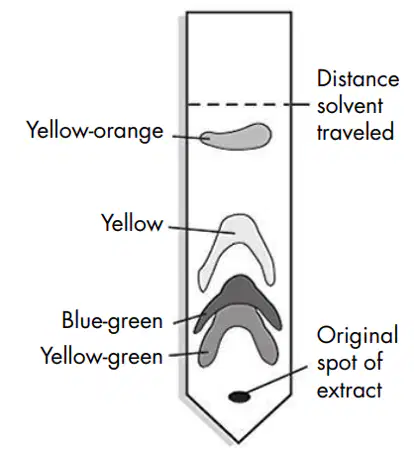
Which pigment traveled the shortest distance?
yellow-orange
blue-green
yellow
yellow-green
label the following diagram
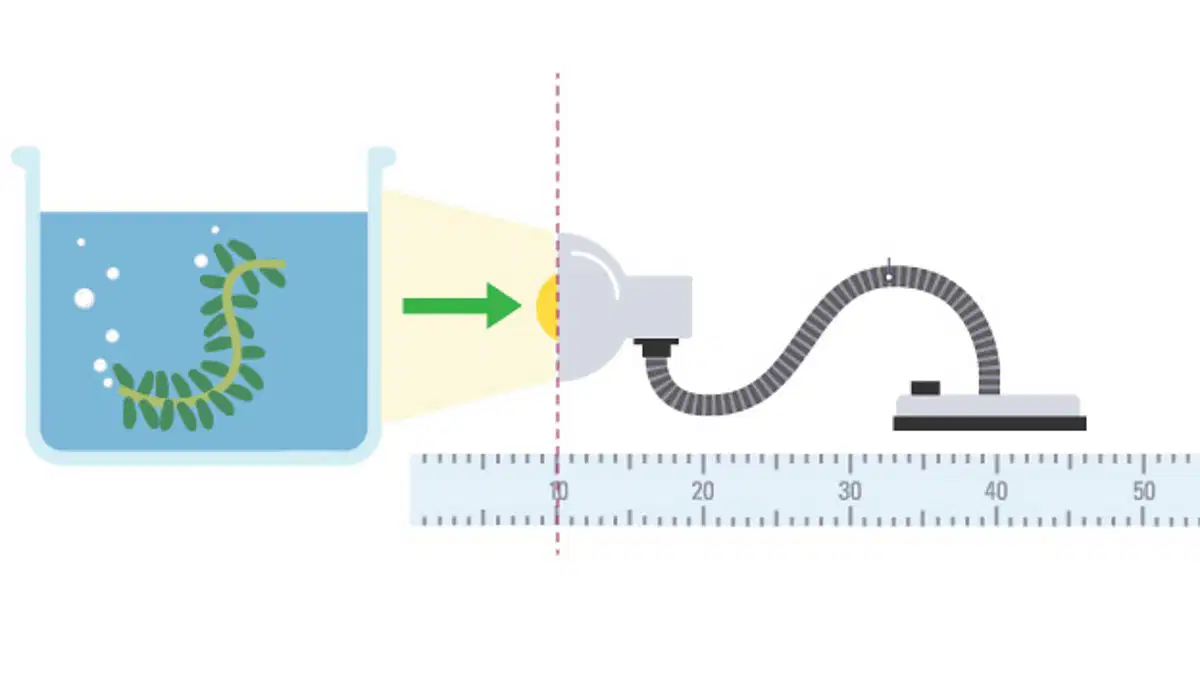
How do you meausre the rate of photosynthesis in this experimental setup?
by counting bubbles
by measuring the distance between the lamp and the plant
by measuring the water content
by measuing the light intensity

Imagine that y-axis of each graph in Figure 8–6 describes the rate of photosynthesis. Which of the graphs represents the effect of temperature on the rate of photosynthesis?
A
B
C
D

Imagine that y-axis of each graph in Figure 8–6 describes the rate of photosynthesis. Which of the graphs represents the effect of water content on the rate of photosynthesis?
A
B
C
D

Imagine that y-axis of each graph in Figure 8–6 describes the rate of photosynthesis. Which of the graphs represents the effect of light intensity on the rate of photosynthesis?
A
B
C
D
Chloroplast exist in which type of organisms
animals
plants
fungi
bacteria
The other name of calvin cycle
light dependent reaction
light independent reaction
crebs cycle
What are photosystems made of?
chlorophyll
protein
chlorophyll and protein
ATP and ADP
photosynthesis is consisted of
light dependent and light independent
light dependent
light independent
calvin cycle

