
 Worksheets
Nuclear Chemistry Quick Check
Total questions: 30
Worksheet time: 8hrs 30mins
Name
Class
Date
1.
Radioactive particles that cause the most damage are known as:
a)
Alpha
b)
Beta
c)
Gamma
d)
Nuclear
2.
When the nucleus of an atom is bombarded with neutrons this causes a chain reaction, what is this called?
a)
Fusion
b)
Fission
c)
Nuclear Reaction
d)
both fission and nuclear reaction
3.
This type of particle can penetrate paper, but not aluminum foil.
a)
Alpha
b)
Beta
c)
Gamma
d)
Nuclear
4.
These radioactive particles cause the least amount of damage.
a)
Alpha
b)
Beta
c)
Gamma
d)
Nuclear
5.
When two nuclei combine to form a new element this process is called:
a)
fusion
b)
fission
c)
nuclear reaction
6.
When you go to the dentist and get an x-ray, what type of blanket do the put on you before?
a)
aluminum
b)
plastic
c)
lead
d)
concrete
7.
What type of material surrounds most nuclear power plants?
a)
Lead
b)
concrete
c)
aluminum
d)
paper
8.

Which radioactive isotope decays quicker?
a)
Carbon-14
b)
Plutonium-239
c)
Same
9.

After 32,000 years how much Plutonium-239 is left undecayed?
a)
32
b)
40
c)
5
10.
Which of the following is an example of nuclear fusion?
a)
A plutonium atom is used to start a chain reaction that detonates a nuclear weapon
b)
A uranium atom is split apart into lighter elements
c)
Two hydrogen atoms are combined to form a helium atom
d)
Two hydrogen atoms bond with an oxygen atom to form a water molecule
11.

Has the symbol
a)
Alpha
b)
Beta
c)
Gamma
d)
electron
12.

In order of most to least penetrating radiation we have
a)
Alpha , Beta, Gamma
b)
Beta , Gamma , Alpha
c)
Gamma, Beta, Alpha
d)
Gamma, Alpha, Beta
13.

Which type of nuclear radiation is being emitted here?
a)
Alpha
b)
Beta
c)
Gamma
d)
none
14.

Has the symbol
a)
Alpha
b)
Beta
c)
Gamma
d)
proton
15.
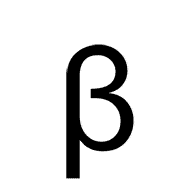
Has the symbol
a)
Alpha
b)
Beta
c)
Gamma
d)
neutron
16.

This is an example of...
a)
Fission reaction
b)
Fusion reaction
c)
Decomposition reaction
d)
Combustion
17.
How does nuclear fusion compare to nuclear fission?
a)
Nuclear fusion produces no radioactive waste
b)
Nuclear fusion produces more radioactive waste
c)
. Nuclear fusion is cheaper and easier to produc
d)
Nuclear fusion requires rare, expensive elements to work
18.
Which of the following best describes the process of nuclear fission?
a)
Splitting an atom's nucleus apart
b)
Separating an atom's electrons from its nucleus
c)
Fusing two atomic nuclei together
d)
Splitting an atom's electrons in half
19.
Which process produces beta particles?
a)
Alpha decay
b)
Beta decay
c)
Gamma decay
d)
Nuclear fusion
20.
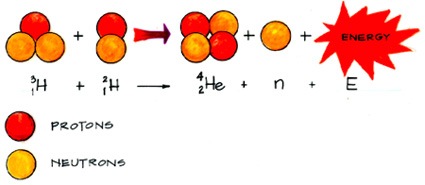
Which process involves the joining of small nuclei?
a)
Beta decay
b)
Alpha decay
c)
Nuclear fission
d)
Nuclear fusion
21.

Which process involves the splitting of large nuclei?
a)
Beta decay
b)
Alpha decay
c)
Nuclear fission
d)
Nuclear fusion
22.
The time taken for half of an amount of radioactive atoms to decay.
a)
Nuclear fusion
b)
Full-life
c)
Dead time
d)
Half-life
23.
The nuclear process occurring at a nuclear power plant.
a)
Nuclear fusion
b)
Nuclear fission
c)
Combustion
d)
Multiplication
24.
Complete the sentence: As time passes the level of radiation produced by a radioactive material...
a)
Decreases
b)
Increases
c)
Remains constant
25.

Arrange in order of increasing ability to penetrate matter.
a)
Beta, gamma, alpha
b)
Alpha, gamma, beta
c)
Gamma, beta, alpha
d)
Alpha, beta, gamma
26.
Which process produces alpha particles?
a)
Alpha decay
b)
Beta decay
c)
Gamma decay
d)
Nuclear fusion
27.
What is one problem with using nuclear fission as an energy source?
a)
finding radioactive elements that have longer half-lives
b)
finding ways of storing radioactive wastes
c)
finding compounds to cool heated water
d)
finding non-radioactive elements for reactors
28.
Which type of radiation has the greatest penetrating power?
a)
Alpha
b)
Beta
c)
Gamma
d)
Microwaves
29.
Alpha particles have a _____ charge.
a)
+2
b)
0
c)
+1
d)
-1
30.
What does it mean when an element is radioactive?
a)
atom emits radiation
b)
nucei unstable due to uneven p to n ratio
c)
nuclei changes to become stable
d)
all of the above
100 %

