Wayground logo

Free Printable Worksheets

Font size

S
M
L
XL
Worksheets

Chemical Bonding

Total questions: 40

Worksheet time: 35mins

Name
Class
Date
1.
An ionic bond forms when atoms ___________ electrons.
a)
gain
b)
share
c)
increase
d)
transfer
2.
Which type of bond has an equal sharing of electrons?
a)
Polar Covalent 
b)
Non Polar Covalent
c)
Ionic
d)
Metallic
3.

Why do atoms bond?

a)

They typically don't bond

b)

To add or take away energy levels

c)

To have a full valance shell.

d)

To have a full inner shell

4.

Ionic bonding is between a

a)

nonmetal and nonmetal

b)

metal and nonmetal

c)

metal and metal

d)

Depends on the situation

5.

Covalent bonding is between a

a)

nonmetal and nonmetal

b)

metal and nonmetal

c)

metal and metal

d)

It depends on the situation

6.
In chemical compounds, covalent bonds form when
a)
the electronegativity difference between two atoms is very large.
b)
electrons are completely transferred between two metals.
c)
pairs of electrons are shared between two nonmetal atoms.
d)
two nonmetal atoms are attracted to each other by opposite charges.
7.

Using electronegativities, what type of bond is formed by S and Br.

a)

ionic

b)

polar covalent

c)

non-polar covalent

8.
What is the name of the compound NO?
a)
nitrogen dioxide
b)
nitrogen monoxide
c)
dinitrogen trioxide
9.
The name of Cu₃N₂ is
a)
copper (III) nitride
b)
copper (II) nitride
c)
copper nitride
d)
tricopper dinitride
10.
The chemical formula of iron (III)bromide is
a)
FeBr
b)
Fe(III)Br
c)
FeBr₃
d)
Fe₂Br₃
11.

______ molecules are found in nature as pairs of two atoms of the same type covalently bonded together.

a)

Diatomic

b)

Monatomic

c)

Polyatomic

d)

Network

12.

Which of the following types of elements can exist in nature as diatomic molecules?

a)

alkali metals

b)

transition metals

c)

halogens

d)

noble gases.

13.
A solid substance is an excellent conductor of electricity. The chemical bonds in this substance are most likely?
a)
ionic, because the valence electrons are shared between atoms
b)
covalent, because the valence electrons are mobile
c)
metallic, because the valence electrons are stationary
d)
metallic, because the valence electrons are mobile
14.

Which compound would have a very low melting point?

a)

sodium chloride

b)

copper (II) sulfate

c)

sulfur dioxide

d)

aluminum

15.
What is the correct chemical name for the molecular compound:  SF4
a)
Sulfur Fluoride
b)
Sulfur TetraFluoride
c)
TetraSulfide Fluoride
d)
Sulfur (IV) Fluoride
16.
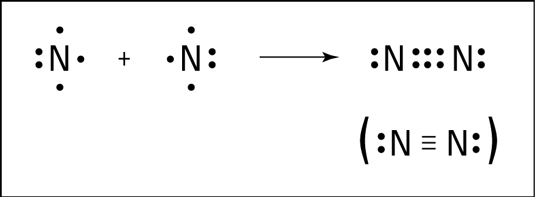
Given the picture, what type of bond is  holding the atoms together in this molecule?
a)
polar covalent bond
b)
nonpolar covalent bond
c)
ionic bond
d)
metallic bond
17.

CO2 has polar bonds but is a NON POLAR molecule. Why?

a)

it has an asymmetrical shape

b)

bond polarity or dipole moment between C and O atoms cancel

c)

there is net dipole moment between C and O atoms in molecule

d)

bond polarity does not exist between C+ and O- atoms

18.

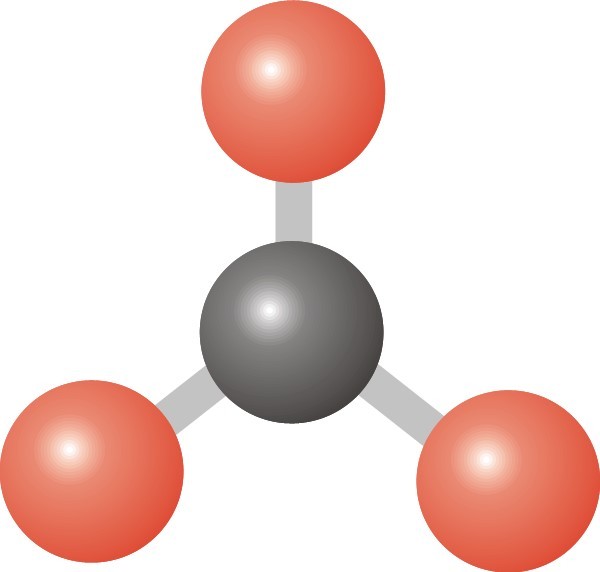
Is this molecule polar or nonpolar?

a)

polar

b)

nonpolar

19.
What molecule could this be? 
a)
BF3
b)
CH4
c)
H2O
d)
CO2
20.
Hydrogen needs _____ electrons in its valence shell to be stable.
a)
4
b)
6
c)
8
d)
2
21.

When you have H-Cl atoms, what is the polarity?

a)

nonpolar

b)

polar

c)

ionic

22.
Which of the following is the correct Lewis structure for the compound PBr3?
a)
structure A
b)
structure B
c)
structure C
d)
structure D
23.

Carbonate (CO32-) has how many double bonds?

a)

0

b)

1

c)

2

d)

3

24.

Which Lewis Dot Model drawing correctly shows an O2 molecule?

a)
b)
c)
d)
25.

Which of the following is the AXE notation for OF2?

a)

AX2E0

b)

AX2E1

c)

AX2E2

d)

AX2E3

26.

What is the AXE Notation for SeO3?

a)

AX3E0

b)

AX3E1

c)

AX3E2

d)

AX3E3

27.

Which of the following pairs of elements can form an ionic bond

a)

S and O

b)

N and F

c)

P and H

d)

B and Cl

28.

How many lone pairs of electrons will a trigonal pyramid molecule have?

a)

1

b)

2

c)

3

d)

4

29.

H2O molecule has _____________ geometry

a)

linear

b)

Bent

c)

Tetrahedral

d)

Trigonal Pyramid

30.
How many electrons are shared in a double bond?
a)
1
b)
2
c)
4
d)
6
31.

What is the molecular geometry of the following?

a)

Linear

b)

Trigonal planar

c)

Tetrahedral

d)

Trigonal Bipyramidal

32.
What is the MOLECULAR geometry of the central oxygen?
a)
Linear
b)
Trigonal Planar
c)
Bent
d)
Tetrahedral
33.
What molecular shape is the structure shown here? (NH4+)
a)
linear
b)
trigonal planar
c)
tetrahedral
d)
trigonal pyramidal
34.
What VSEPR shape is this
a)
Linear
b)
Line
c)
Tetrahedral
d)
Bent
35.

What molecular shape does SeO3 have?

a)

Bent

b)

Trigonal planar

c)

Trigonal pyramid

d)

Tetrahedral

36.

Which of the following molecules would be polar?

a)

CCl4

b)

CS2

c)

AsF5

d)

SeO2

37.

Which of the following would have a shorter bond length?

a)

HCl

b)

O2

c)

N2

d)

Cl2

38.

Which compound would have a higher melting point?

a)

CO2

b)

MgS

c)

MgCl2

d)

MgBr2

39.

The name of H2S

a)

sulfuric acid

b)

hydrogen sulfide

c)

hydrosulfuric acid

d)

dihydrogen monasulfide

40.

Name of Ba(OH)2

a)

Barium dihydride

b)

Barium hydroxide

c)

Barium hydride

d)

Barium oxygen hydride