wayground logo

Free Printable Worksheets

NEW

Font size

S
M
L
XL
Worksheets

Applied Chemistry Midterm

Total questions: 54

Worksheet time: 39mins

Name
Class
Date
1.
Which of the following is a positively charged subatomic particle found in the nucleus of an atom?
a)
Electron
b)
Proton
c)
Neutron
d)
Quark
2.
A particle that moves around the nucleus is a(n)...
a)
Proton
b)
Neutron
c)
Electron
d)
Quark
3.
the central region of an atom where its neutrons and protons are is its 
a)
nucleus 
b)
electron cloud
c)
core 
d)
center 
4.
What is the mass number?
a)
the number of protons
b)
the sum of the number of protons and the number of neutrons in the nucleus of an atom 
c)
the number of electrons
d)
the number of neutrons
5.

Which of these determines the identity of an atom?

a)

proton

b)

neutron

c)

valence electron

d)

protons and neutrons

6.

What element has an atomic number of 33?

a)

antimony

b)

aluminum

c)

arsenic

d)

argon

7.

Determine the atomic number of boron.

a)

4

b)

5

c)

6

d)

7

8.

For a neutral atom, the number of _______________ equals the number of ______________.

a)

protons; electrons

b)

neutrons, electrons

c)

protons, neutrons

9.
Atoms with similar properties are most likely located...
a)
in the same period.
b)
in the same group.
c)
in different periods.
d)
to the right and left of each other.
10.
The Modern Periodic Table of Elements is arranged by
a)
atomic mass
b)
atomic number
c)
valence electrons
d)
number of isotopes
11.

All elements in the same Group have the similar properties because they have the same number of

a)

electron shells

b)

valence electrons

c)

protons

d)

neutrons

12.

All elements in the same period have the same number of...

a)

electron shells

b)

valence electrons

c)

protons

d)

neutrons

13.

Light is emitted by

a)

electrons gaining energy and going up to a higher energy level

b)

electrons giving off energy as a photon and going down to a lower energy level

c)

little gremlins inside lightbulbs

d)

tractors

14.

When an electron goes up an energy level in a atom, we say that the electron is_______.

a)

pretty neat

b)

hot

c)

cold

d)

excited

15.

Which best explains why different elements emit different colors of light when they are burned?

a)

Every element has a different arrangement of electrons that get excited in different ways to release different types of light.

b)

They get hot.

c)

Every element has the same arrangement of electrons that get excited in the same ways to release different types of light.

d)

Every element has light always stored in its electrons.

16.
Contains only one kind of atom.
a)
Element
b)
Compund
c)
Mixture
17.
Contains two or more atoms combined
a)
Elements
b)
Compounds
c)
Mixtures
18.
Is sugar (C12H22O11) an element or a compound?
a)
Element
b)
Compound
19.
Classify the picture with the correct label.
a)
Element
b)
Compound
c)
Mixture of Elements
d)
Mixture of Compounds
20.

How many ATOMS are in a molecule of ethanol (C2H6O)?

a)

3

b)

8

c)

9

d)

1

21.

How many different ATOMS are in a molecule of ethanol (C2H6O)?

a)

3

b)

8

c)

9

d)

1

22.

Which element in Period 2 has the greatest atomic radius?

a)

Be

b)

C

c)

Na

d)

Li

23.

Of the halogens, which has the smallest radius?

a)

F

b)

Br

c)

He

d)

At

24.

Which of the period 3 elements has the strongest pull for new electrons (highest electron affinity)?

a)

Ar

b)

Cl

c)

Na

d)

Al

25.

Subatomic particles with a negative charge

a)

Electrons

b)

Neutrons

c)

Protons

d)

Quarks

26.
subatomic particles found on the outermost shell & responsible for the atom's reactivity
a)
neutrons
b)
valence electrons
c)
isotopes
d)
ions
27.
A charged atom
a)
Ion
b)
Isotope
c)
Electron Cloud
d)
Quark
28.

What is the charge of an ion that has 3 protons and 2 electrons?

a)

+1

b)

-1

c)

0

d)

+2

29.

What is the name of an element that has 3 protons and 2 electrons?

a)

a lithium atom

b)

a lithium ion

c)

a helium atom

d)

a helium ion

30.

Why does chlorine usually gain one electron?

a)

to become unstable

b)

to have an unstable inner shell of electrons (8)

c)

to have a stable inner shell of electrons (8)

d)

to have a stable outer shell of electrons (8)

31.

What is the symbol for an ion with 12 protons and 10 electrons?

a)

Ne+

b)

Ne2+

c)

Mg+

d)

Mg2+

32.

Metals __________ electrons to get a stable electron configuration.

a)

lose

b)

gain

c)

do nothing with

33.

Most nonmetals ______________ electrons to acquire a stable electron configuration.

a)

lose

b)

gain

c)

do nothing with

34.

Group 18 nonmetals _____________ electrons to have a stable electron configuration.

a)

lose

b)

gain

c)

do nothing with

35.
Ionic bonds form between metals and ____.
a)
metalloids
b)
metals
c)
nonmetals
36.
What determines how ionic bonds will form?
a)
Number of protons
b)
Mass of the atom
c)
Number of total electrons
d)
Number of valence electrons
37.
Ionic bonds happen because of the ____ of valence electrons.
a)
sharing
b)
transfer
38.
What type of bond is this? Lithium with Fluorine?
a)
ionic
b)
covalent
39.
An ionic bond is the attraction between:
a)
oppositely charged ions
b)
similarly charged ions
c)
neutral ions
d)
neutral atoms
40.
 Which of the following is the correct formula for these two ions:
Al+3 +  S-2
a)
AlS3
b)
Al2S3
c)
Al3S2
d)
Al3S
41.

Which of the following is the best representation of a molecule of fluorine (F2)?

a)

A

b)

B

c)

C

d)

D

42.

What is it called if there are three-pairs of electrons being shared?

a)

Triple Bond

b)

Three Single Bonds

c)

Tribond

d)

Double and Single Bond Combo

43.
What can be generalized about covalent bonds?
a)
Electrons will be exchanged.
b)
Electrons will be transferred.
c)
Electrons will be given and taken.
d)
Electrons will be shared.
44.

Which formula is for phosphorus trichloride?

a)

KCl3

b)

PCl3

c)

K3Cl

d)

P3Cl

45.

Silicon dioxide is the compound in sand. What is its formula?

a)

SO2

b)

NaO2

c)

SiO2

d)

SiO

46.

What is the formula for diphosphorus pentoxide?

a)

P2O5

b)

PO5

c)

P5O2

d)

P2O6

47.
What two types of atoms make a covalent bond?
a)
2 Nonmetals
b)
1 Nonmetal and 1 Metal
c)
2 Metals
d)
2 Noble Gases
48.
How many carbon atoms are in methane?
a)
1
b)
2
c)
3
d)
4
49.
Which of the following compounds is an example of hydrocarbon?
a)
CO2
b)
C2H6
c)
C2H5OH
d)
CH3COOH
50.
Which of the following elements must be present in any organic compound?
a)
Carbon
b)
Oxygen
c)
Potassium
d)
Hydrogen
51.
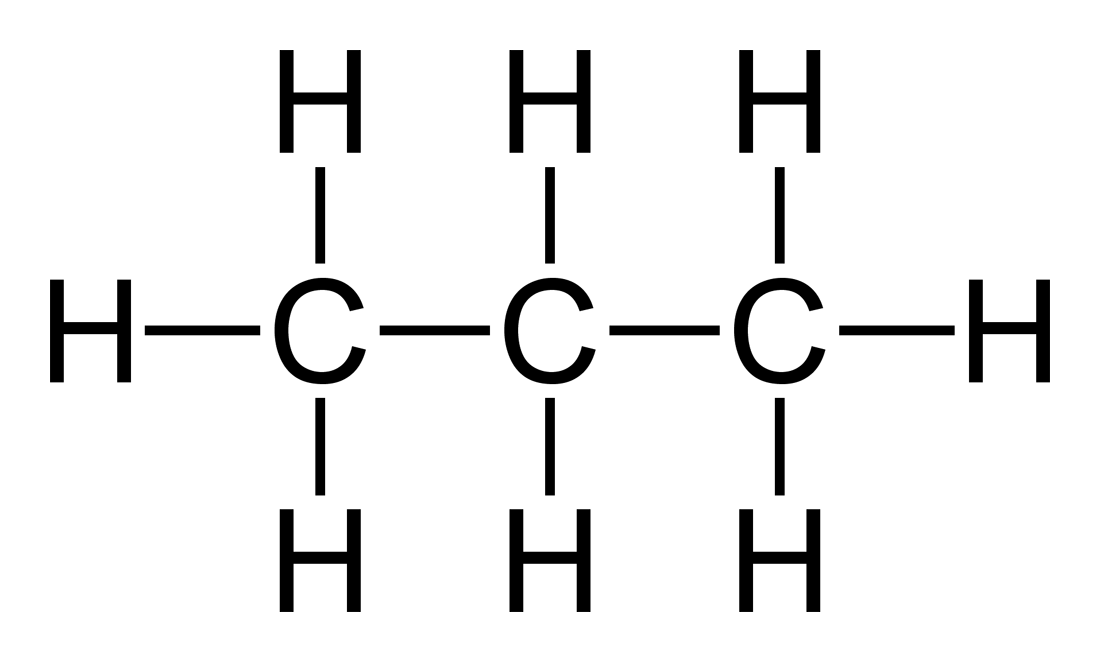
Name this alkane
a)
Methane
b)
Ethane
c)
Propane
d)
Butane
52.
Name this alkane
a)
Methane
b)
Ethane
c)
Propane
d)
Butane
53.
Which of the following could contain a triple bond?
a)
C4H10
b)
C4H8
c)
C4H6
d)
C4H12
54.

The general formulas for alkanes, alkenes and alkynes are:

a)

alkane: CnH2n+2

alkene: CnH2n

alkyne: CnH2n-2

b)

alkane: CnH2n

alkene: CnH2n+2

alkyne: CnHn+4

c)

alkane: CnH2n-2

alkene: CnH2n

alkyne: CnH2n+2

d)

alkane: CnH2n+2

alkene: CnH2n

alkyne: CnHn-4