
 Worksheets
Water Cycle
Total questions: 56
Worksheet time: 1hrs 7mins

What is A?
Evaporation
Condensation
Precipitation
Runoff

What is B?
Evaporation
Transpiration
Precipitation
Runoff

What is D?
Evaporation
Condensation
Precipitation
Runoff
Precipitation means...
water vapor cooling to form clouds
water running downhill
water falling from the sky
water heating up and rising as gas
Runoff means...
water vapor cooling to form clouds
water running downhill
water falling from the sky
water heating up and rising as gas
Condensation means...
water vapor cooling to form clouds
water running downhill
water falling from the sky
water heating up and rising as gas

Evaporation means...
water vapor cooling to form clouds
water running downhill
water falling from the sky
water heating up and rising as gas
During evaporation water changes from ...
water vapor (gas) to liquid
liquid to water vapor (gas)
water vapor (gas) to solid ice
During condensation water changes from ....
solid ice to liquid water
liquid water to water vapor (gas)
water vapor (gas) to liquid water drops
Liquid water turns into gas and rises into the sky in....
precipitation
condensation
evaporation
Water falls from the sky in...
evaporation
condensation
precipitation
_____________________ is the step of the water cycle where the Sun heats up liquid water in a puddle and turns it into water vapor gas.
precipitation
evaporation
runoff


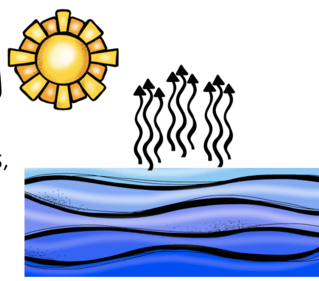
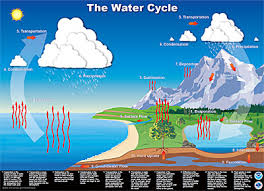

How are the processes of evaporation and condensation similar?
They both involve a change in the states of matter.
Are observed only in the areas that have high winds
occurs when water is heated by the energy from the sun.
occurs when water is moved between the ocean and the land

What part of the water cycle is shown on the chart below. Make sure to look at the letters!
w=precipitation
y=transpiration
z-evaporation
x=condensation
When developing a model of the cycling of water between the land, ocean, and atmosphere, one must include the forces that propel the water. For the model, these forces would be which of the following?
The sun's radiation and gravity
Rivers, streams and Tributaries
Plants, animals, and human activity
The polar ice caps and oceans
Which of the following processes contributes most to the movement of water from land to the atmosphere?
Precipiation
evaporation
Condensation
Crystallization
Gravity plays a major role in the global movement of water in which of the following processes?
The expansion of water as it turns into ice
Water vapor rising into the atmosphere
The shifting of ocean currents as they strike land
Water flowing in rivers and streams
The layer of gas surrounding plant Earth that is held in place by gravity.
Radiant Energy
Evaporation
Percolation
atmosphere
The main source of energy for the water cycle.
Transpiration
Run off
Gravity
Radiant Energy
Rain or surface water that drains or flows from the land into lakes, rivers and oceans.
Radiant Energy
Run Off
Evaporation
Precipitation
Water that soaks into the ground and moves downward through the cracks in the rock and soil.
Precipitation
Groundwater
Percolation
Evaporation
Change of a liquid into a gas or vapor.
Transpiration
Percolation
Condensation
Evaporation
Rain, snow, sleet, or hail that falls from the clouds in the sky.
Precipitation
Evaporation
Condensation
Water cycle
Water that is in cracks or pores in the underground soil and rock layers.
Water cycle
Percolation
Groundwater
Evaporation
The movement of water both on and above the Earth's surface.
Water cycle
Evaporation
Condensation
Gravity
The process by which crystals form.
Precipitation
Crystallization
Transpiration
Percolation
The process during which plants release moisture into the air.
evaporation
Precipitation
Condensation
transpiration
When water vapor loses thermal energy and becomes a liquid (cloud)
Evaporation
Condensation
Transpiration
Precipitation
The force that causes objects with mass to attract one another.
Radiant Energy
Sun
Gravity
Force
What is c?
Evaporation
Condensation
Precipitation
Runoff
What is E?
Evaporation
Condensation
Precipitation
Runoff
What is F?
Evaporation
Condensation
Precipitation
Percolation
What is G?
Evaporation
Groundwater
Percolation
Run off

