

wayground logo

Free Printable Worksheets

NEW

Font size

S
M
L
XL
Worksheets

Chemical Bonding

Total questions: 47

Worksheet time: 12hrs 45mins
Name
Class
Date
1.
Which of the following has a full valence shell?
a)
Oxygen
b)
Neon
c)
Barium
d)
Carbon
2.
Elements on the LEFT side of the periodic table will most likely form:
a)
Positive ions
b)
Negative ions
c)
Neutral Ions
d)
None of these
3.
Which type of bond has an equal sharing of electrons?
a)
Polar Covalent 
b)
Non Polar Covalent
c)
Ionic
d)
Metallic
4.
Which type of bond has an unequal sharing of electrons?
a)
Polar Covalent 
b)
Non Polar Covalent
c)
Ionic
d)
Metallic
5.
Which type of bond has a transfer of an electron from on atom to another?
a)
Polar Covalent 
b)
Non Polar Covalent
c)
Ionic
d)
Metallic
6.
All chemical bonds involve two atoms sharing electrons.
a)
True
b)
False
7.
Bonds that form between two metals are called ______________ bonds.
a)
ionic 
b)
covalent
c)
metallic
d)
pervasive
8.
If an atom loses two electrons what charge will it have?
a)
+ 2
b)
 - 2
c)
+1
d)
-1
9.
Covalent compounds
a)
Share electrons
b)
transfer electrons
c)
contain a sea of electrons
d)
conduct electricity
10.
What is the number of valence electrons for Oxygen?
a)
8
b)
6
c)
2
d)
1
11.
What elements generally make an ionic bond?
a)
metal and nonmetal
b)
2 nonmetals
c)
metal
d)
none of the above
12.
What elements generally make a covalent bond?
a)
metal and nonmetal
b)
2 nonmetals
c)
metal
d)
none of the above
13.
Predict the bond that will form between Be and F.
a)
Ionic
b)
Covalent
14.
Predict the bond that will form between Se and Cl
a)
Ionic
b)
Covalent
15.
Using electronegativities, what type of bond is formed by S and Br.
a)
ionic
b)
polar covalent
c)
non-polar covalent
16.
Using electronegativities, what type of bond is formed by Co and F.
a)
ionic
b)
polar covalent
c)
non-polar covalent
17.
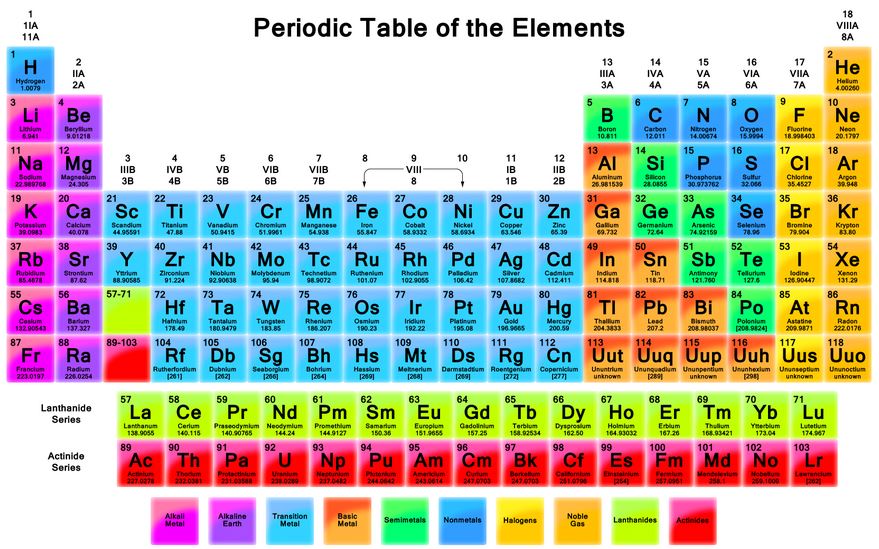
How many electrons does Si contain? (click to see image)
a)
14
b)
28
c)
2
d)
4
18.
How many electrons can the first energy level hold?
a)
1
b)
2
c)
8
d)
0
19.
The number of _____ is most important in determining how an atoms will bond. 
a)
Neutrons
b)
Protons
c)
Valence Electrons
d)
Electron sin the innermost shell
20.
If an oxygen atom has 8 protons (+) and 10 electrons (-), what is it's charge?
a)
O10-
b)
O8+
c)
O2-
d)
O10+
21.
What does the prefix "di" mean
a)
1
b)
2
c)
3
d)
4
22.
When an atom loses an electron, it is called a..
a)
crystal
b)
formula
c)
ion
23.
Is the following compound ionic or covalent:
AlCl3
a)
ionic 
b)
covalent
24.
What type of bond is formed when electrons are transferred (stolen, or given) from one atom to another?
a)
Ionic Bond
b)
Covalent Bond
c)
Metallic Bond
d)
Acidic Bond
25.
What is an interaction that holds 2 atoms together called?
a)
Chemical Bond
b)
Covalent Bond
c)
Ionic Bond
d)
Metallic Bond
26.
What is a repeating three-dimensional pattern that forms when ions bond called?
a)
Crystal Lattice
b)
Crystal Lettuce 
c)
Crystal Configuration
d)
Quartz
27.
What type of bond forms when atoms share electrons?
a)
Ionic Bond
b)
Covalent Bond
c)
Metallic Bond
d)
Gold Bond Medicated Powder
28.
Why don't noble gases normally form chemical bonds?
a)
They have only 2 valence electrons
b)
Their outer level electrons are empty
c)
They have 8 neutrons
d)
They have a full valence electron shell
29.
Elements in the same ________ are more chemically similar.
a)
group
b)
period
c)
club
d)
table
30.
Which elements have the most similar chemical properties?
a)
K and Na
b)
K and Ca
c)
K and Cl
d)
K and S
31.
Name group 1A on the periodic table.
a)
alkali metals
b)
alkaline earth metals
c)
noble gases
noble gases
d)
halogens
32.
Name group 2A on the periodic table.
a)
alkali metals
b)
alkaline earth metals
c)
noble gases
d)
transition metals
33.
Name group 8A on the periodic table.
a)
alkali metals
b)
alkaline earth metals
c)
transition metals
d)
noble gases
34.
Name groups 3B - 12B on the periodic table.
a)
noble gases
b)
halogens
c)
metalloids
d)
transition metals
35.
Name group 7A on the periodic table.
a)
transition metals
b)
metalloids
c)
halogens
d)
alkali metals
36.
Which statement is true about the carbon family?
a)
They are all non-metals.
b)
They all have four valence electrons.
c)
They are all metals.
d)
They do not react with other elements.
37.
Which statement is true about the alkaline earth metal family?
a)
They have 2 valence electrons.
b)
They are found on the right side of the periodic table.
c)
They form -2 charges.
d)
They tend to gain valence electrons.
38.
Why do elements bond?
a)
To be friends
b)
To create a new element
c)
To become stable
39.

Breaking a bond is always

a)

Endothermic (requires energy)

b)

Exothermic (releases energy)

40.

Forming a bond is always

a)

Exothermic (gives off energy)

b)

Endothermic (requires energy)

41.

Which of the following is an intramolecular force?

a)

hydrogen bonding

b)

covalent bonding

42.

Which intramolecular force has the greatest strength?

a)

ionic bond

b)

nonpolar covalent

c)

polar covalent

43.

Which of these is the weakest intermolecular force?

a)

Dipole-dipole

b)

Hydrogen bonding

c)

London dispersion forces

44.

Which intermolecular force do all molecules have?

a)

Dipole-dipole

b)

Hydrogen bonding

c)

London dispersion forces

45.

Which intermolecular force requires hydrogen and one of the following: nitrogen, oxygen, fluorine?

a)

Dipole-dipole

b)

Hydrogen bonding

c)

London dispersion forces

46.

Which type of intermolecular force does this molecular drawing best represent?

a)

dipole-dipole forces

b)

hydrogen bonding

c)

London dispersion forces

47.

Melting and boiling points depend on thermal energy and the strength of ________

a)

intramolecular forces

b)

intermolecular forces

c)

polar covalent bonds

d)

metallic bonds
