
 Worksheets
Space End of Topic Quiz
Total questions: 19
Worksheet time: 10mins
How many planets are there in the solar system?
8
9
6
7
A star can form from a cloud of dust and gas called a..?
nebula
red giant
supernova
white dwarf
What do we call the stable period of a star's life cycle?
middle ages
steady state
stable phase
main sequence
What process occurs in stars?
Nuclear fusion
Nuclear fission
Nuclear fussion
Nuclear fision
For an object in circular orbit around the Earth, its instantaneous velocity will be...
parallel to direction of acceleration
perpendicular to direction of acceleration
perpendicular to the direction of motion
parallel to the velocity
The closer you get to a star/planet, the ____ the gravitational force
Weaker
Stronger
What dictates when a main sequence star starts to become a red giant or red supergiant?
When it runs out of hydrogen
When it runs out of helium
When it runs out of uranium
When it runs out of oxygen
Elements heavier than ____ cannot be produced by a main sequence star
Iron
Tungsten
Carbon
Lead

In the 1920s, Edwin Hubble made observations of many distant galaxies, and formulated Hubble’s Law - which states that galaxies that are further away...
are moving away faster, with a greater apparent red-shift in their spectra
are moving away slower, with a greater apparent red-shift in their spectra
are moving away faster, with a greater apparent blue-shift in their spectra
are moving away slower, with a greater apparent blue-shift in their spectra
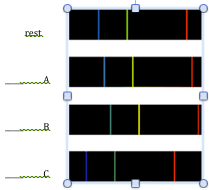
Based on Doppler effect, which of the galaxies is moving away from Earth?
A
B
C
A and B
Based on the emission spectra you see, which of the galaxies is farthest away from Earth?
A
B
C
A and B
The Cosmic Background Radiation is:
the remaining energy from the big bang.
incredibly hot.
visible to the human eye.
only located in certain places in the universe.

