
 Worksheets
OL Unit 3 Test- Chemical Equations
Total questions: 92
Worksheet time: 2hrs 36mins

Sonia performed an experiment where she mixed two chemicals together - one was a clear liquid & one was a powered substance. The end result was a blue liquid. What indicated there was a chemical change?
change in amount of liquid
change in color of liquid
this was not a chemical change
the powdered substance completely dissolved
Which of the following indicates a chemical reaction has taken place?
change of state (solid, liquid, gas)
change inshape
development of a precipitate
change in size
What type of reaction is the equation NaCl → Na + Cl2?
Synthesis Reaction
Decomposition Reaction
Single Displacement Reaction
Double Displacement Reaction
Cu + AgNO3 → Ag + CuNO3
Synthesis Reaction
Decomposition Reaction
Single Displacement Reaction
Double Displacement Reaction
Ca3(PO4)2 + H2SO4 → CaSO4 + H3PO4
Synthesis Reaction
Decomposition Reaction
Single Displacement Reaction
Double Displacement Reaction


Si + S8 → Si2S4
Synthesis
Decomposition
Single displacement
Double displacement
Ca + AlCl3 → CaCl2 + Al
Synthesis
Decomposition
Single displacement
Double displacement
KOH + H3PO4 → K3PO4 + H2O
Synthesis
Decomposition
Single displacement
Double displacement
Pb(NO3)2 → PbO + NO2 + O2
Synthesis
Decomposition
Single displacement
Combustion
Mg + N2 → Mg3N2
Synthesis
Decomposition
Single displacement
Combustion
NO2 → N2 + O2
Synthesis
Decomposition
Single displacement
Combustion
P4 + O2 → P2O3
Synthesis
Decomposition
Single displacement
Combustion
Fe + H2SO4 → Fe2(SO4)3 + H2
Synthesis (combination)
Decomposition
Single replacement
Combustion
Which reaction type is the following: C5H10O4 + O2 → CO2 + H2O
Decomposition
Single Replacement
Combustion
Double Replacement
Balance this equation:
____ Li + ____Cl2 → 2 LiCl
1, 1
2, 2
2, 1
1, 2

Based on the activity series, will this reaction occur?
Cu + H2O →
Yes
No

Based on the activity series, will this reaction occur?
Br2 + KI →
Yes
No

Based on the activity series, will this reaction occur?
Au + HCl →
Yes
No

Based on the activity series, will this reaction occur?
Fe + HCl →
Yes
No

Predict the product(s) of this reaction (don't worry about balancing):
Mg + HCl → H2 + ___________
MgHCl
MgCl2
MgCl
Mg2Cl
no reaction

Predict the product(s) of this reaction (don't worry about balancing):
SrI2 +Br2→ SrBr2 + ___________
I2Br2
I
I2
IBr2
no reaction
Predict the product(s) of this reaction (Don't worry about balancing)
Pb(NO3)2 + KI → PbI2 + _____________
K(NO3)2
NO3K
KNO3
KNO

Which metal is more reactive than calcium?
magnesium
potassium
silver
aluminum

What will be the result of the following:
Br2 + NaF → _____ + ______________
bromine will replace Na
Na will replace Br
Br will replace F
no reaction will occur

What will be the result of the following:
Li + NaF →
Li will replace F
Na will replace Li
Li will replace Na
no reaction will occur

What will be the result of the following:
KBr + Na →
K will replace Na
Na will replace Br
Na will replace K
no reaction will occur

What will be the result of Zn+2 + AuCl2 → _____ + _______________
ZnCl2 + Au
ZnAu + Cl2
no reaction
ClAu + Zn

Fill in the blank. (Copper has a charge of 2+)
Cu + AgNO3 → Ag + _____
Cu(NO3)2
CuNO3
CuAg
Cu
Predict the products for the this Double Replacement reaction:
AgNO3 + KCl →
AgCl + KNO3
AgK + ClNO3
KAg + NO3Cl
AgCl + 3 KNO

Predict the products for this equation.
(Zn with a charge of +2)
Zn + H2SO4 → _____ + _______________
Zn(SO4)2 + H
ZnSO4 + H2
ZnSO4 + H4
Predict the products for this Double Replacement reaction:
AgNO3 + KCl →
AgCl + KNO3
AgK + ClNO3
KAg + NO3Cl
If an element is diatomic it should have a subscript of___
1, always
2, only when it is by itself
it shouldn't have a subscript, it should have a coefficent
Which of the following indicates a chemical reaction has taken place?
change of state (solid, liquid, gas)
change in shape
gas bubbles
change in size

What type of reaction is this?
Synthesis Reaction
Decomposition Reaction
Single Displacement Reaction
Double Displacement Reaction

What type of reaction is this?
Synthesis Reaction
Decomposition Reaction
Single Displacement Reaction
Double Displacement Reaction

What type of reaction is this?
Synthesis Reaction
Decomposition Reaction
Single Displacement Reaction
Double Displacement Reaction

What type of reaction is this?
Synthesis Reaction
Decomposition Reaction
Single Displacement Reaction
Double Displacement Reaction

What are the products for this reaction?
AgCl + NaNO3
AgNa + ClNO3
NaNO + AgCl
no reaction will occur
What are the products for this reaction?
BaCl2 + MgSO4 --> ____________ + ____________
MgCl2 + BaSO4
MgBa + ClSO4
BaNO + MgCl
MgCl + BaSO4
How many Hydrogen atoms are in 4H2O?
6
8
2
4
How many Sodium atoms are in 6NaCl?
1
12
6
How many atoms of Carbon are in this formula? C6 H12O6
6
1
12
Which formulas have the most number of HYDROGENs?


How many CARBON are in this formula?
5
2
10
20

How many total POTASSIUM atoms are in this formula?
8
2
4
12
three hydrogen (H)
one sulfur (S)
four oxygen (O)
What are the reactants?
sodium + water --> sodium hydroxide + hydrogen
sodium and sodium hydroxide
sodium and water
water and hydrogen
sodium hydroxide and hydrogen
In a chemical reaction, the substances which are present at the beginning are called reactants.
True
False
2SO2 + O2 --> 2SO3 The coefficient of SO3 is 2.
True
False

In the chemical equation shown, the reactants are indicated by
A
B

Magnesium can be burned in oxygen to produce solid magnesium oxide.
Mg + O2→ MgO
Mg+ O→ MgO
Mg + CO2 → MgO + C
Mg + O2→ Mg2O2

Sodium reacts with chlorine gas to produce sodium chloride.
NaCl→ Cl + Na
Na+ CO2 → NaCO2
Na + Cl2→ NaCl
Na + Cl → NaCl

When hydrogen reacts with sulfur, a smelly gas, dihydrogen monosulfide, is produced.
H2 + S → HS
H2 + S → H2S
H + S→ HS
H + S→ H2S
Hydrogen gas and nitrogen monoxide gas forms water and nitrogen gas.
H2 + NO --> H2O + N2
H + NO --> H2O + N
H2 + N2O3 --> H2O + N2
H + NO --> H2O + N2
Potassium chlorate solid when heated produces potassium chloride solid and oxygen gas.
KClO3 + heat --> KCl + O2
PClO3 + heat --> PCl + O2
KClO3 + heat --> KCl + O
KCl + heat --> KCl + O2
Barium metal and water yields barium hydroxide and hydrogen gas
Ba + H2O --> Ba(OH)2 + H2
Ba2 + H2O --> Ba(OH)2 + H
Ba + H2O --> BaOH2 + H
Ba2 --> Ba(OH)2 + H2
Hydrogen gas and chlorine gas produce hydrogen chloride
H2 + Cl2 --> HCl
H + Cl --> HCl
H2 + Cl2 --> H2Cl2
H + Cl --> H2Cl
Aluminum and oxygen produces aluminum oxide
Al + O2 --> Al2O3
Al + O --> Al2O3
Al3 + O2 --> Al2O3
Al + O --> AlO
What are the seven diatomic elements?
H2, Cl2, Br2, O2, N2, I2, F2
H2, Cl2, I2, F2, Hg2, Br2, Fe2
H2, Cu2, Ni2, B2, O2, I2, Fe2

What part of the equation does the #1 represent?
product
produces/yields
solid
reactant
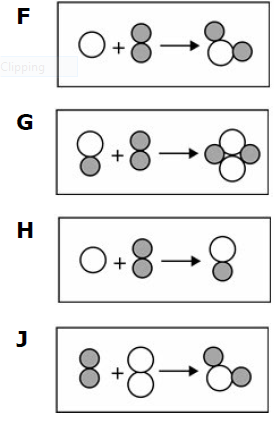
CHOOSE ALL THAT APPLY: which of these equations are NOT BALANCED?
F
G
H
J

The two (2) is indicating _________.
subscripts
reactants
coefficients
aqueous

The three (3) indicates which part?
reactants
products
equation
formulas

The number four (4) represents which part of the equation?
aqueous
gas
liquid
solid

Number five (5) is indicating ____ of the equation.
solid
liquid
gas
aqueous

Number six (6) is pointing to the "2" behind the H. What is that 2 called?
superscript
coefficient
subscript
subefficient

Number seven (7) is indicating ____ of the equation.
reactants
products
equation
formulas

Number eight (8) is indicating ____ of the equation.
solid
liquid
gas
aqueous

_ H2 + O2 -> 2 H2O
Al + O2 → 2Al2O3
____ P4 + 5 O2 -----> ____ P2O5
1, 5, 2
2, 5, 7
2, 5, 5
5, 5, 2
2 Al + _____ Br2 -----> ____ AlBr3
2, 2, 2
2, 3, 2
2, 2, 4
2, 2, 3
4 Cr + _____O2 -----> ____ Cr2O3
4, 2, 4
4, 3, 4
4,1, 5
4, 3, 2
___ NaClO3 ----> _____ NaCl + 3 O2
1, 3, 3
2, 3, 3
2, 2, 3
3, 2, 3
2 AlBr3 + ___ Cl2 ----> ___ AlCl3 +___ Br2
2, 2, 3, 3
2, 3, 2, 3
2, 3, 3, 2
2, 2, 3, 4
_____ H2 + _____O2 ----> 2 H2O
1, 1, 2
2, 2, 2
1, 2, 2
2, 1, 2
_____ H2 + 1 N2 ----> _____ NH3
1, 1, 3
3, 1, 2
3, 1, 1
1, 1, 2
_____ KClO3 ----> 2 KCl + _____ O2
3, 2, 2
2, 2, 2
2, 2, 3
2, 2, 4

