
 Worksheets
PhySci quiz 4 Collision Theory and the Factors
Total questions: 60
Worksheet time: 55mins
What criteria must be met for reactant collisions to result in a successful product?
The reactants must collide with each other
The reactants must collide with enough energy and be in the right positions
The reactants must have enough energy to form the activated complex
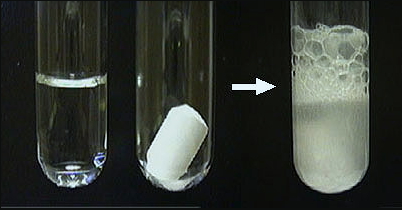
How could we make this reaction happen more quickly?
Decrease the concentration of the acid
crush the chalk to increase the surface area
Put the test tube in an ice bath
When surface area is decreased the rate of reaction...
Decreases, because there are LESS possible sites for correct collisions
Increases, because there are LESS possible sites for correct collisions
Decreases, because there are MORE possible sites for correct collisions
Increases, because there are MORE possible sites for correct collisions
Which has more surface area?
Large chunks of chalk
Cube of sugar
Powdered sugar
Small chunks of sugar
A temperature increase causes the particles ......
to slow down
move faster
collide higher
in the right order
How does a catalyst work in speeding up a reaction?
By lowering the activation energy or reaction
by giving them more energy
by making them more available
What is the rate of reaction?
How much energy is needed for a reaction to occur.
The energy required to break a bond.
The time it takes for a reaction to occur.
Collision Theory
Which of the following increase the reaction rate?
less surface area
lower temperature
increased concentration

Which is CORRECT about temperature as one of the factors affecting rate of chemical reaction?
The higher the temperature is, the slower will be the rate of reaction.
The higher the temperature is, the faster will be the rate of reaction.
The lower the temperature is, the faster will be the rate of reaction.
The lower the temperature is, the slower will be the rate of reaction.

Activation energy is also known as _____________________.
Note: If a reaction has a low activation energy then the reaction will be fast as a lot of particles will have the required energy.
free energy
energy barrier
internal energy
reaction energy

How does a catalyst work in speeding up a reaction?
By lowering the activation energy or reaction
By giving them more energy
By making them more available
By producing more products
Increasing the ____ causes the particles (atoms
or molecules) of the reactants to move more quickly so that
they collide with each other more frequently and with more
energy.
Catalyst
Surface Area
Temperature
Concentration
Grains of sugar have a greater _______ than a solid cube of
sugar of the same mass, and therefore will dissolve quicker in water.
Surface Area
Catalyst
Temperature
Concentratrion
Decreasing concentration has which of the following effects on reaction rate?
Increases reaction rate.
Has no effect on reaction rate.
Decreases reaction rate.


The glow stick glowed brighter in hot water because
the chemical reaction slowed down in hot water
the chemical reaction speed up in hot water
temperature has no effect on the glow stick chemical reaction
all of the above
How does a catalyst increase the rate of a chemical reaction?
Provides lower energy route for the reaction so that a greater number of particles have enough energy to react.
Increased number of collisions increases the chance of a 'successful collision'
Particles collide faster and harder so a larger proportion have greater energy than the required activation energy.
How does temperature increase the rate of a chemical reaction?
Provides lower energy route for the reaction so that a greater number of particles have enough energy to react.
Increased number of collisions increases the chance of a 'successful collision'
Particles collide faster and harder so a larger proportion have greater energy than the required activation energy.
Greater number of 'active sites' available for a reaction to take place (referring to solids)
How does concentration increase the rate of a chemical reaction?
Provides lower energy route for the reaction so that a greater number of particles have enough energy to react.
Increased number of collisions increases the chance of a 'successful collision'
Particles collide faster and harder so a lagrer proportion have greater energy than the required activation energy.
Greater number of 'active sites' available for a reaction to take place (referring to solids)
The ____________ states that atoms, ions, or molecules must collide in order to react.
transition state
activation energy
rate law
collision theory
Which of the following statement is correct?
Smaller size of reactants, smaller total surface area, higher reaction rate
Larger size of reactants, smaller total surface area, higher reaction rate
Smaller size of reactants, larger total surface area, higher reaction rate
Larger size of reactants, larger total surface area, higher reaction rate
____________ temperature can ___________ the rate of reaction.
Higher; increase
Lower; increase
Moderate; increase
What factors effect rate of reaction?
Temperature, Concentration, Pressure and Energy
Surface Area, Concentration, Energy and Pressure
Temperature, Pressure, Concentration and Surface area
Pressure, Surface area, Density and Energy
What criteria must be met for reactant collisions to result in a successful product?
The reactants must collide with each other
The reactants must collide with enough energy and be in the right positions
The reactants must have enough energy to form the activated complex
The measure of the change in the concentration of the reactants or products.
Activation Energy
Activation Rate
Chemical Reaction
Concentration
The substance or particles that enter into and are altered in the course of a chemical reaction.
Catalyst
Enzyme
Product
Reactant
The measure of how fast or slow a reaction happens.
Activation Energy
Collision theory
Particle Size
Rate of Reaction
The substance formed as a result of a chemical reaction.
Product
Reactant
Resistance
Substrate
If you shrink the container size that your gas substance is in what will happen?
The reaction rate will stay the same
The reaction rate will speed up
The reaction rate will slow down

Which 2 trials show the effect of temperature change on reaction rate, and what is the effect of increasing temperature?
1 and 6; rate increases as temperature increases
2 and 6; rate decreases as temperature increases
3 and 6; rate increases as temperature increases
4 and 6; rate decreases as temperature increases
Which 2 trials show the effect of a catalyst on reaction rate, and what is the effect of adding a catalyst?
1 and 5; rate increases when a catalyst is added
2 and 5; rate decreases when a catalyst is added
3 and 5; rate increases when a catalyst is added
4 and 5; rate decreases when a catalyst is added
A form of matter that has definite composition and distinct characteristics.
Atoms
Compound
Mixture
Substance
When we investigate the rate of reaction we are looking at the...
amount of product formed
speed of reaction
concentration of reacting particles
combining reactants with products

Which of the following statement is correct?
Smaller size of reactants, smaller total surface area, higher reaction rate
Larger size of reactants, smaller total surface area, higher reaction rate
Smaller size of reactants, larger total surface area, higher reaction rate
Larger size of reactants, larger total surface area, higher reaction rate

