Worksheets
HLS Midterm 2 Revision
Total questions: 171
Worksheet time: 2hrs 9mins
warms and filters
nose
stomach
small intestine
trachea

upper part of respiration, throat area
larynx
pharynx
trachea
lungs

contains the vocal chords/voice
mouth
trachea
bronchioles
larynx

main tube in respiration
lungs
trachea
alveoli
bronchial tubes

2 tubes entering the lungs
pharynx
larynx
bronchial tubes
bronchioles

smaller branches in lungs
pharynx
epiglottis
bronchioles
alveoli

protects from choking
pharynx
epiglottis
larynx
trachea

exchange of gases
bronchial tubes
alveoli
larynx
pharynx
the process of forcing air into the body
inspiration
expiration
desperation
motivation
forcing air out of the body
temptation
inspiration
desperation
expiration
which inspiration steps are in the correct order
air forced in, diaphragm relaxes, air pressure raises
diaphragm contracts, air pressure lowers, air forced in
air pressure raises, air forced out, diaphragm contracts
diaphragm relaxes,air pressure drops, air forced in
which expiration steps are correct
diaphragm relaxes, air pressure raises, air forced out
air forced in, air pressure raises, diaphragm contracts
diaphragm contracts, air forced out, air pressure drops
air pressure raises, diaphragm contracts, air forced out
normal breathing rate is called
tidal volume
tidal wave
yawn
residual volume
a massive inhale is called
IRV
ERV
ARV
URV
a massive exhale is called
ERV
IRV
ORV
URV
the air left in the lungs after an exhale is called
alveoli
residual volume
inspiration
expiration
What is diffusion?
the active movement of a substance against its concentration gradient
the net movement of a substance from an area of low to higher concentration
the net movement of a substance from an area of high to lower concentration
the passive movement of a substance against its concentration gradient
Where does gaseous exchange occur in mammals?
alveoli
villi
small intestine
heart
How are alveoli adapted for gaseous exchange?
they provide a long diffusion pathway between the lungs and the blood
they are in close contact with the lung capillaries
their walls are made up of multiple cell layers
they have a small surface area for diffusion
Which of these is NOT an adaptation of leaves for gaseous exchange?
they are flat to increase the surface area
they have internal airspaces next to cells
they have small holes on their surface called stomata
they are thick to maximise diffusion pathway
What does the trachea divide into?
Alveoli
Two bronchi
Bronchioles
What happens to the diaphragm when you breathe in?
Contracts and moves upwards
Relaxes and moves downwards
Contracts and moves downwards
What effect does tar have on ciliated cells?
Kills the cells
Damages the cilia
Tar doesn't affect these cells
What is emphysema?
When there is too much mucus in the lungs
When the alveolar walls have broken down, reducing surface area
A type of lung cancer
Damage to the cilia
Which chemical in cigarette smoke causes the lung tissue to blacken?
tar
nicotine
carbon monoxide
Suggest the effect of long term smoking on the amount of oxygen transported in someone's blood?
Decreased
Increased
What is meant by the term bronchitis?
Inflammation of the bronchi (caused by infection)
A tumour in the bronchi
Only having 1 bronchus
Which chemical in cigarette smoke increases the risk of lung cancer?
tar
nicotine
carbon monoxide
Which chemical in cigarette smoke results in coughing and more frequent infections?
tar
nicotine
carbon monoxide

The chewing of your food is called what?
Eating
Mastication
Swallowing
Enzymes

Involuntary muscle contractions that move food.
Chemical breakdown
Flexion
Swallowing
Peristalsis

What is the chemical that breaks down food in your mouth?
Saliva
Lipase
Lipid
Bile

What is the first Nutrient that is broken down in the digestion process?
Fats
Carbohydrates
Proteins
Fiber

Where does MOST of the digestion process occur?
Small intestine
Mouth
Stomach
Large Intestine
Colon

The physical & chemical breakdown of food is called?
Digestion
Absorption
Swallowing
Excretion

Pick the correct order of digestion
Mouth,stomach,esophagus,large intestine,small intestine
Mouth,esophagus,stomach,small intestine, large intestine
Mouth, esophagus, stomach, large intestine, small intestine, colon
Mouth, stomach, esophagus, small intestine, large intestine

What chemical breaks down Fat?
Water
Saliva
Sodium
Bile

Where is Bile produced?
Liver
Stomach
Pancreas
Colon

What does the Gall Bladder store?
Bile
Fat
Carbohydrates
Insulin

Another name for the Large Intestine?
Really big intestine
Colon
Pancreas
Massive
Your stomach has what 3 functions?
Stores food
Makes Chyme
Breaks down Fat
Controls food moving into the small intestine
Peptidases in the intestinal juice complete the digestion of proteins by breaking down polypeptides and peptides into __________ .
fatty acids
hydrochloric acids
amino acids
in the small intestines, the enzyme maltase breaks down maltose into _____________________ .
glucose + fructose
glucose + glucose
glucose + galactose
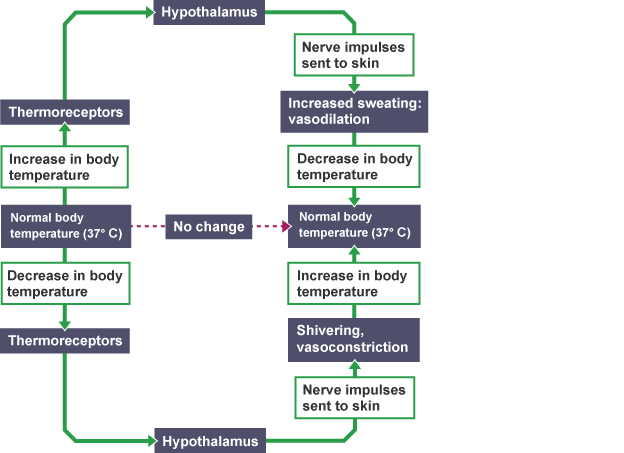
Homeostasis mechanisms...
keep everything exactly the same.
usually operate by positive feedback systems.
act to keep the internal environmental conditions outside the normal range
is the ability to maintain a relatively stable internal environment
Which type of feedback system is more common in maintaining homeostasis?
positive
negative
neutral
balanced
What type of feedback system is more dangerous to an organism?
positive
negative
neutral
balanced
This feedback system amplifies a change until a desired outcome is reached.
positive feedback system
negative feedback system
neutral feedback system
self-monitoring feedback system
This is the term used to describe the normal range of a variable in an organism
control center
effector
stimulus
set point
It transmits signals to the control center when it detects a change.
control center
effector
response
sensor
The reaction of the effector is called..
response
sensor
stimulus
set point
receives and analyzes information received from the sensors
control center
effector
sensor
response
The feedback system that returns the body back to the normal set point.
positive
negative
neutral
returnable

What type of feedback system is described above?
positive
negative
neutral
leofied

What type of feedback system does the model represent?
positive
negative
neutral
glyogen
What causes blood glucose levels to rise?
eating
vigorous exercise
sleeping
going to the toilet
What causes blood glucose levels to fall?
eating
vigorous exercise
sleeping
going to the toilet
What type of foods are broken down into glucose in the small intestine?
carbohydrates
proteins
fats
What do cells need glucose for?
photosynthesis
respiration
protein synthesis
combustion
Insulin causes which organ to remove glucose from the blood?
liver
pancreas
brain
kidneys
Excess glucose in the bloodstream is converted to which other substance when stored in the liver and muscle cells?
glygogen
glucagon
glycerin
glycerol
What name do we use to describe the maintaining of constant conditions, such as blood glucose levels, body temperature and water levels, inside the body?
hormonal control
homeostasis
nervous system
endocrinasis
ADH is created in the:
Hypothalamus
Posterior Pituitary Gland
Brain
Kidney
ADH is released from the pituitary gland into the:
Circulatory system
Endocrine system
Nervous system
All of the above
When ADH is secreted, urine will:
Be more dilute
Be more concentrated
Have a larger volume
All of the above
When you drink a larger volume of water than is required by your body tissues:
ADH secretion will be increased
ADH secretion will be inhibited
ADH secretion will not be affected
None of the above
Cells that detect high blood concentration are called:
Chemoreceptors
Osmoreceptors
Thermoreceptors
Nociceptors
Changes in blood volume and concentration are detected in the brain cells in the:
Posterior Pituitary Gland
Anterior Pituitary Gland
Thalamus
Hypothalamus

Anti-diuretic hormone (ADH) is released by which gland of the endocrine system
Thyroid
Pituitary
Ovaries
Adrenal
If you are dehydrated (low water potential in the blood), the body must conserve water. To do so, the brain triggers the pituitary gland to ...
release MORE ADH, making the collecting duct MORE permeable
release LESS ADH, making the collecting duct LESS permeable
release MORE ADH, making the collecting duct LESS permeable
release LESS ADH, making the collecting duct MORE permeable
If you are over-hydrated (high water potential in the blood), the body must excrete excess water. To do so, the brain triggers the pituitary gland to ...
release MORE ADH, making the collecting duct MORE permeable
release LESS ADH, making the collecting duct LESS permeable
release MORE ADH, making the collecting duct LESS permeable
release LESS ADH, making the collecting duct MORE permeable
The major organs in the excretory system include:
Kidneys and anus
Bladder and kidneys
Intestines and kidneys
Intestines and bladder
_________________ is a waste product that forms from the breakdown of amino acids and nucleic acids.
Ammonia
Urea
Ammonium
Uric Acid

What structure is letter D?
Medulla
Renal artery
Renal vein
Ureter

What structure is letter B?
Ureter
Cortex
Medulla
Calyces

What structure is letter C?
Renal artery
Calyces
Cortex
Medulla
What is the capillary network in Bowman's capsule?
vasa rectae
nephron
glomerulus
proximal convolution

Letter A represents which part of the nephron?
Bowmans Capsule
Descending Loop of Henle
Distal ]Convoluted Tubule
Renal Artery

Which of the following letters shows the proximal convoluted tubule?
A
D
E
H

Letter B represents which part of the nephron?
Afferent arteriole
Bowmans capsule
Efferent arteriole
Renal venoule

Letter C represents which part of the nephron?
Afferent arteriole
Efferent arteriole
Glomerulus
Collecting duct

Letter D represents which part of the nephron?
Afferent arteriole
Efferent arteriole
Proximal convoluted tubule
Cortex

Letter E represents which part of the nephron?
Bowmans capsule
Proximal convoluted tubule
Distal convoluted tubule
Glomerulus

Letter F represents which part of the nephron?
Bowmans capsule
Ascending loop of Henle
Distal convoluted tubule
Descending loop of Henle

Letter F represents which part of the nephron?
Bowmans capsule
Ascending loop of Henle
Distal convoluted tubule
Descending loop of Henle

Letter G represents which part of the nephron?
Ascending loop of Henle
Collecting duct
Afferent arteriole
Renal venule

Letter H represents which part of the nephron?
Afferent arteriole
Efferent arteriole
Proximal convoluted tubule
Distal convoluted tubule

Letter I represents which part of the nephron?
Bowmans capsule
Collecting duct
Renal vein
distal convoluted tubule

The three stages of urine production are _______, ______________, and ___________.
filtration, reabsorption, and secretion
filtration, urine secretion, and leukocytosis
reabsorption, discretion, and secretion

What is normally found in urine?
red blood cells
bacteria
proteins
urea

During which process along the nephron is some of the water returned to the blood?
Filtration
Reabsorption
Secretion

What 2 substances are not normally filtered out from the blood during the initial filtration?
Blood Cells
Proteins
Glucose
water

What acts as a filter in the nephron?
Glomerulus
Bowman's Capsule
Loop of Henle
Collecting Tubule

During the journey along the nephron, most of the water, glucose, and vitamins are:
stored in the bladder
excreted through the ureters
reabsorbed back into the blood
concentrated in the urine

Which of the following enters into the Bowman's capsule, while the rest are left behind in the capillaries?
White blood cells
Red blood cells
Platelets
Plasma

There are two kidneys, two ureters, one bladder, and one urethra.
True
False

Each kidney contains roughly how many nephrons?
1 thousand
1 million
1 billion
10 billion

The correct order for the parts of the nephron are....
Proximal convoluted tubule, loop of henle, Bowman's capsule
Bowman's capsule, proximal convoluted tubule, loop of henle
Loop of Henle, bowman's capsule, proximal convoluted tubule

This part of the neuron receives chemical messages from the neurotransmitters of other neurons. It is labeled A in the diagram.
Dendrite
Axon
Axon Terminal
Cell Body

The long, fiber like part of a neuron which the cell sends information to receiving neurons. Labelled D in diagram.
Synapse
Axon
Axon Terminal
Dendrite

_____ neurons carry messages away from the central nervous system and out to muscles or glands. The RED neuron in diagram.
sensory
motor
inter
central


Select two examples of effectors.
Neuron
Gland
Muscle
Receptor
Which type of neuron causes a muscle to contract in a reflex arc?
Motor Neuron
Sensory Neuron
Interneuron
Effector

Where would the nerve impulse start in this reflex arc?
A
C
D
E

What type of neuron is A?
Sensory
Inter
Motor
Which is the correct order of neurons in a reflex arc?
Sensory neuron, motor neuron, relay neuron
Relay neuron, sensory neuron, motor neuron
Sensory neuron, relay neuron, motor neuron
Which ions are involved in establishing the resting potential?
sodium ions
calcium ions
potassium ions
hydrogen ions
Which process(es) is(are) involved in establishing the resting potential?
diffusion
facilitated diffusion
active transport
osmosis
The inside of a neurone is negatively charged when at resting potential.
True
False
Which ions 'leak' out of neurones to establish resting potential?
sodium ions
potassium ions
hydrogen ions
chloride ions
Which term is used to describe the change in the membrane potential to positive as sodium ions enter a neurone?
(a)
Which is true for repolarisation?
sodium channels open, potassium channels close
sodium channels open, potassium channels open
sodium channels close, potassium channels open
sodium channels close, potassium channels close
Which of the following increase the speed of transmission of a nerve impulse?
presence of myelin sheath
smaller diameter of axon
increased temperature
What has to be reached before a neurone can fully depolarise?
threshold potential
refractory period
hyperpolarisation
resting potential
What value is the resting potential in mV (number and sign only)?
(a)
What is saltatory conduction?
when the threshold potential is reached
when the action potential jumps from node to node
when the neurone becomes hyperpolarised
What happens to the membrane potential during depolarisation?
It becomes more negative
It becomes more positive
It remains unchanged
It fluctuates randomly
Which of the following is a characteristic of non-myelinated axons?
Faster impulse transmission
Slower impulse transmission
Impulse transmission is unaffected by myelination
Impulse transmission is random
How does axon diameter affect the speed of nerve impulse conduction?
Larger diameter decreases speed
Larger diameter increases speed
Diameter has no effect
Smaller diameter increases speed
Which of the following best describes the refractory period?
A period when the neurone is hyperactive
A period when the neurone cannot be stimulated
A period of increased sensitivity
A period of random activity
What effect does temperature have on the speed of nerve impulse conduction?
Higher temperature decreases speed
Higher temperature increases speed
Temperature has no effect
Lower temperature increases speed
What is the main reason for the discrete nature of nerve impulses?
Continuous conduction
Refractory period
Constant membrane potential
Random ion movement
The minimum stimulus needed to achieve an action potential is called the (a) stimulus
At resting potential there is a high concentration of (a) ions outside and a high concentration of potassium ions inside the neuron.
During the absolute refractory period a second stimulus will produce a second action potential
True
False
Action potential propagate to
one direction
both directions
Depolarisation occurs under the myelin
True
False
Which factor(s) affect the speed of conduction of an impulse?
diameter of the axon
diameter of the axon and myelin presence
diameter, myelin and temperature
temperature
Where can the Adrenal Glands be found?
On the liver
In the brain
On the Kidneys
Near the thymol gland
What do the adrenal glands release?
A hormone
An enzyme
Cholesterol
Insulin
What is Homeostasis ?
the maintenance of a constant internal environment
the maintenance of a constant external environment
the maintenance of a constant living environment
The normal human body temperature is
35 °C
37 °C
34 °C
40 °C
The hormone that controls glucose levels is called ...
ADH
Insulin
Adrenaline
Oestrogen
The hormone that is released when you are scared ...
ADH
Insulin
Adrenaline
Oestrogen
What gland releases insulin?
Ovary
Testes
Pancreas
Adrenal
The endocrine system is made up of glands that release hormones into the blood.
True
False
What are chemicals that travel in the blood and cause changes in different parts of the body?
Hormones
Glands
impulses
nerves

The hormone that makes the liver store sugars is
glucose
glycogen
glucagon
insulin
Why is it important to maintain a constant body temperature?
to stop the multiplication of bacteria in the body
so that we don't get cold
to maintain the optimum temperature for enzymes
so that we have enough energy to move
What do receptors do?
Detect a change in the environment
Process information
Give a response
A change in the environment
What does the coordination centre do?
Processes information from receptors
Detects changes in the environment
Gives the response
Is a change in the environment
What is a stimuli?
Detects a change in the environment
A change in the environment
Process information from the receptor
Gives the response
What do effectors do?
Detects the changes in the environment
processes information from receptors
Gives the response
Is the change in the environment
Which are examples of effectors?
Muscles
Glands
Muscles and Glands
Nervous system