
 Worksheets
7L Space - all
Total questions: 56
Worksheet time: 1hrs 26mins

Which planet in our solar system is closest to the Sun?
Earth
Jupiter
Mercury
Saturn

Which of the following is an accurate model of how the Sun, Earth, and Moon move?
Sun and moon orbit Earth
Earth and moon orbit Sun
Earth orbit's the Sun and the moon orbits Earth
Earth and sun orbit moon

What planet is eighth in the Solar System?
Uranus
Jupiter
Neptune
Mars
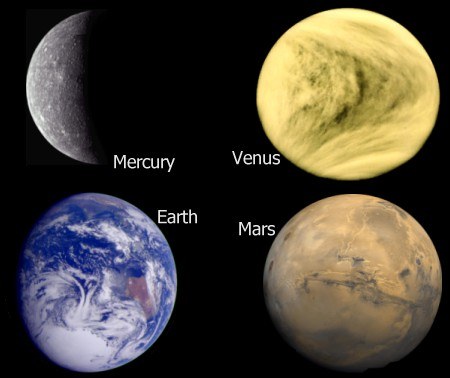

Why does Earth have different seasons?
because of the distance between Earth and the sun
because of the speed of Earth as it rotates on its axis
because of the amount of light blocked by the moon on its axis
because of the tilt of Earth on its axis as it moves around the sun


Which planet has a ring large enough to be from Earth with a small telescope?
Saturn
Jupiter
Neptune
Uranus

The GAS GIANTS or Outer planets are:
Mercury, Earth, Jupiter, Saturn
Saturn, Neptune, Pluto, Mars
Saturn, Jupiter, Uranus, Neptune
Earth, Mars, Saturn, Neptune

The inner planets are:
Jupiter, Earth, Mars, Mercury
Saturn, Uranus, Mars, Earth
Earth, Pluto, Neptune, Mars
Mercury, Venus, Earth, Mars

Why do the sun and moon appear to move across the sky?
the rotation of the solar system makes the sun and moon seem to move
the rotation of the earth make the sun and moon seem to move
the sun and moon revolve around earth
the earth revolves around the sun and moon

Why does the moon appear to shine?
It is like a star and gives off light
it refracts light from space
It reflects light from the sun
It absorbs light from the sun

A moon that is completely lit is a
a crescent moon
a full moon
a new moon

The southern half of Earth tilts away from the Sun during which month below
June
December
March

Earth spins around an imaginary line called the
eclipse
horizon
axis

The tilt of the Earth and its revolution around the Sun causes
seasons
full moons
new moons

In summer, the number of hours of daylight is _________________ the number of hours of darkness.
about equal to
the same as
greater than


Select the order from smallest to largest.
Sun, galaxy, solar system, universe
Sun, galaxy, universe, solar system
Sun, solar system, galaxy, universe
Sun, solar system, universe, galaxy

Day and night is caused by the _____________ of earth on its axis.
revolution
orbit
rotation

As the Earth travels around the sun, this tilt causes different areas of the Earth’s surface to get different amounts of daylight at different times of the year. The angle of the Sun’s rays to the surface also causes areas to have more or less of the Sun’s energy. This causes the ________.
months
day and night
seasons
years

Which of the following causes seasons?
the earths tilt
the earths rotation
the earths revolution around the sun
the earths size


How long does a solar eclipse last?
a few minutes
a few hours
a few seconds
half a day


What is an orbit?
The path an object takes as it moves around another object in space
A giant circle
The 3 moons around Earth
A ball of gas
The solar system is the sun and objects that orbit around it?
True
False
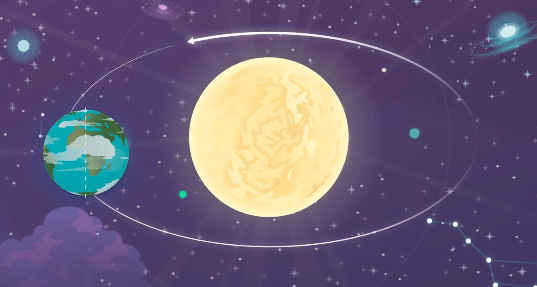


Which of the following is an accurate model of how the Sun, Earth, and Moon move?
Sun and moon orbit Earth
Earth and moon orbit Sun
Earth orbit's the Sun and the moon orbits Earth
Earth and sun orbit moon

What causes the moon's phases
Where you are standing on Earth
the amt of sunlight reflected onto the moon from the sun
The tilt of Earth
how fast the moon is moving


Objects appear to move from east to west because Earth turns from _______ to ________.
East to West.
West to East.
North to South.
South to North.

If Earth rotated slower, we would have...
shorter days.
longer days.
shorter years.
longer years.

Which seasons have an equal amount of daylight and darkness?
Spring and Autumn
Winter and Summer
Winter and Spring
Summer and Autumn

Where on Earth can you experience entire days of darkness?
The equator
The poles
The Tropic of Cancer
The Tropic of Capricorn

When will the sun reach the highest altitude at noon?
December
March
September
June

_____________ happens as we begin to turn towards the sun.
Sunset
Sunrise

Which season has the least amount of daylight in the Northern Hemisphere?
Winter
Spring
Summer
Fall

As the moon's shape appears to get smaller, we say that the moon is _.
swelling
waxing
waning
disappearing

The cycle of the moon lasts about a _.
day
year
week
month



