
 Worksheets
UNIT 6 Review AP BIO
Total questions: 49
Worksheet time: 28mins
Epigenetics modulates genetic expression:
differently in each cell in the body.
by altering the genome.
in response to only intracellular processes.
consistently throughout an individual's life.
Translation is a process where:
a polypeptide sequence is produced from a sequence of rRNA codons.
a polypeptide sequence is produced from a sequence of tRNA codons.
a polypeptide sequence is produced from a sequence of mRNA codons.
a DNA nucleotide sequence is used to produce mRNA codon sequence.
Transcription factors are produced by:
coding DNA.
structural genes.
non-coding DNA and structural genes.
non-coding DNA.
A traumatic event experienced by an organism can affect the health of its children and grandchildren. This can happen through inherited:
epigenetic tags.
polypetide chains.
transcription factors.
DNA nucleotide patterns.
A lack of this nonprotein molecule would result in the inability of the cell to "turn off" genes:
Operon
Inducer
Promoter
Repressor
Corepressor
A lack of this nonprotein molecule would result in the inability of the cell to "turn off" genes:
Operon
Inducer
Promoter
Repressor
Corepressor
A mutation within the promoter region has occurred. What would potentially happen to transcription rate?
Mutated promoters decrease the rate of transcription.
Mutated promoters increase the rate of transcription.
Mutated promoters can increase or decrease the rate of transcription.
Mutated promoters cease transcription of the adjacent gene.
The lactose operon is likely to be transcribed when
there is more glucose in the cell than lactose.
the cyclic AMP levels are low.
there is glucose but no lactose in the cell.
the cyclic AMP and lactose levels are both high within the cell.
the cAMP level is high and the lactose level is low.
Attachment of ______ groups to ______ will cause promotion of gene expression due to looser DNA.
acetyl, DNA
methyl, DNA
acetyl, histones
methyl, histones
The noncoding sequence of DNA located within the promoter where RNA polymerase will bind is called the (a) .
A type of control element that acts with transcription factors to promote initiation may be perceived as a distal control element. This control element is called a(n):
(a)
All of the following occur before mature RNA is formed except:
Addition of a poly-A tail
Addition of a 3' cap
Addition of a release factor
Removal of introns
Alternative splicing
The protein that functions in unwinding DNA strands before replication occurs is called:
Topoisomerase
Single-strand binding proteins
Helicase
Ligase
Spliceosome
A type of hereditary pattern exhibited by the coat colors of Labrador retrievers shows a phenotypic ratio of 9:7. This type of pattern is known as:
Polygenetic inheritance
Multiple alleles
Codominance
Incomplete dominance
Epistasis

What type of gene control is shown in this image?
processing control
transcriptional control
post translational control
mRNA stability control
What is the function of the poly-A tail in mRNA?
to add modified guanin to the 3' end of the mRNA
to indicate the site of translational termination
to code for the binding of RNA polymerase to the DNA
to help protect the mRNA from degradation and exist longer in the cytoplasm

5'-AUG-UCU-UCG-UUA-UCC-UUG-3'
Both eukaryotes and prokaryotes have plasmids. What are plasmids?
large extra-chromosomal, double-stranded, linear DNA molecules
large extra-chromosomal, double-stranded, circular DNA molecules
small extra-chromosomal, double-stranded, circular DNA molecules
small extra-chromosomal, double-stranded, linear DNA molecules
Which enzyme is responsible for relaxing supercoiling in front of the replication fork?
helicase
DNA polymerase
topoisomerase
ligase
Describe the difference between the synthesis of the leading and lagging strands.
directionality: leading = 3' -> 5', lagging = 5' -> 3'
synthesis continuity: leading = discontinuous & lagging = continuous
directionality: leading = 5' -> 3', lagging = 3' -> 5'
synthesis continuity: leading = continuous & lagging = discontinuous
Which of the following are NOT post-transcriptional modifications?
5' cap
intron removal
poly-A tail
TATA box
Identify which molecules bind to the promoter region
Ligase
Topoisomerase
DNA polymerase
RNA polymerase
In the trp operon, __ acts as a __ and helps the repressor bind to the operator.
tryptophan, corepressor
tryptophan, inducer
lactose, corepressor
lactose, inducer
Which of the following are types of post-transcriptional control of genes in eukaryotes?
alternative RNA splicing or processing
gene silencing through RNA interference
destruction of ubiquitin tagged proteins
all of the above
Alternative RNA splicing involves
removing introns and splicing the same exons together
removing exons and splicing the same introns together
removing introns and splicing different exons together
removing exons and splicing different introns together

Which of the following polypeptides is coded for by the following
mRNA sequence:
AUG GUU AAA CGA CAA UCC
Val, Lys, Phe, Gly, Ser
Met Asp, Phe, Ala, Arg
Met, Val, Lys, Arg, Gln, Ser
Ile, Gln, Lys, Asp, Gln, Ser

In his transformation experiments, what did Griffith observe?
Mixing a heat-killed pathogenic strain of bacteria with a living nonpathogenic strain can convert some of the living cells into the pathogenic form.
Infecting mice with nonpathogenic strains of bacteria makes them resistant to pathogenic strains.
Cytosine makes up 38% of the nucleotides in a sample of DNA from an organism.
Approximately what percentage of the nucleotides in this sample will be thymine?
12%
24%
31%
38%

Based your answer on the figure: A mutation results in a defective enzyme A. Which of the following would be a consequence of that mutation?
an accumulation of A and no production of B and C
an accumulation of A and B and no production of C
RNA polymerase moves in which direction along the DNA?
3ʹ → 5ʹ along the template strand
3ʹ → 5ʹ along the coding (sense) strand
A frameshift mutation could result from
a base insertion only.
either an insertion or a deletion of a base.
a base deletion only.

Which enzyme was used to produce the molecule in the Figure?
ligase
a restriction enzyme

The segment of DNA shown in the figure has restriction sites I and II, which create restriction fragments A, B, and C. Which of the gels produced by electrophoresis shown below best represents the separation and identity of these fragments?


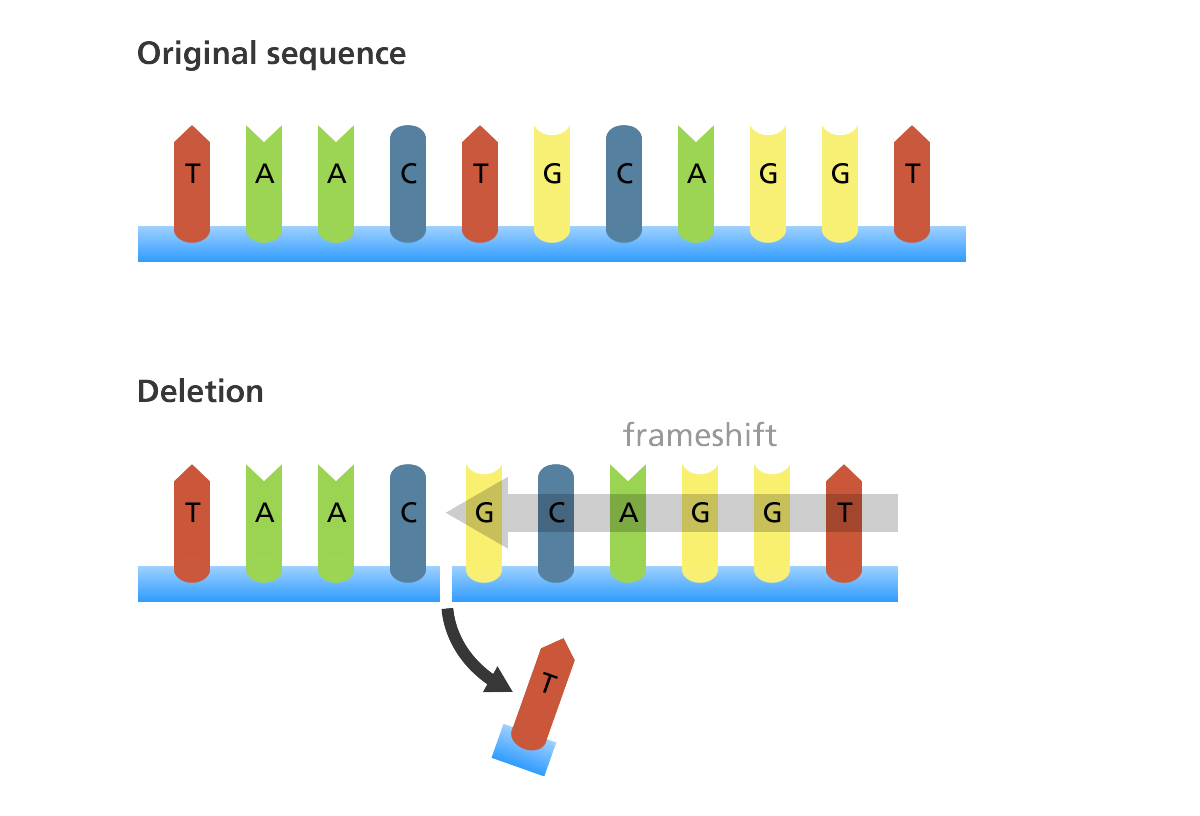

What type of mutation is this?
Nonsense mutation
Missense mutation
Silent mutation
Frameshift mutation

