
 Worksheets
Chapter 17: Direct current
Total questions: 71
Worksheet time: 2hrs 19mins
Which statement is FALSE about electricity?
Electric current is defined as the rate of charge flow
The resistance will increase when the temperature increase
The electric current decreases when the resistance increases
The resistivity increases when the length of the conductor increases
If the resistor are connected in parallel in a circuit which one has the highest current?
R1 < R2 < R3 < R4
R1
R2
R3
R4
Which of the following parameter DOES NOT alter the electrical resistance of a piece of metal wire?
The temperature of the wire
The diameter of the wire
The type of material of the wire
The direction of the current flow in the wire
If the length of the wire is doubled and its area of cross section is decreased to half, then its resistance
Increased by 4 times
Increased by 2 times
will become half of its initial value
Remains the same
A battery is connected across a parallel combination of 2 identical resistor. If the potential difference across the terminals is V and the current in the battery is I, Then:
The potential difference across each resistor is V and the current in each resistor is I
The potential difference across each resistor is V/2 and the current in each resistor is I/2
The potential difference across each resistor is V and the current in each resistor is 1/2
The potential difference across each resistor is V/2 and the current in each resistor is I
(I X R)
Voltage divided by Resistance
(V / R)
Current
Power
Ohms
Watts
What is the formula for ohms law?
1+2=3
R X E = I
V =I x R
E= MC squared

What happens to the resistance of a resistor when the temperature is increased?
Increases
decreases
stay the same
vary randomly

What happens to resistance when the length of the wire increases?
Stays the same
Increases
Decreases

For the graph shown in the figure, what physical quantity does the slope of the graph represent for ohmic material?
power
resistivity
resistance
1/(resistance)
Which circuit can be used to determine the electromotive force of a battery?


S.I unit of e.m.f is ______?
volt
ampere
ohm
joules
electromotive force is______?
work done to by the source to drive a unit charge around a complete circuit.
amount of light produced by a bulb
amount of heat produced by a resistor
amount of force produced by an electric motor
unit of potential difference is____?
volt
ampere
ohm
newton
Correct ( can be more than 1)
ϵ=V+Ir
ϵ=I(R+r)
ϵ=V
How to you calculate the total resistance in a series circuit?
R1 + R2+ R3
R1 - R2 - R3
1/R1 + 1/R2 + 1/R3
R1 = R2 = R3
How do you calculate total resistance in a parallel circuit?
R1 + R2 + R3
R1 - R2 - R3
1/R1 +1/R2 + 1/R3 = 1/RT
R1 = R2 = R3
Which is a true statement?
No sources of emf have internal resistance
Some sources of emf have internal resistance
Most sources of emf have internal resistance
All sources of emf have internal resistance
An ideal voltmeter in physics has...
...an easily readable scale
...an infinite resistance
...zero resistance
...a negligible internal resistance
In Physics, an ideal ammeter has...
...a 10A fuse
...infinite resistance
...an autoranging function
...zero resistance
The SI unit for EMF is
JC-1
VA-1
ΩA-1
VC-1
r
emf
p.d.
internal resistance
lost volts
Which circuit diagram represents the correct way to measure the current in a resistor?


Conventionally, current is described as flowing from the ................ terminal of a battery to the ................ terminal.
Negative.....negative
Negative....positive
Positive......negative
Positive....positive

This is the symbol for
ammeter
light bulb
resistor
voltmeter

This is the symbol for
ammeter
light bulb
resistor
voltmeter
Effective resistance increases when in .............. circuit.
Parallel
Series
Open
Closed
Effective resistance decreases when in .............. circuit.
Parallel
Series
Open
Closed
Current entering and leaving a point in a circuit should be
equal
decreasing
increasing
variable
"The total current in a parallel circuit equals the sum of the individual branch currents."
Ohm's Law
Kirchhoff's Voltage Law
Kirchhoff's Current Law
Bolen's Law
"The sum of all voltage drops in a series circuit equals the total applied voltage." This is know as what?
Ohm's Law
Kirchhoff's Voltage Law
Kirchhoff's Current Law
Bolen's Law

For the circuit shown, the resistances are R1 > R2 > R3. What is true about the current through each resistor?
I1 = I2 = I3
I1 > I2 > I3
I1 > I3 > I2
I1 < I3 < I2
Kirchhoff's 1st law deals with
current in circuit
voltage in circuit
e.m.f in circuit
voltage in circuit and e.m.f in circuit
"The sum of all voltage drops in a series circuit equals the total applied voltage." This is know as what?
Ohm's Law
Kirchhoff's Voltage Law
Kirchhoff's Current Law
Bolen's Law
P equals ...
IV
ER
I2R
V2R

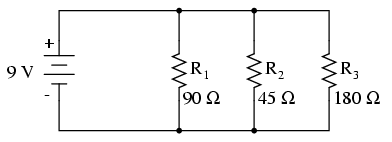
What type of circuit is this?
series
simple
open
parallel

What kind of circuit is this?
series
parallel
simple
open
Which one is true about potential divider
It consists one fixed resistor
It's resistors are connected in parallel to suply
It's resistors connected in series to suply
It's resistors connected in series and parallel to suply
A potentiometer is a device used for
measuring potential energy
measuring resistance
comparing potential difference
comparing potential energy
The Vout across the resistor of resistance R2 is given by:
Vout = (R1/(R1+R2)) x Vin
Vout = (R2 x (R1+R2)) x Vin
Vout = (R2/ (R1+R2)) x Vin
Vout = ( R1 x (R1 + R2))x Vin
A current is said to exist whenever _____.
A wire is charged
A battery is present
Electric charges are unbalanced
Electric charges move in a loop
The movement of electrically charged _____ is called electric _____
particles, transport
ions, current
particles, current
ions, transport
Which of the following will cause an electrical current to decrease?
The voltage stays the same
Decrease the resistance
Increase the voltage
Increase the resistance
Factor which does not affect the resistance
Type of material
Length of material
Mass of the material
Area of the material
If the length of a wire increases, the resistance ____________
Decreases
Increases
Stays the same
Unknown
What is internal resistance?
The resistance inside the cell that increases with more current drawn from the cell
The resistance inside the cell that decreases with more current drawn from the cell
The resistance inside the cell that remains constant as the current drawn from the cell changes
The resistance inside each component which increases as more resistances are added in series
What is the principle of potentiometer ?
V is proportional to L, when steady current flows through a wire of uniform area of cross section at constant temperature
Deflection in G is proportional to current
Resistance is proportional to length
Resistance is inversely proportional to area of cross section
What is the use of a potentiometer? (can be more than 1)
1. comparison of emf's of two primary cells
2. finding internal resistance of a cell
3. can be used as a variable resistor
ρ has a unit of ..........
Ω
Ωm
Ωm2
Ωm3
we use Aρl to find .........
P
V
I
ρ
R

