
 Worksheets
Quiz Review Thermo (Basics) Quiz with Math
Total questions: 66
Worksheet time: 1hrs 24mins
Freezing is ___________
endothermic
exothermic
If heat flows into the system from the surrounding, then heat is taken as ------
positive
negative
If heat is released by the system, the internal energy of the system decreases, then Q will be ____.
negative
positive

The diagram represents two solids and the temperature of each. What occurs when the two solids are placed in contact with each other?
Heat energy flows from solid A to solid B. Solid A decreases in temperature
Heat energy flows from solid A to solid B. Solid A increases in temperature
Heat energy flows from solid B to solid A. Solid B decreases in temperature.
Heat energy flows from solid B to solid A. Solid B increases in temperature.
Heat change at constant pressure is
U
ΔU
H
ΔH
The faster the speed of molecules is, the higher the temperature is.
True
False
The temperature is independent on the mean speed of the molecules.
True
False
The _____ molecules we have and the faster they move, the thermal energy will be bigger.
More
Less
Thermal energy is dependent on the:
Speed of the molecules
Number of molecules
Mass of the molecules
Temperature of the molecules
Temperature is to ENERGY, as heat is to ____.
Energy
Work
Heat is the amount of thermal energy gained or lost in the process.
True
False
All matter is composed of particles that are in constant, random motion. Because of this motion, the particles have ____ energy.
Kinetic
Nuclear
Potential
Mechanical
The quantity that tells how hot or cold something is compared to a standard is ____ and it is related to the average kinetic energy of a substance.
Heat
Thermal energy
Temperature
Which has more internal energy, a bathtub full of cool water or a cup of hot water?
Bathtub full of cool water
Cup of hot water
If a piece of aluminum is placed in contact with both a bathtub full of cool water and a cup of hot water, which way will heat flow?
From the bathtub to the cup
From the cup to the bathtub
Energy is released, -ΔH
Endothermic Reaction
Exothermic Reaction
Chemical Equilibrium
Homogenous Reaction
Energy is absorbed, +ΔH
Endothermic Reaction
Exothermic Reaction
Chemical Equilibrium
Heterogenous Reaction
If 34673.10 J of heat are absorbed by 105.0 g of water when it is heated. The initial temperature of the water is 20.0°C; what is the final temperature of the water? The specific heat of water is 4.18 J/g•°C.
79 C
1380 C
99 C
1400 C
A sample of iron receives 50 J of heat energy that raises the temperature of the iron 25.0°C. If iron has a specific heat of 0.10 J/g°C, what is the mass of the iron sample?
25 g
30 g
20 g
50 g
Melting is ___________
endothermic
exothermic
Boiling is ___________
endothermic
exothermic
Condensation is ___________
endothermic
exothermic
During a phase change, the temperature ________.
increases
stays the same
decreases
When heating a liquid, the temperature ________.
increases
stays the same
decreases
If temperature decreases, the average kinetic energy ________.
increases
stays constant
decreases
How much energy is required to melt a 10g cube of ice at 0°C? (Which equation will you use?)
Q = mΔH
- Q = mΔH
Q = mcΔT
-Q = mcΔT
How much energy is released to freeze a 10g cube of ice at 0°C? (Which equation will you use?)
Q = mΔH
- Q = mΔH
Q = mcΔT
-Q = mcΔT
How much energy is released to when water is heated from 10⁰C to 90⁰C? (Which equation will you use?)
Q = mΔH
- Q = mΔH
Q = mcΔT
-Q = mcΔT
How much energy is released to freeze water from 90⁰C to -10⁰C to ? (Select all the equations you will you use?)
Q = mΔH
- Q = mΔH
Q = mcΔT
-Q = mcΔT
How much energy is needed to heat water from 10⁰C to 110⁰C? (Select all the equations you will you use?)
Q = mΔH
- Q = mΔH
Q = mcΔT
-Q = mcΔT
Reorder the following from the lowest energy to the highest.
solid
liquid
gas
Consider the Q = mΔH at each phase. Assume you have a 1 gram sample. Put the following phase changes in order from the least amount of energy to the highest.
condensing
freezing
melting
vaporization
During a phase change, the temperature stays constant and _____ increases.
Kinetic Energy
Enthalpy
Potential Energy
Speed of the Particles
When a sample is in the vapor state, the temperature increases and _____ increases.
Kinetic Energy
Enthalpy
Potential Energy
Speed of the Particles

Which line segment represents the substance only in the solid state?
AB
BC
CD
DE
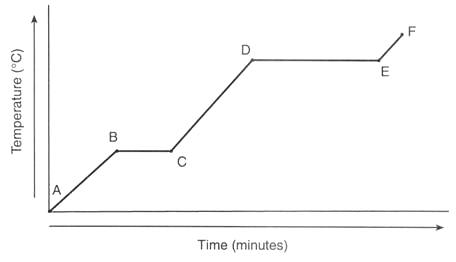
Select all line segments in which the temperature stays constant.
AB
BC
CD
DE
EF

What is the boiling point of this substance?
100 oC
60 oC
-60 oC
20 oC

Given the heating curve of a solid being heated at a constant rate, how long did it take to completely evaporate the substance after it reaches its boiling point?
3 minutes
4 minutes
5 minutes
8 minutes
14 minutes

The melting point of the sample is
-60 ºC
-100 ºC
60 ºC
100 ºC

What can be concluded by comparing the lengths of the melting and boiling lines?
It takes more energy to vaporize the sample than it does to melt it.
It takes more energy to increase the temperature of the gas than the liquid.
The substance stays at the boiling point for a short time.
The substance prefers the gas phase over the other phases.

Look at the slopes at each part of the graph. What can be concluded by comparing the slope of heating the liquid (water) versus that of the slope for ice or steam? (Choose all correct answers.)
More energy is required to heat up water than it does to heat up ice or steam.
Less energy is required to heat up water than it does to heat up ice or steam.
cwater > cice and cwater > csteam
cwater < cice and cwater < csteam
Select all line segments in which the temperature is changing.
AB
BC
CD
DE
EF

Which line segment represents the heat of fusion (ΔHfus)?
AB
BC
CD
DE
EF
Which line segment represents the heat of vaporization (ΔHvap)?
AB
BC
CD
DE
EF
Select all line segments in which the kinetic energy is changing.
AB
BC
CD
DE
EF
Select all line segments in which the potential energy is changing.
AB
BC
CD
DE
EF
What is the melting point of this substance?
100 oC
60 oC
-60 oC
20 oC
The freezing point of the sample is
-60 ºC
-100 ºC
60 ºC
100 ºC

The graph shows the heating curves for benzene and water.
Which substance has a higher heat of vaporization?
benzene
water
The graph shows the heating curves for benzene and water.
Which substance has a higher heat of fusion?
benzene
water
The graph shows the heating curves for benzene and water.
Which substance has a higher specific heat capacity as a liquid?
benzene
water
The graph shows the heating curves for benzene and water.
Which substance has a higher boiling point?
benzene
water
The graph shows the heating curves for benzene and water.
Which substance has a higher melting point?
benzene
water

From point A to point E, the sample is going through an
exothermic process by releasing heat to the surroundings
exothermic process by absorbing heat from the surroundings
endothermic process by releasing heat to the surroundings
endothermic process by absorbing heat from the surroundings
Thermal energy always moves:
From a high temperature object to a lower temperature object.
From a lower temperature object to a higher temperature object.
From an object with lower kinetic energy to an object with higher kinetic energy.
From an object of higher mass to an object of lower mass.
What is true about intermolecular forces in gases
they have been broken by heat
They are very strong
They cannot be put back together
they represent a chemical change
As matter cools what happens to the intermolecular forces?
they strengthen
they weaken
they reverse
What does heat do to intermolecular forces?
strengthens them
Weakens them
reverses them
What is holding molecules in a solid close to each other?
Intermolecular forces
Chemical Bonds
Heat
Cold

In which region(s) of the graph would the substance be melting?
No melting occurs on this graph
Region C-E
Region E-G
Region G-I
Region I-K

What is the freezing point of the substance?
0oC
60oC
120oC
180oC
From point A to point F, the sample is going through an __________ process by __________.
exothermic, releasing heat to the surroundings
exothermic, absorbing heat from the surroundings
endothermic, releasing heat to the surroundings
endothermic, absorbing heat from the surroundings

Label the graph with the correct scientific processes.
A
Gas
B
Condensation
C
Liquid
D
Freezing
E
Solid
What type of curve is this?
Heating
Cooling
Specific heat is the amount of (a) needed to increase the temperature of one (b) of any material one degree Celcius.

