wayground logo

Free Printable Worksheets

Font size

S
M
L
XL
Worksheets

Body Systems and Change AND Dynamic Electricity Revision

Total questions: 70

Worksheet time: 50mins

Name
Class
Date
1.

This is the symbol for a _____?

a)

switch

b)

light

c)

battery

d)

wires

2.
This is the symbol for a _____?
a)
an AC current source
b)
a DC current source
c)
an ammeter
d)
a voltmeter
3.
This is the symbol for a _____?
a)
an AC current source
b)
a DC current source
c)
an ammeter
d)
a voltmeter
4.

If you replace the paper clip with a plastic spoon, what happens?

a)

The bulb doesn't light

b)

The bulb is dimmer

c)

The wires get hot

d)

There is no change

5.

What kind of circuit is this?

a)

series

b)

parallel

6.

What type of circuit is show in the image?

a)

Series Circuit

b)

Parallel Circuit

7.

Pick the correct sentence.

a)

This circuit will work because it is a closed circuit.

b)

Energy will freely flow in this circuit.

c)

This circuit will not work because there is no energy source.

d)

This circuit will not work because there is no switch.

8.

Does this diagram represent a series or parallel circuit?

a)

series circuit

b)

parallel circuit

9.

Electrical lights will not come on unless their electrical circuit is a --

a)

parallel circuit

b)

series circuit

c)

closed circuit

d)

short circuit

10.

What material would be safest to use as an insulator to cover electrical wires?

a)

rubber

b)

tin

c)

aluminum

d)

water

11.

What is the ammeter reading in this circuit? Assume that all bulbs are identical.

a)

9A

b)

0.5A

c)

0.75A

d)

1.5A

12.

What is the voltmeter reading in this circuit? Assume that all bulbs and resistors have the same resistance.

a)

5V

b)

2.5V

c)

1.67V

d)

15V

13.

What is the ammeter reading in this circuit? Assume that all bulbs and resisters have the same resistance.

a)

5A

b)

10A

c)

15A

d)

1.67A

14.

What is the voltmeter reading in this circuit? Assume that the voltage across the other bulb is 9V.

a)

6V

b)

12V

c)

3V

d)

24V

15.

What is the voltmeter reading in this circuit? Assume that all bulbs are identical.

a)

12V

b)

6V

c)

24V

d)

3V

16.

What is the voltmeter reading in this circuit? Assume that all bulbs are identical.

a)

3.33V

b)

6.66V

c)

10V

d)

3V

17.
This is an example of a _______ circuit
a)
open
b)
series
c)
parallel
d)
square
18.
This is an example of a ______ circuit
a)
Series
b)
Parallel
c)
Open
d)
Dihexihedral
19.
What kind of circuit is this?
a)
Series
b)
Consecutive
c)
Parallel
d)
Training
20.
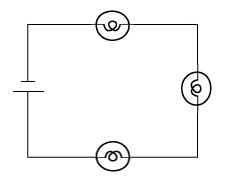
The picture shows an electrical circuit. This circuit is a series circuit because: 
a)
It has 3 light bulbs.
b)
The same current flows through all three light bulbs.
c)
It uses a single battery.
d)
The electrical current is divided between the three light bulbs.
21.
This is an example of a ______ circuit
a)
Series
b)
Parallel
c)
Open
d)
Dihexihedral
22.
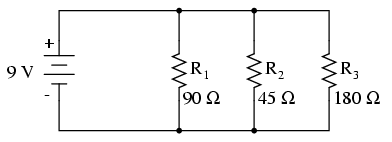
The voltage drop across the 180 ohm resistor is 
a)
9 V
b)
6 V
c)
2 V
d)
12 V
23.
Which best describes a parallel circuit?
a)
Electricity flows along one pathway.
b)
The flow of electricity comes from one source. 
c)
Electricity flows along more than one pathway. 
d)
The flow of electricity comes from more than one source. 
24.
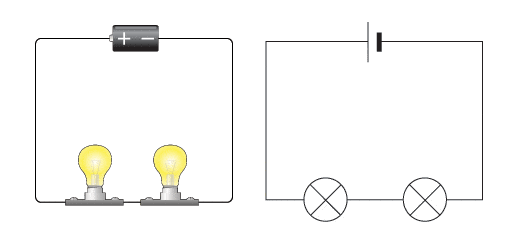
Which best describes a series circuit? 
a)
It has two light bulbs. 
b)
The same current flows through both light bulbs. 
c)
It uses a single battery.
d)
The current is divided between the light bulbs. 
25.
What is one problem with using a series circuit? 
a)
It has a lot of series. 
b)
If one goes down, they all go down! 
c)
It doesn't work properly.
d)
There are no problems. 
26.
What is one benefits of using a parallel circuit?  
a)
It gets confusing.
b)
There are no problems.
c)
If one goes down, it does not affect the others. 
d)
Porque es para llelio. 
27.
Resistance is measured in ___. 
a)
watts. 
b)
amps.
c)
ohms.
28.
Voltage is measured in __.
a)
volts.
b)
watts.
c)
coulombs. 
29.
As the resistance of a circuit increases, the current will
a)
increase
b)
decrease
c)
stay the same
30.
What is the formula for resistance?
a)
V x I = R
b)
R = V/I
31.
the tendency for a material to oppose the flow of electrons
a)
current
b)
circuit
c)
resistance
d)
difference
32.

What is electricity?

a)

Flow of Protons

b)

Flow of Atoms

c)

Flow of Electrons

d)

Flow of Neutrons

33.

If the voltage is increased and the resistance stays the same (fixed), what would happen to the current? (Ohms law)

a)

increase

b)

decrease

c)

stay the same

d)

halve

34.

If the resistance is increased and the voltage stays the same, what would happen to the current? (Ohms law)

a)

increase

b)

decrease

c)

stay the same

d)

halve

35.
A _____________________ is something that scientists use to represent an object or process
a)
mass
b)
matter
c)
model
d)
weight
36.

Models are an important tool in Science select ALL of the correct reasons why below

a)

simplify complex/abstract scientific phenomena

b)

to increase understanding

c)

oversimplify complex concepts, fostering misunderstandings

d)

to make microscopic processes macroscopic (big) to enable people to visualise concepts
37.
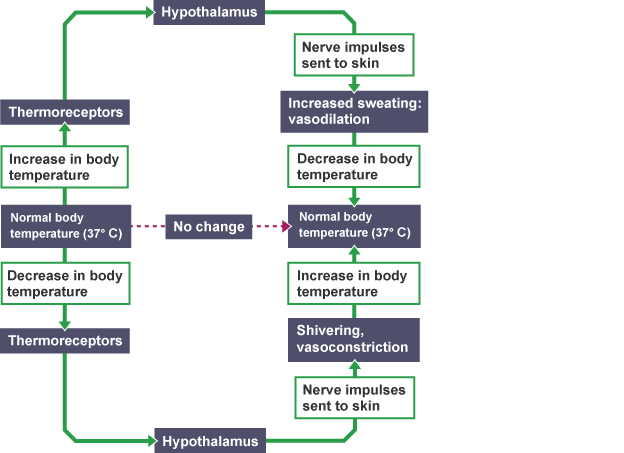
If the environment gets cold, we will often shiver in order to:
a)
keep body temperature the same as the external temperature
b)
decrease body temperature
c)
increase body temperature
d)
regulate blood pressure
38.
Homeostasis in the human body is often maintained by a: 
a)
neutral feedback loop 
b)
solar feedback loop
c)
positive feedback loop
d)
negative feedback loop
39.
The maintenance of an organism’s internal environment is called:
a)
compensating
b)
homeostasis
c)
balancing
d)
routine
40.
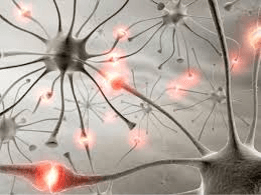
a body system that controls and coordinates all body activities through electric impulses/messages between brain, spinal cord and nerves.
a)
endocrine system 
b)
nervous system
c)
nerve
d)
neuron
41.
brain cell /
nerve cell
a)
Dr. Suess tree
b)
neuron
c)
skin cell
d)
red blood cell
42.
a body system that controls growth and homeostasis by secreting hormones from glands.
a)
skeletal system
b)
nervous system
c)
endocrine sytem
d)
integumentary system
43.
organ of the endocrine system that secretes hormones.
a)
heart
b)
gland
c)
brain
d)
skin
44.
chemical made by glands that tell cells to make something or respond in some way.
a)
acid
b)
enzyme
c)
perspiration
d)
hormone
45.
What is the immune system’s main purpose?
a)
Let’s germs into the body.
b)
Helps your body fight off  illness and disease.
c)
The immune system produces illness and bacteria.
d)
The immune system trap germs in an organ so they do not spread.
46.
What is the series of steps in the immune system called?
a)
Response immune
b)
Immune response
c)
Immune steps
d)
Steps immune
47.
What is the largest outer defense of the body?
a)
Stomach Acid 
b)
Mucous Membranes
c)
Cilia
d)
Skin
48.
Which cells allow the body to to remember and recognize previous invaders?
a)
White Blood Cells
b)
Antigens 
c)
Phagocytes
d)
Lymphocytes
49.
What do white blood cells create to fight infections?
a)
Antibiotics
b)
Antigens
c)
Antibodies
d)
Leukocytes
50.
What does phagocytes do in our body? 
a)
weaken the immune system
b)
chew up white blood cells
c)
chew up invading organisms.
d)
allow the body to remember and recognize previous invaders and help the body destroy them.
51.

What is the effect of the body releasing calcitonin?

a)

blood calcium levels increase

b)

parathyroid

c)

blood calcium levels decrease

d)

thyroid

52.

What organ releases calcitonin when the calcium levels are too high in the body?

a)

blood calcium levels increase

b)

parathyroid

c)

blood calcium levels decrease

d)

thyroid

53.

Which organ responds when the calcium levels are too low?

a)

blood calcium levels increase

b)

parathyroid

c)

blood calcium levels decrease

d)

thyroid

54.
Which of the following is the body’s first line of defense against disease?
a)
vaccines
b)
white blood cells
c)
antibodies
d)
skin
55.
What is an antigen?
a)
A protein produced by white blood cell
b)
A type of white blood cell
c)
A Vaccine
d)
A foreign molecule
56.

This line of defense forms a barrier that stops all "things" from getting into the body or blood

a)

1st line defense

b)

2nd line defense

c)

3rd line defense

57.
Which is NOT considered FIRST line of defense?
a)
White Blood Cells
b)
Skin
c)
Hair
d)
Mucous Membranes
58.
What function does mucus play in the immune system?
a)
traps foreign particles from entering the body
b)
moistens food
c)
produces WBCs
d)
acts as a lubricant
59.

Inflammation occurs during which line of defense?

a)

First Line

b)

Second Line

c)

Third Line

d)

Fourth Line

60.

Which of these is NOT an example of non-specific defense?

a)

Mucus

b)

B cells

c)

Skin

d)

Stomach acid

61.

What is the purpose of macrophages / phagocytes?

a)

To engulf and destroy pathogens, and then "tell" other cells about it.

b)

To activate B cells to make antibodies.

c)

To make antibodies.

d)

To repair damaged cells and tissue.

62.
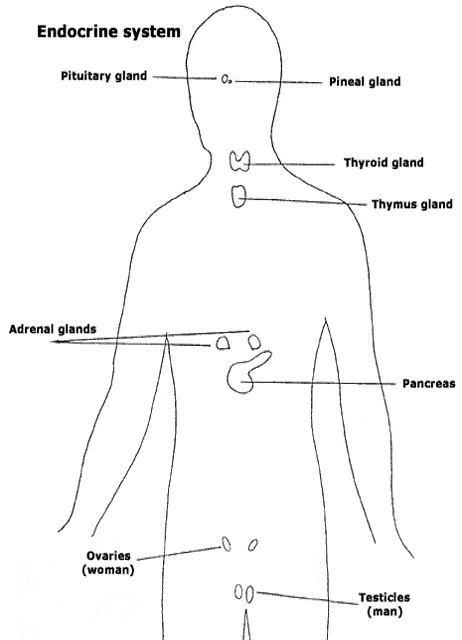
The gland labeled 4 in the diagram is?
a)
the thymus gland
b)
the thyroid gland
c)
the parathyroid glands
d)
the adrenal glands
63.
When levels go above or below a set point a hormone is released to return the body to set point. When the body is restored to set point no more hormone is released. This is an example of...
a)
a positive feedback loop
b)
a negative feedback loop
c)
a neutral feedback loop
64.
Which of the following is an example of a positive feedback loop?
a)
regulation of body temperature at 37 degrees Celsius 
b)
regulation of blood sugar levels
c)
contractions during childbirth
d)
regulation of water levels in humans
65.
What two things are found in the central nervous system?
a)
brain/spinal cord
b)
spinal cord/motor neurons
c)
motor/sensory neurons
d)
only brain
66.
Part of the nervous system made of the nerves that are not part of the brain or spinal cord.
a)
central nervous system
b)
peripheral nervous system
67.
What type of feedback loop is shown?
a)
Positive
b)
Neutral
c)
Negative
68.
Failure to maintain homeostasis could result in:
a)
lack of internal balance
b)
eventual death
c)
difficulty carrying on metabolism 
d)
all three
69.

What is the bodies response when your temperature drops below the optimum level?

a)

Blood vessels dilate to release heat to the environment. Glands begin to sweat.

b)

Heat is retained

c)

Heat is lost

d)

Blood vessels constrict to conserve heat. Body shivers to generate heat.

70.

What is the bodies response when your temperature rises above the optimum level?

a)

Blood vessels dilate to release heat to the environment. Glands begin to sweat.

b)

Heat is retained

c)

Heat is lost

d)

Blood vessels constrict to conserve heat. Body shivers to generate heat.