
 Worksheets
FINAL EOC Review!
Total questions: 75
Worksheet time: 18hrs 17mins
Name
Class
Date
1.
What process best explains how a nerve cell and a muscle cell can both develop from the same fertilized egg?
a)
differentiation
b)
natural selection
c)
selective breeding
d)
genetic engineering
2.
During strenuous exercise, body temperature increases. The body responds to the increase in temperature by sweating, which helps to reduce the body temperature. Which is demonstrated in this situation?
a)
excretion
b)
metabolism
c)
homeostasis
d)
synthesis
3.
What is the function of autotrophs in the carbon cycle?
a)
to use oxygen to produce glucose
b)
to take in excess water
c)
to use carbon dioxide to produce glucose
d)
to feed on herbivores
4.
Before mitosis begins, which happens before the nucleus starts dividing?
a)
The cytoplasm separates.
b)
The DNA replicates.
c)
The sister chromatids separate.
d)
The homologous chromosomes cross over.
5.
A strand of DNA has these bases:
AGC CAT GTA TAC What is the complementary DNA strand?
AGC CAT GTA TAC What is the complementary DNA strand?
a)
ACG GAT CTA TAG
b)
TCG GTA CAT ATG
c)
TGC CTA GAT ATC
d)
UCG CUA CAU AUG
6.
Which statement best describes the relationship that exists among proteins, DNA, and cells?
a)
Proteins combine to produce cells, which produce DNA
b)
Proteins are made up of DNA, which determines the cells that are produced.
c)
DNA is made up of proteins, which tell a cell how to function.
d)
Cells contain DNA, which controls the production of proteins.
7.
What are the subunits of DNA and their function?
a)
nucleotides that store information
b)
monosaccharides that provide quick energy for the cell
c)
lipids that store energy and provide insulation
d)
proteins that provide the building blocks for the structural components of organisms
8.
What type of organic molecules are enzymes?
a)
carbohydrates
b)
lipids
c)
nucleic acids
d)
proteins
9.
A freshwater plant is placed in a container of saltwater. What will most likely happen to the cells of the plant?
a)
They will swell because water will move into them.
b)
They will swell because salt will move into them
c)
They will shrink because water will move out of them.
d)
They will shrink because salt will move out of them.
10.

This diagram shows a plant cell. Which structure is found in a plant cell but is absent in an animal cell?
a)
1
b)
2
c)
3
d)
4
11.
How does the amount of energy resulting from fermentation compare with that of aerobic respiration?
a)
Aerobic respiration results in less energy.
b)
Aerobic respiration results in more energy.
c)
Each process results in equal amounts of energy.
d)
Each process results in variable amounts of energy.
12.
What will most likely be the result if all of the mitochondria are removed from a plant cell?
a)
It will be unable to carry out respiration.
b)
It will lose water through osmosis.
c)
It will break down ribosomes in the cell
d)
It will be unable to photosynthesize.
13.

If there is 1000 Kcal available in the producers in trophic level 1, how much energy is available in the herbivores in trophic level 2?
a)
10 Kcal
b)
1 Kcal
c)
100 Kcal
d)
1000 Kcal
14.

If these organisms were arranged in a food pyramid, which organism would have the least amount of total energy available?
a)
coyote
b)
insect
c)
lizard
d)
shrub
15.

The grass that the mice eat contains energy. what is the source of energy for the grass?
a)
Rainwater
b)
The Sun
c)
The soil
d)
Minerals
16.

Which species most likely has the largest population?
a)
Herring
b)
Plankton
c)
Shrimp
d)
Shark
17.

what did Charles Darwin observe in finch populations of the Galapagos Islands off the coast of South America?
a)
different species on different islands
b)
all species on one of the islands
c)
identical species on all the islands
d)
the same species as North America
18.
What is the process in which humans breed organisms for certain traits?
a)
natural selection
b)
inheritance
c)
artificial selection
d)
descent withOUT modification
19.
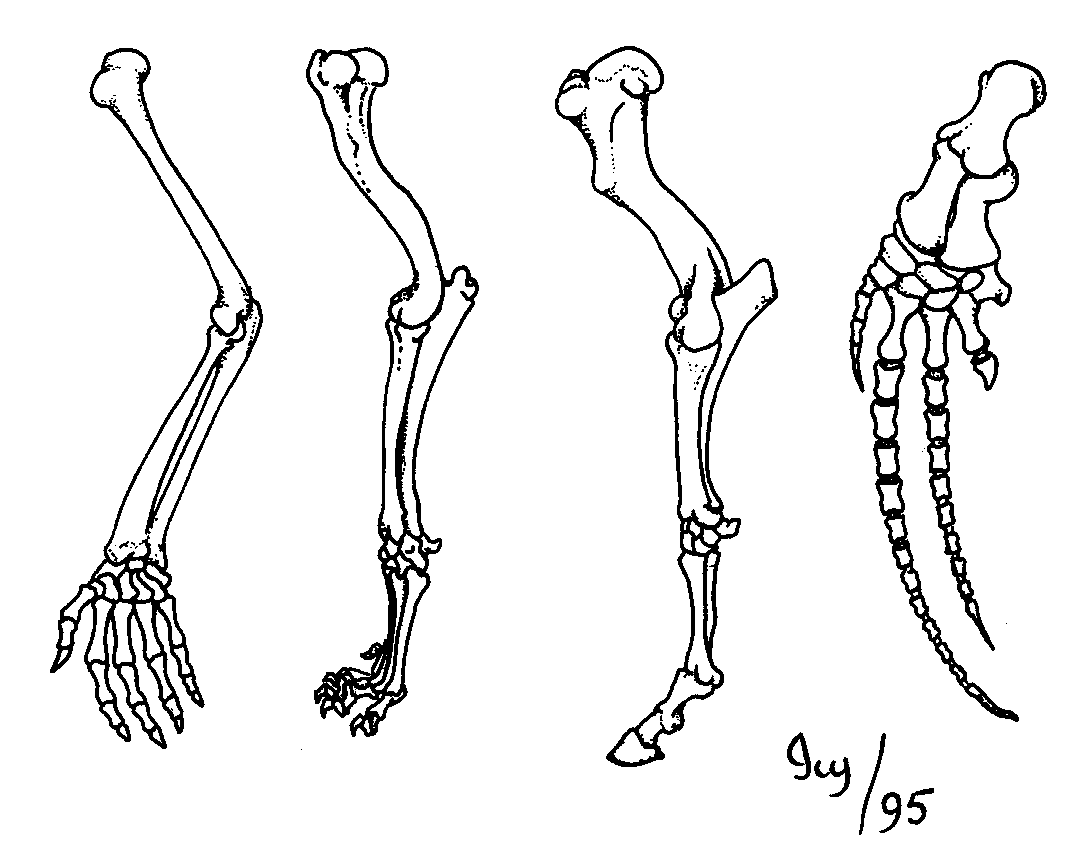
Structures with the same parts have different functions; suggests that organisms share a common ancestry
a)
vestigial structures
b)
homologous structures
c)
adaptive radiation
d)
fossil
20.

When is DNA replicated during the cell cycle?
a)
During the G1 phase
b)
During the G2 phase
c)
During the S phase
d)
During the M phase
21.

Identify this process.
a)
Replication
b)
Transcription
c)
Translation
d)
Proof reading
22.
Which sequence depicts the correct order of protein synthesis within a cell?
a)
DNA → mRNA → amino acids → proteins
b)
DNA → amino acids → mRNA → proteins
c)
DNA → mRNA → proteins → amino acids
d)
DNA → proteins → amino acids → mRNA
23.
What type of RNA carries the DNA message out of the nucleus to the ribosomes?
a)
mRNA
b)
tRNA
c)
rRNA
24.
What do we call the process of turning DNA into mRNA?
a)
replication
b)
transcription
c)
translation
25.
when DNA is transcribed to RNA....
a)
A pairs with U
b)
G pairs with U
c)
C pairs with T
d)
A pairs with C
26.
Amino acids are the building blocks of...
a)
atoms
b)
DNA
c)
proteins
d)
a loving relationship
27.
How many amino acids are coded for by this sequence of nucleotides:
ATG GGA ACT CCA
ATG GGA ACT CCA
a)
4
b)
2
c)
6
d)
12
28.
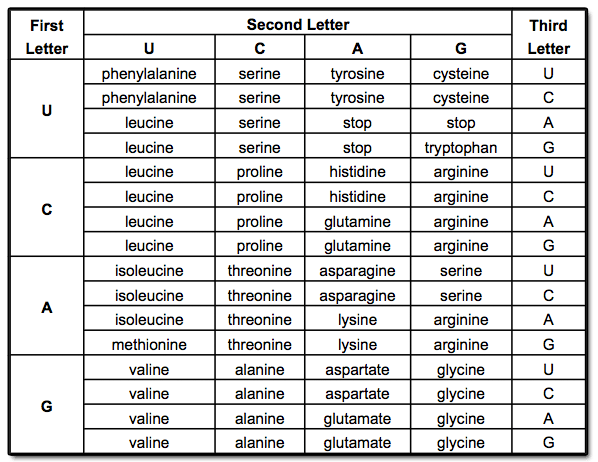
What is the correct amino acid sequence for the mRNA code AUGCCAGUAUGA
a)
Met-Pro-Val-Stop
b)
Met-Pro-Ala
c)
Tyr-Gly-His
d)
Tyr-Gly-Arg-His
29.
What mutation has occurred here?
T-G-A-C-C-A
T-G-A-G-C-A
T-G-A-C-C-A
T-G-A-G-C-A
a)
Substitution
b)
Deletion
c)
Insertion
d)
Frameshift
30.
What type of gene mutation has occurred here?
Normal-
T-G-A-C-C-A
Mutant-
T-G-A-C-C-A-A
Normal-
T-G-A-C-C-A
Mutant-
T-G-A-C-C-A-A
a)
Base Substitution
b)
Base Deletion
c)
Base Insertion
d)
Frameshift
31.
Where do mutations occur?
a)
DNA and RNA
b)
DNA
c)
RNA
d)
mRNA and tRNA
32.

What is the correct amino acid for the following mRNA codon:
CAA
CAA
a)
Arg
b)
Met
c)
Gln
d)
Val
33.

What is the correct amino acid for the following mRNA codon:
UGA
UGA
a)
Stop
b)
Met
c)
Asp
d)
Ala
34.
Which is the mRNA molecule that would be transcribed from this DNA template:
TGGCAAGTACGT
TGGCAAGTACGT
a)
ACCGTTCATGCA
b)
UGGCAAGUACGU
c)
UCCGUUCUUGCU
d)
ACCGUUCAUGCA
35.
For which molecule does Biuret's show a positive test result?
a)
monosaccharide
b)
polysaccharide
c)
protein
d)
lipid
36.
The purpose of nucleic acids is to store
a)
Water
b)
Minerals
c)
Genetic Information
d)
Energy
37.
What are the monomers of carbohydrates?
a)
Nucleotides
b)
Amino Acids
c)
Polysaccharides
d)
Monosaccharides
38.
The monomer of a nucleic acid is
a)
Monosaccharide
b)
Amino Acid
c)
Nucleotide
d)
Triglyceride (3 Fatty Acids and 1 Glycerol)
39.
For which molecule does Biuret's show a positive test result?
a)
monosaccharide
b)
polysaccharide
c)
protein
d)
lipid
40.
Which biomolecule contains pastas and breads?
a)
Lipid
b)
Protein
c)
Nucleic Acid
d)
Carbohydrate
41.

In which organelle (part of the cell) does photosynthesis take place?
a)
mitochondria
b)
chloroplast
c)
nucleus
d)
cell membrane
42.
How can photosynthesis be related to cellular respiration?
a)
What's produced (made) by one is needed (the reactants) for the other
b)
They both produce the same products
c)
They both have the same reactants (need the same things)
d)
These 2 processes have nothing in common
43.
______________ produces the most ATP.
a)
photosnthesis
b)
aerobic respiration
c)
anaerobic respiration
d)
glycolysis
44.
An experiment is performed on plants to see how different liquids affect plant growth. Each plant in the experiment is given a different liquid; water, apple juice, or milk. Each plant has the same amount of soil, sunlight, and listens to the same music. In this investigation, the independent variable is ...
a)
The type of plant
b)
The amount of sunlight
c)
The type of music
d)
The type of liquid
45.
An experiment is performed on plants to see how different liquids affect plant growth. Each plant in the experiment is given a different liquid; water, apple juice, or milk. Each plant has the same amount of soil, sunlight, and listens to the same music. In this investigation, what are the experimental constants?
a)
Type of plant, amount of music, and sunlight
b)
Water, apple juice, milk
c)
Plant growth
46.
In the process of photosynthesis, plants use the energy of the Sun to form ___ and ___ from ___ and ___.
a)
glucose and oxygen; carbon dioxide and water
b)
carbon dioxide and water; glucose and oxyge
47.

Cattle egrets forage (feed) in fields among cattle. The egret gets easy access to flying insects stirred up by the cattle, and the cattle don't care if they are there or not.What type of symbiosis is this?
a)
mutualism
b)
commensalism
c)
competition
d)
parasitism
48.
The collection of all of the biotic and abiotic factors in an area describes -
a)
community
b)
population
c)
ecosystem
d)
organism
49.

T - tall and t = short
In the punnett square below, what belongs in the missing square
In the punnett square below, what belongs in the missing square
a)
tt
b)
Tt
c)
Bb
d)
TT
50.

B = brown fur b = white fur
In the punnett square, what is the probability for white fur?
In the punnett square, what is the probability for white fur?
a)
0%
b)
25%
c)
50%
d)
75%
51.
Which of the following genotypes is heterozygous?
a)
Bb
b)
BB
c)
bb
d)
B
52.
Which would be considered a somatic cell?
a)
Sperm cell
b)
Egg Cell
c)
Skin Cell
d)
All of these
53.
Which of the following would be considered a Gamete cell?
a)
Egg Cell
b)
Sperm Cell
c)
Both of these
d)
None of these
54.
What would indicate a human male?
a)
XX
b)
X
c)
XY
d)
XXY
55.
What organelle's function is to make protein?
a)
Rough E.R.
b)
Smooth E.R.
c)
Ribosome
d)
Nucleus
56.
What organelle's function is to break down glucose to make cell energy?
a)
Chloroplasts
b)
Mitochondria
c)
Nucleus
d)
ATP
57.
What plant structure is designed to allow water to move up/out to rest of plant?
a)
Xylem
b)
Pholem
c)
Roots
d)
Leaves
58.

This cell is simple. Only genetic material, cytoplasm and ribosomes inside. What type of cell is it?
a)
Eukaryotic
b)
Prokaryotic
c)
Plant
d)
Animal
59.
What is the term for the uncontrolled division of cells that results in malignant growth?
a)
tissues
b)
cancer
c)
mitosis
d)
anaphase
60.
What is the longest phase of the CELL CYCLE?
a)
prophase
b)
interphase
c)
metaphase
d)
mitosis
61.
In humans, having dimples is dominant over not having dimples. If both parents are heterozygous for dimples, what is the likelihood that their children will have dimples?
a)
25%
b)
50%
c)
75%
d)
100%
62.
Red tulips when crossed with white tulips produce (heterozygous) pink tulips. If two pink tulips are crossed, what would be the expected outcomes for the offspring?
a)
100% Pink
b)
50% Red, 50% White
c)
50% Red, 50% Pink
d)
25% Red, 50% Pink, 25% White
63.
Red tulips when crossed with white tulips produce (heterozygous) pink tulips. This is an example of which type of inheritance?
a)
Multiple Allele Blood Types
b)
Sex-Linked
c)
Incomplete Dominance
d)
Codominance
64.

What does a food web represent?
a)
All connections of energy flow throughout all organisms in a habitat.
b)
The specific ways that mutualism is carried out.
c)
A single pathway or energy flow between organisms.
d)
How carnivores get their food.
65.
The energy at each trophic level in the pryamid of energy decreases by a factor of ____.
a)
10
b)
1
c)
100
d)
2
66.
Which of these could lead to global warming?
a)
recycling plastic
b)
conserving water
c)
deforestation
d)
bioaccumulation
67.

Identify a correct food chain that demonstrates the energy flow of this food web. (watch the arrows)
a)
Plant>Snail>Bluebird>Eagle
b)
Plant<Snail<Bluebird<Eagle
c)
Plant>Snail<Eagle>Bluebird
d)
Plant<Rabbit<Eagle
68.
Which is an example of an invasive species?
a)
rattlesnakes in the desert searching for prey
b)
the kudzu vine introduced to help prevent soil erosion
c)
bacteria decomposing dead organic matter in the soil
d)
algae that produces oxygen in fresh water
69.
Two organisms that are so similar they can interbreed in nature and produce fertile offspring
a)
biotic factor
b)
herbivore
c)
ecosystem
d)
species
70.
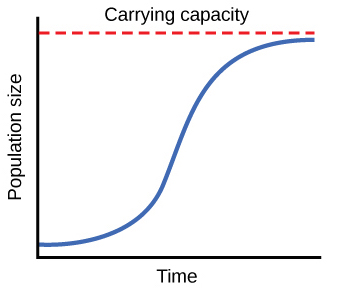
__________ growth shows growth of a population under environmental constraints (carrying capacity-K) that sets a maximum population size
a)
logistic
b)
exponential
c)
niche
d)
uniform
71.
Which is primarily composed of the molecules cytosine, guanine, adenine, and thymine?
a)
lipid
b)
DNA
c)
RNA
d)
protein
72.
What is the movement of molecules or solutes from an area of high concentration to an area of low concentration?
a)
osmosis
b)
active transport
c)
merging
d)
diffusion
73.
How is do RNA and DNA differ?
a)
DNA contains adenine, RNA contains thymine
b)
DNA contains a sugar and RNA does not
c)
DNA is double stranded, RNA is single stranded
d)
DNA is found in the cytoplasm, RNA is only in the nucleus
74.

The ability to taste a bitter chemical called PTC is a dominant trait in humans. The Punnett square below shows a cross between two parents who are heterozygous for the ability to taste this chemical. What is the probability, expressed as a percentage, that these parents will produce an offspring who is homozygous recessive for the tasting trait?
a)
0%
b)
25%
c)
50%
d)
75%
75.

The chart shows the embryos and adult forms of animals from different classification groups. What do the embryos suggest about these three animals?
a)
The animals are not related.
b)
The animals share a common ancestor and are therefore related
c)
Fish are more closely related to humans than are chickens.
d)
Fish and chickens ar closely related, but humans are not related to either fish or chickens.
100 %

