
 Worksheets
Planet Earth Unit Exam
Total questions: 66
Worksheet time: 1hrs 11mins

Most tectonic plates contain?
Only continental crust
Only oceanic crust
Both continental and oceanic crust
No crust

Which is a more scientific term that identifies the Earths outermost structural layer?
Asthenosphere
Lithosphere
Mesosphere
Outer core
In which layer of Earth does convection occur?
Asthenosphere
Oceanic crust
Lithosphere
Inner core
If scientists could sample Earth's inner core, they would most likely find…
Liquid metal
Solid metal
Liquid rock
Partly molten rock
Using data from seismic waves, geologists have learned that Earth's interior is made up of several
continents
layers
ridges
trenches

Which of Earth's layers is thickest?
crust
mantle
outer core
inner core


The hypothesis of Continental Drift was proposed by ...
Alfred Wagen
Harry Hens
Harry Hess
Alfred Wegner

What was the name of the supercontinent?
Panorama
Pangea
Panamerican
Wegener
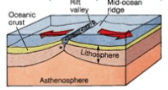
divergent
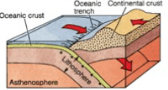
convergent
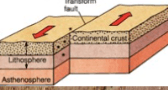
transform
At which plate boundary is new crust formed?
divergent
convergent
continental
transform

These waves are the fastest seismic waves and are the first to reach any particular location.
P Waves
S Waves
Surface Waves
Velocity Waves

A water wave caused by an earthquake is called a __________________.
tsunami
seismic wave
electromagnetic wave
Typhoon wave

The point on earth's surface, directly above an earthquakes origin is called the __________________.
epicenter
fault
seismic wave
focus

The instrument that records and measures earthquake's seismic waves is called a ____________________.
seismograph
seismogram
Barometer
Richter Scale
Earthquakes are classified based on their ____.
Magnitude
depth
frequency
Location
Slower destructive waves that occur on the surface of the earth are what type of earthquake waves?
D wave
S waves
P wave
Converging wave

How much bigger is a magnitude 8 earthquake compared to magnitude 5 quake on the Richter Scale?
3 times bigger
1000 times bigger
40 times bigger
100 times bigger
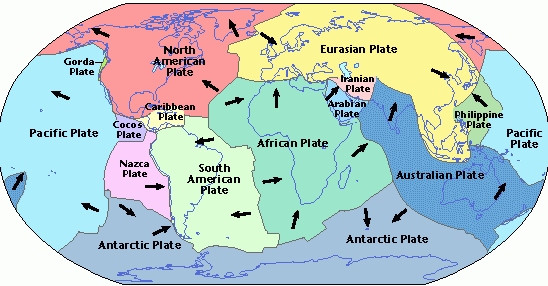
Countries
Tectonic Plates
Climate Zones
The outer and inner core

lava is...
molten rock above the earth's surface
molten rock below the earth's surface
molten rock in the center of the earth

Which volcano type has a gentle slope and gentle eruptions that last a long time?
Cinder cone volcanoes
Shield volcanoes
Composite volcanoes
Super Volcanoes
This type of volcano has steep slopes, has explosive eruptions of gas and ash. Most volcanoes are this type.
Composite volcano
Shield volcano
Cinder Cone volcano
Ash volcanoe

(a) is a fast moving avalanche of hot gas, ash, and rock that erupts from an explosive volcano.
The ring of fire surrounds the (a) ocean.

Which type of volcano is currently resting, but could erupt sometime in the future?
Active
Dormant
Extinct
All of the above
What is the correct order (starting from the surface) of Earth’s layers?
crust, outer core, inner core, mantle
mantle, outer core, inner core, crust
crust, mantle, outer core, inner core
outer core, inner core, crust, mantle
What process breaks rocks into smaller pieces?
erosion
weathering
sediment

Moss growing on the side of a rock,, causing pits in the rock is an example of:
Chemical weathering
Biological weathering
Mechanical weathering
Deposition

Luster is how:
Hard a substance is
Scratchable a substance is
Shiny a substance is
breakable a substance is
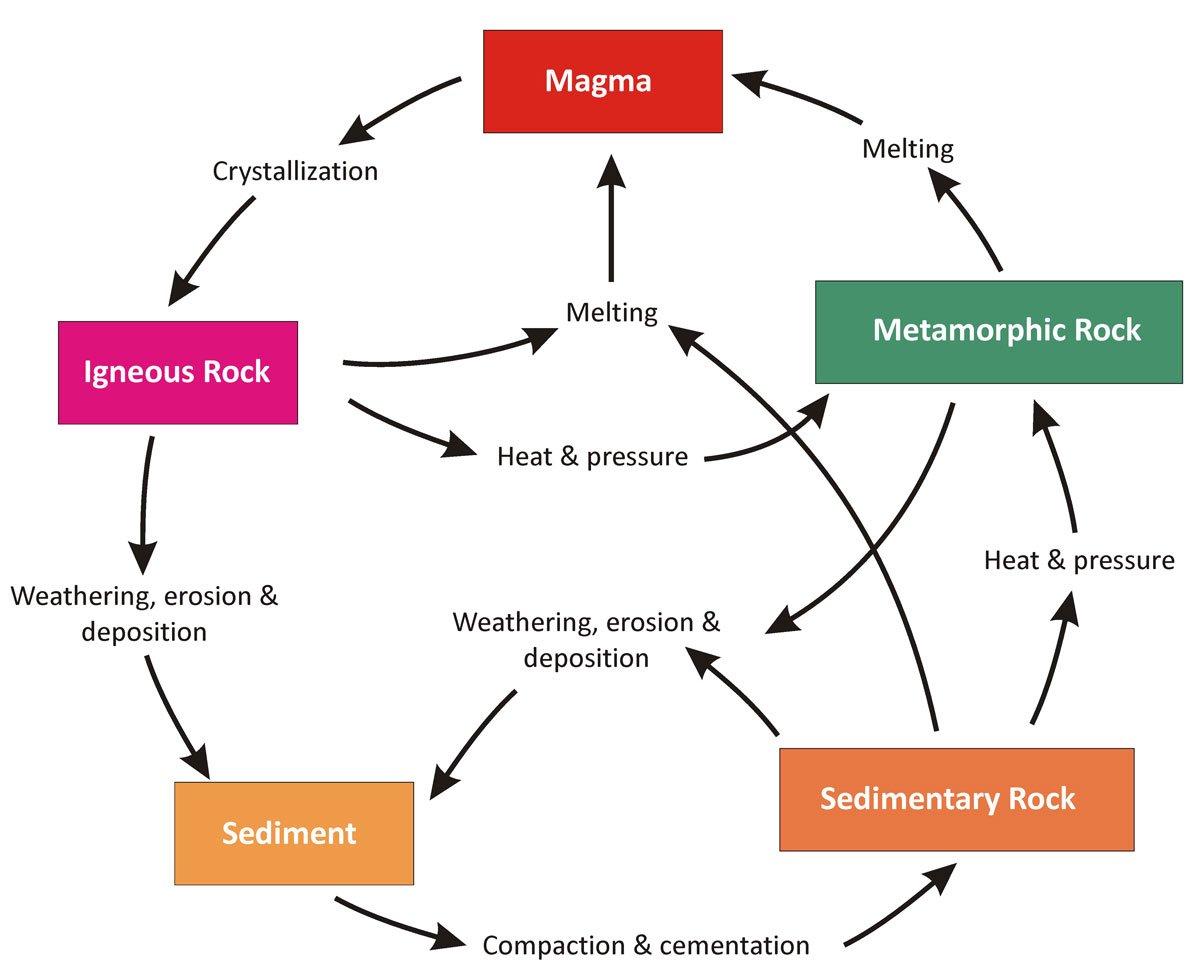
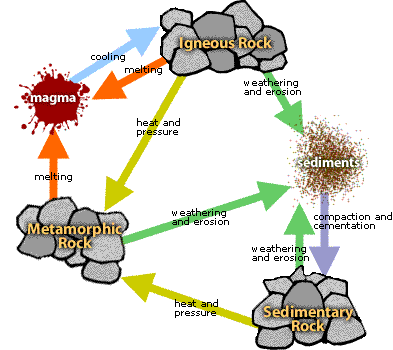


This rock was another type of rock that was heated and compressed over time. What type of rock is this?

This rock was formed by smaller pieces of rock that settled at the bottom of a lake millions of years ago. What type of rock is this?

Rocks that form from cooling magma inside Earth?
Igneous intrusive
Igneous extrusive
Metamorphic foliated
Metamorphic nonfoliated
In which type of rock might you see a fossil?
Marble
Igneous rock
Metamorphic rock
Sedimentary rock
Thinking about sedimentary rock, the oldest layers are found
on the top most layer
in the middle of other layers
all layers are the same age
towards the bottom

Which mineral property is measured using the Mohs scale?
Colour
Lustre
Streak
Cleavage & Fracture
Mineral hardness

Carefully examine the hardness scale picture. Which mineral can be scratched by a copper penny but not a fingernail?
Gypsum
Talc
Fluorite
Quartz
Calcite
Coal is made of
Plants
Sediments
Crystals
Dirt
Seashells

Which property is least reliable when identifying a mineral?
Color
Luster
Streak
Hardness

What is the softest mineral on the Moh’s scale?
Calcite
Quartz
Talc
Diamond

What is the hardest mineral on the Moh’s scale?
Calcite
Quartz
Talc
Diamond
When broken down, rocks and minerals provide soil nutrients for plants and trees to grow. (True / False )
True
False

The diagram shows different layers of sedimentary rock. Each layer is labeled with a letter.
The left part of Layer B is younger than the right part.
The left part of Layer F is the same age as Layer M.
Layer R is older than Layer M
Layer I is older than Layer B

Trilobites are extinct animals that lived in the sea and oceans. Fossils of these animals can be found in dry areas such as Alberta. What does this indicate?
Trilobites now live underground.
Trilobites are the ancestors of jellyfish.
Alberta was once covered by an ancient inland sea where Trilobites lived.
The environment changed, and Trilobites evolved to walk on land and become amphibians.
Scientists are able to conclude that a forested ecosystem existed in Antarctica millions of years ago by studying:
the current climate
the fossil record under the ice
glacial movement
seafloor spreading
The remnant, or trace, of an ancient living organism that has been preserved in rock or sediment
Era
Period
Fossil
Correlation
The (a) consisted of the first life forms, including simple (b) .
Which is NOT a cause of a mass extinction event?
meteorite collision
severe hurricane
global climate change
volcanic activity

What era did the formation of the earth occur?
Paleozoic
Precambrian
Cenozoic
Cambrian

How old do Paleontologists believe the Earth is?
2019 years old
3.6 billion years old
4.6 billion years old
4.6 million years old

What are the four eras in order from OLDEST to NEWEST?
Pre-Cambrian, Paleozoic, Mesozoic, Cenozoic
Pre-Cambrian, Mesozoic, Paleozoic, Cenozoic
Cenozoic, Mesozoic, Paleozoic, Pre-Cambrian
Mesozoic, Pre-Cambrian, Cenozoic, Paleozoic

The dinosaurs and reptiles were dominant in which Era?
Precambrian
Mesozoic
Paleozoic
Cenozoic


Deposition is
the breaking down of rocks into smaller pieces
the process of moving rock
the temperature outside
dropping off broken pieces of rock

What type of fold is this?
syncline
anticline
monocline

90% of Earth’s history occurred during which era?
Precambrian
Paleozoic
Mesozoic
Cenozoic

On a recent trip to the mountains, Sally knew she had found a special rock. Based on her grade 7 rocks and mineral Knowledge she was able to describe the origin of the rock in detail. a) IDENTIFY the SPECIFIC rock family (2 words) this rock belongs to. b) WHERE did this rock likely form (be specific) and c) HOW did Sally know this just by looking at it?

Knowing Earth's history, a) Do you believe another mass extinction event will happen in the future? If so, what do you think will cause it?
b) Assuming humans survive, should science attempt to "bring back" extinct species to help diversify ecosystems? Why or why not?

During class, we grew some amazing Borax crystals. a) Growing large crystals is similar to the crystals found in what SPECIFIC rock family? b) Do large crystals form best in slow or quickly cooling conditions?

