wayground logo

Free Printable Worksheets

Font size

S
M
L
XL
Worksheets

Dichotomous keys

Total questions: 67

Worksheet time: 1hrs 14mins
Name
Class
Date
1.
What is the purpose of a dichotomous key?
a)
to find a common ancestor
b)
to show the evolution of organisms
c)
to show relationships between organisms
d)
to identify organisms
2.
What step do we always start with when using dichotomous keys?
a)
1
b)
2
c)
3
d)
4
3.
When using a dichotomous key to identify organisms, what do we look at?
a)
physical features
b)
weather patterns
c)
environment
d)
diet
4.
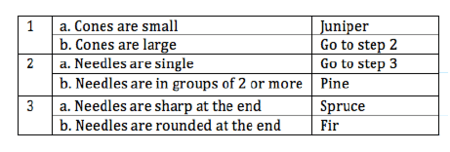
A dichotomous key for trees is provided. Hikers found a tree that has large brown cones and single sharp needles. What species of tree have the hikers found?
a)
Juniper
b)
Pine
c)
Spruce
d)
Fir
5.
A dichotomous key for insects is given. To what order does an insect with two pairs of scaly wings belong?
a)
Coleoptera
b)
Heteroptera
c)
Diptera
d)
Lepidoptera
6.

How many options should every branch in a dichotomous key have?

a)

1

b)

2

c)

3

d)

4

7.

How many options should every branch in a dichotomous key have?

a)

1

b)

2

c)

3

d)

4

8.

How many options should every branch in a dichotomous key have?

a)

1

b)

2

c)

3

d)

4

9.
A dichotomous key for insects is given. To what order does an insect with two pairs of scaly wings belong?
a)
Coleoptera
b)
Heteroptera
c)
Diptera
d)
Lepidoptera
10.
Term given to describe the 2 name naming system is:
a)
dichotmous key
b)
binomial nomenclature
c)
2 scientific names
d)
binomial key
11.
The first part of a scientific name is an organism's _______________ and the second part is its ________________.
a)
species, genus
b)
phylum, order
c)
class, spices
d)
genus, species
12.
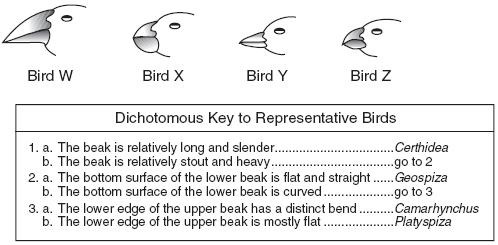
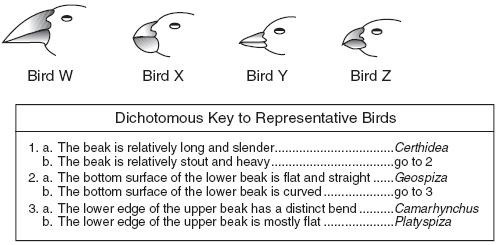
What is the name of bird Z?
a)
Certhidea
b)
Geospiza
c)
Camarhynchus
d)
Platyspiza
13.
A student discovers an arachnid with a segmented abdomen, long legs, and a tail with no stinger. The student uses the dichotomous key below to identify it. Which arachnid has the student found?
a)
Whip Scorpion
b)
Wind Scorpion
c)
Daddy long legs
d)
Scorpion
14.

The largest grouping of organisms is ____________________ and the smallest is _________________________________.

a)

Domain, species

b)

Domain, kingdom

c)

Species, domain

d)

Kingdom, species

15.
What should you do when typing a scientific name?
a)
Capitalize the first word
b)
Capitalize the first word and underline the whole thing
c)
Capitalize the first word and italicize the whole thing
d)
Nothing
16.

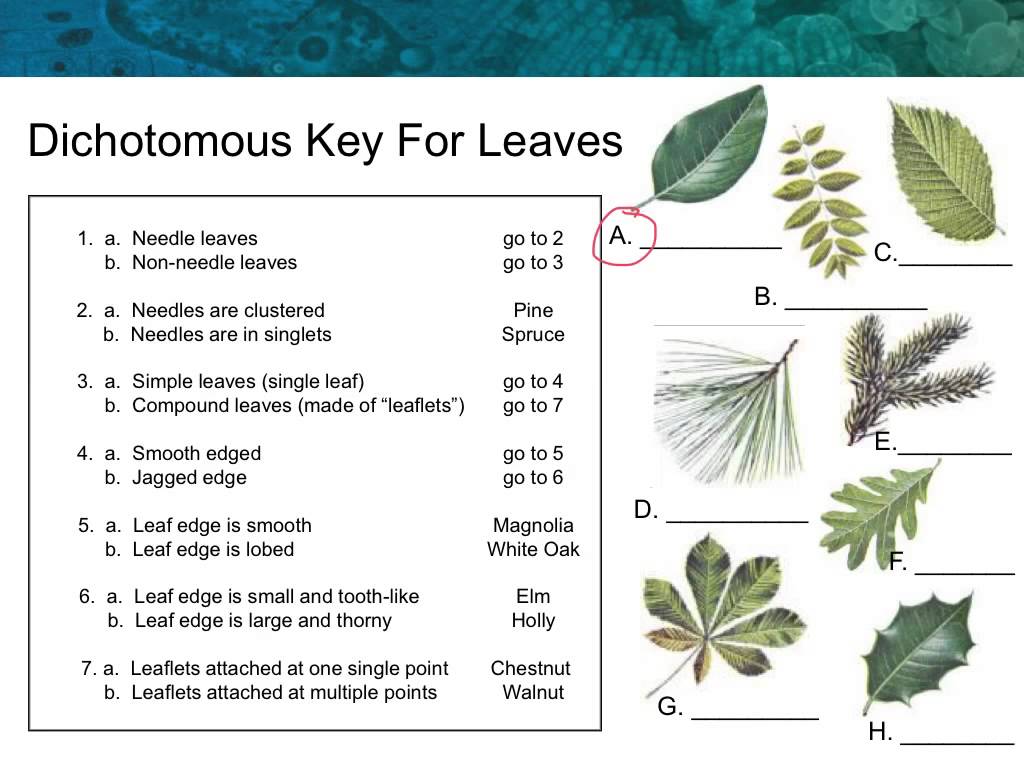
Identify leaf F

a)

Cydonia

b)

Magnolia

c)

Aesculus

d)

Fraxinus

e)

Ilex

17.

Which of the following features are used to classify a centipede (select all that apply)?

a)

Has wings

b)

Has no wings

c)

Has more than 8 legs

d)

Has a shell

18.
Which of the following characteristics will most likely be helpful in identifying a butterfly using a dichotomous key?
a)
Migrates north every spring
b)
hangs on branches
c)
flutters wings fast on hot days
d)
Wings have long extensions
19.
An illustration and a dichotomous key are given. What is the correct classification for this organism?
a)
Class Insecta
b)
Order Amblygygi
c)
Order Araneae
d)
Order Scorpiones
20.
A labeled diagram of a fiddler crab is provided. Which of the following is an accurate observation of the structures of a fiddler crab? Fiddler crabs have -
a)
five pairs of walking legs on each side.
b)
an enlarged propodus on both front legs.
c)
a pair of eyes on stalks at the top of the body.
d)
two pairs or chelipeds for a total of four.
21.
A table of arachnid and insect characteristics is shown. Which characteristic could be used to distinguish between
arachnids and insects?
a)
Jointed legs
b)
Body segments
c)
Presence of eyes
d)
Presence of antennae
22.
What step do we always start with when using dichotomous keys?
a)
1
b)
2
c)
3
d)
4
23.
What step do we always start with when using dichotomous keys?
a)
1
b)
2
c)
3
d)
4
24.
What is a dichotomous key used for in science?
a)
To organize biomes
b)
Classify organisms
c)
Identify bacteria only
d)
None of these
25.
What is a dichotomous key used for in science?
a)
To organize biomes
b)
Classify organisms
c)
Identify bacteria only
d)
None of these
26.
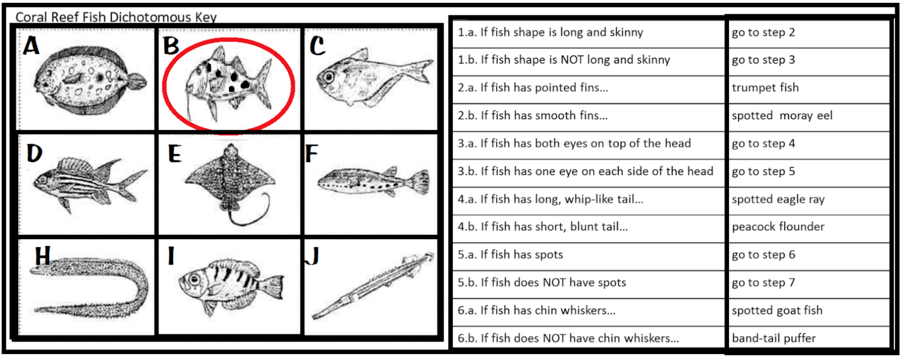
Using this dichotomous key, identify the name of the circled Fish, J.
a)
peacock flounder
b)
band-tail puffer
c)
trumpet fish
d)
spotted goat fish
27.
A student discovers an arachnid with a segmented abdomen, long legs, and a tail with no stinger. The student uses the dichotomous key below to identify it. Which arachnid has the student found?
a)
Whip Scorpion
b)
Wind Scorpion
c)
Daddy long legs
d)
Scorpion
28.
A student discovers an arachnid with a segmented abdomen, long legs, and a tail with no stinger. The student uses the dichotomous key below to identify it. Which arachnid has the student found?
a)
Whip Scorpion
b)
Wind Scorpion
c)
Daddy long legs
d)
Scorpion
29.
Tool used by a taxonomist to identify an unknown organism is a:
a)
dichotomous key
b)
binomial nmenclature
c)
scientific name
d)
binomial key
30.
Using this dichotomous key, identity the name of the circled fish.
a)
band-tail puffer
b)
spotted goat fish
c)
peacock flounder
d)
trumpet fish
31.
Using this dichotomous key, identity the name of the circled fish.
a)
band-tail puffer
b)
spotted goat fish
c)
peacock flounder
d)
trumpet fish
32.

Leaf S (3RD LEAF)

a)

Eastern white pine

b)

balsam poplar

c)

sweet gum

d)

ginko

33.

The largest grouping of organisms is ____________________ and the smallest is _________________________________.

a)

Domain, species

b)

Domain, kingdom

c)

Species, domain

d)

Kingdom, species

34.

The largest grouping of organisms is ____________________ and the smallest is _________________________________.

a)

Domain, species

b)

Domain, kingdom

c)

Species, domain

d)

Kingdom, species

35.

What is a dichotomous key?

a)

A tool for classifying organisms based on their physical traits

b)

A map for finding animal habitats

c)

A key that opens a scientist's laboratory

36.

Identify leaf F

a)

Cydonia

b)

Magnolia

c)

Aesculus

d)

Fraxinus

e)

Ilex

37.

Identify leaf F

a)

Cydonia

b)

Magnolia

c)

Aesculus

d)

Fraxinus

e)

Ilex

38.

A student discovers an arachnid with a segmented abdomen, long legs, and a tail with no stinger.

The student uses the dichotomous key below to identify it.

1. a) Abdomen segmented.............go to 2

b) Abdomen not segmented ......go to 4

2. a) Abdomen with tail....................go to 3

b) Abdomen without tail...............go to 5

3. a) Tail with stinger..........................Scorpion

b) Tail without stinger.....................Whip scorpion

4. a) Legs longer than body.............Daddy Long Legs

b) Legs not longer than body……….Wind scorpion

5. a) Covered with spines .......................Mite

b) Few spines.....................................Tick

a)

Whip Scorpion

b)

Daddy Long Legs

c)

Mite

d)

Tick

39.

Which leaf is shown in the drawing?

a)

Magnolia

b)

Redbud

c)

Sweetgum

d)

None of the above

40.

According to key above, which animal has wings covered by an exoskeleton and a round body?

a)

Ladybug

b)

Grasshopper

c)

Dragonfly

d)

Housefly

41.
A botanist discovers a new plant in the jungle. Which of the
following observations of the plant’s characteristics would be useful in determining its identity with a dichotomous key?
a)
It was discovered in the summertime
b)
It is wet from a recent rain storm.
c)
Its leaves curl up on the edges.
d)
It is eaten by native jungle ants.
42.
A botanist discovers a new plant in the jungle. Which of the
following observations of the plant’s characteristics would be useful in determining its identity with a dichotomous key?
a)
It was discovered in the summertime
b)
It is wet from a recent rain storm.
c)
Its leaves curl up on the edges.
d)
It is eaten by native jungle ants.
43.
When using a dichotomous key to identify organisms, what do we look at?
a)
physical features
b)
weather patterns
c)
environment
d)
diet
44.
When using a dichotomous key to identify organisms, what do we look at?
a)
physical features
b)
weather patterns
c)
environment
d)
diet
45.
What is the name of bird W?
a)
Certhidea
b)
Geospiza
c)
Camarhynchus
d)
Platyspiza
46.
What is the name of bird Z?
a)
Certhidea
b)
Geospiza
c)
Camarhynchus
d)
Platyspiza
47.
What is the scientific name of housefly?
a)
Musca domestica
b)
Insect domestica
c)
Animalia domestica
d)
Diptera domestica
48.
What is the scientific name of housefly?
a)
Musca domestica
b)
Insect domestica
c)
Animalia domestica
d)
Diptera domestica
49.

A student discovers an arachnid without a segmented abdomen, and legs longer than its body. The student uses the dichotomous key below to identify it. Which arachnid has the student found?

a)

Whip Scorpion

b)

Wind Scorpion

c)

Daddy long legs

d)

Scorpion

50.

A student discovers an arachnid without a segmented abdomen, and legs longer than its body. The student uses the dichotomous key below to identify it. Which arachnid has the student found?

a)

Whip Scorpion

b)

Wind Scorpion

c)

Daddy long legs

d)

Scorpion

51.
Tigers, Jellyfish, Gorillas and Sponges are all part of kingdom _______.
a)
Animalia
b)
Plantae
c)
Fungi
d)
Bacteria
52.
Tigers, Jellyfish, Gorillas and Sponges are all part of kingdom _______.
a)
Animalia
b)
Plantae
c)
Fungi
d)
Bacteria
53.

Which of these has a backbone?

a)

jellyfish

b)

squid

c)

worm

d)

snake

54.

Which of these has a backbone?

a)

jellyfish

b)

squid

c)

worm

d)

snake

55.

Biologist group living things based on ____.

a)

Habitat

b)

Size

c)

Colors

d)

Shared Characteristics

56.

Identify the plant shown

a)

A

b)

B

c)

C

d)

D

57.

Identify the plant shown

a)

A

b)

B

c)

C

d)

D

58.

Leaf S

a)

Eastern white pine

b)

balsam poplar

c)

sweet gum

d)

ginko

59.

What type of characteristics are used to make a dichotomous key?

a)

Characteristics that make an organism different from any other organism. (type of beaks, claws, root systems)

b)

Characteristics like age of an organism

c)

Where the organism lives

d)

How many organisms live in the environment

60.

Which characteristics are used to identify the American Robin?

a)

Head color, Beak shape, and Beak Color

b)

Head color and Beak Color

c)

Beak Shape and Beak Color

d)

Beak Color

61.
The scientific name for an organism is made from the:
a)
class and family name
b)
genus and species name
c)
domain and kingdom name
d)
kingdom and phylum name
62.

A chart called Dichotomous what?

a)

Table

b)

Lock

c)

Key

d)

Barrel

63.

What is a scientific name?

a)

A Latin name that is made of two parts

b)

A name in three parts

c)

A name in one part

d)

An English name

64.

Dichotomous key is separated by what?

a)

Direction

b)

Lines

c)

Steps

d)

Arrows

65.

Who used Dichotomous key?

a)

Ecologist

b)

Chemist

c)

Physicist

d)

General Practitioner

66.

The first part of the scientific name is?

a)

Genus

b)

Species name

c)

Family name

d)

Class name

67.

The second part of the scientific name is what?

a)

Class name

b)

Genus

c)

Species name

d)

Family name