
 Worksheets
Heredity
Total questions: 65
Worksheet time: 1hrs 2mins


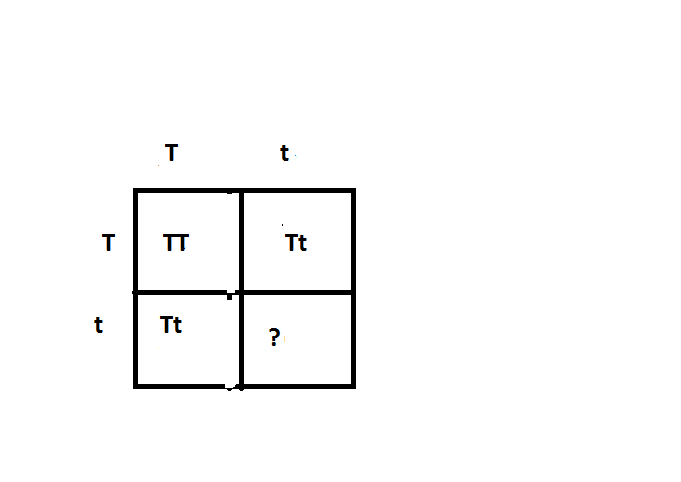
In the punnett square below, what belongs in the missing square
The brown eye trait is dominant over blue eyes. Which of the following genotypes best represents the phenotype for blue eyes?
BB
Bb
bb
bB
The ability to roll your tongue is a dominant trait. If both parents are heterozygous for tongue rolling and they have 8 children together, is it possible that they could have children who are unable to roll their tongues?
Yes
No

What is the genotype for #15?
rr
Rr
RR
rR

What is the genotype for #16?
RR
Rr
rr
rR

A male heterozygous for widow’s peak marries a female without a widow’s peak.
Widow’s peak is a dominant trait (H) not having a widow’s peak is recessive (h).
Use the Punnett Square on Widow's Peal to answer the following question:
What percent of the children will have widow's peak?
25%
50%
75%
100%
Has 2 of the same alleles is __________________.
Genotype
Phenotype
Homozygous
Heterozygous
Has 2 different alleles is _____________________.
Genotype
Phenotype
Homozygous
Heterozygous

An organism that is the offspring of many generations that show the same form of a trait.
Heterozygous
Dominant allele
Purebred
Genotype

Chromosomes are
Found in the mitochondria
Made of 20 pairs
Long strands of DNA that contain many genes
Bundles of DNA that contain only one gene each
In science, mutations are
The reason the X-Men exist
Genetically engineered creatures that you fight in the Hunger Games
A change in the DNA of an organism that produces new traits
Always helpful for survival
True or false: Mutations only harm chances of survival:
True
False
Which of the following is an example of incomplete dominance?
A red cow and a white bull have a red and white spotted calf.
Human ABO blood types
A red flowering plant and a white flowering plant have pink flowered offspring.
A tall plant and a short plant have tall offspring.
In peas, yellow pod color is dominant to green pod color. Two heterozygous parents are crossed. What are the chances that the offspring will have green pods?
25%
50%
75%
100%
In peas, yellow pod color is dominant to green pod color. Two homozygous dominant parents are crossed. What are the chances that the offspring will have green pods?
0%
25%
50%
75%
In peas, yellow pod color is dominant to green pod color. A heterozygous parent is crossed with a homozygous recessive plant. What are the chances that the offspring will have green pods?
25%
50%
75%
100%
ATG TGA CAG
If a DNA sequence it GAATGCCT, what are the matching base pairs?
ACGTACCTG
AEIOU and sometimes Y
CTTACGGA
GCCTATGC
If a DNA sequence is CATCAT, what are the matching base pairs?
ACGTAC
MEOW
GTAGTA
GCCTAT
When one allele is not dominant over another, resulting in a blended phenotype for heterozygous offspring is considered....
Incomplete Dominance
Codominance
When one allele is not dominant over the other, resulting in both traits expressed in a heterozygous individual.....
Incomplete Dominance
Codominance

What type of inheritance pattern is shown here?
Codominance
Incomplete dominance

This is an example of ---
Incomplete dominance
Codominance

What does this Punnett square and the probabilities of the ofspring represent?
incomplete dominance
codominance
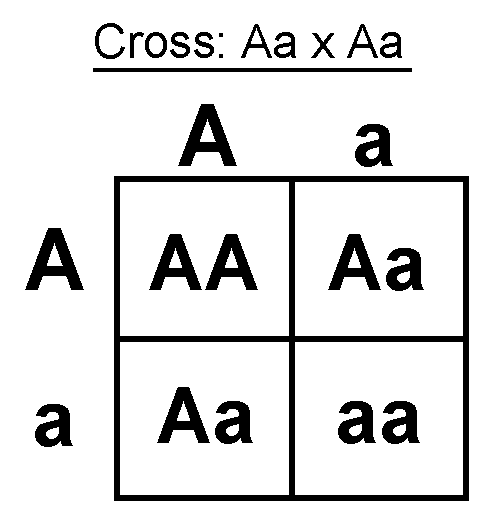

G = green, g = yellow
The genotype for a yellow plant is...
GG
Gg
gg
all of the choices result in yellow
In plants, tall (T) is dominant to short (t). Perform the following cross: Tt x Tt. What is the probability of producing a short plant?
0%
25%
50%
75%

Each one of the boxes on the Punnett square represents what probability of an offspring's genotype?
25%
1%
10%
0%

Brown eyes are dominant over blue eyes. What is the probability that the offspring will have brown eyes in this cross?
25%
50%
75%
100%
Which of the following is a Homozygous Dominant Genotype?
Yy
XX
zz
Why do scientist use Punnett Squares?
A tool scientist use to to see alleles
A tool scientist use to see which alleles are dominant
A tool scientist use to determine possible genotypes for offspring
Which of the following is a homozygous recessive genotype?
HH
dd
Aa
Which of the following is a heterozygous genotype?
Gg
UU
pp
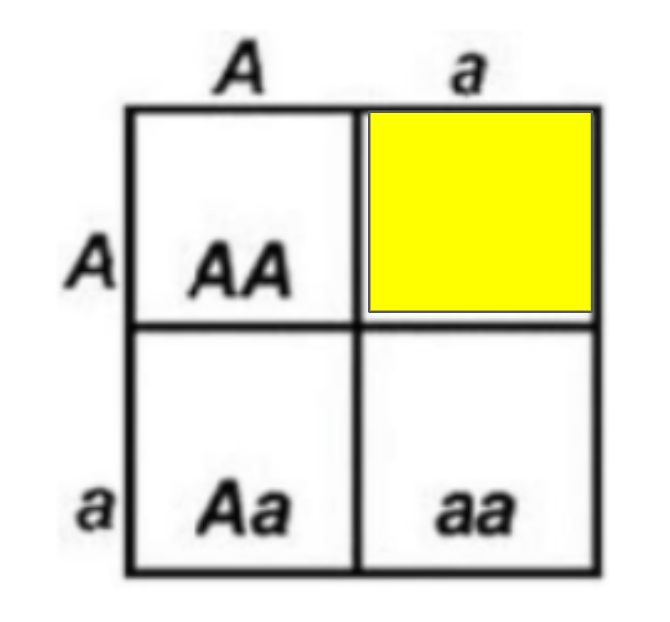
Fill in the Yellow Box
AA
Aa
aa
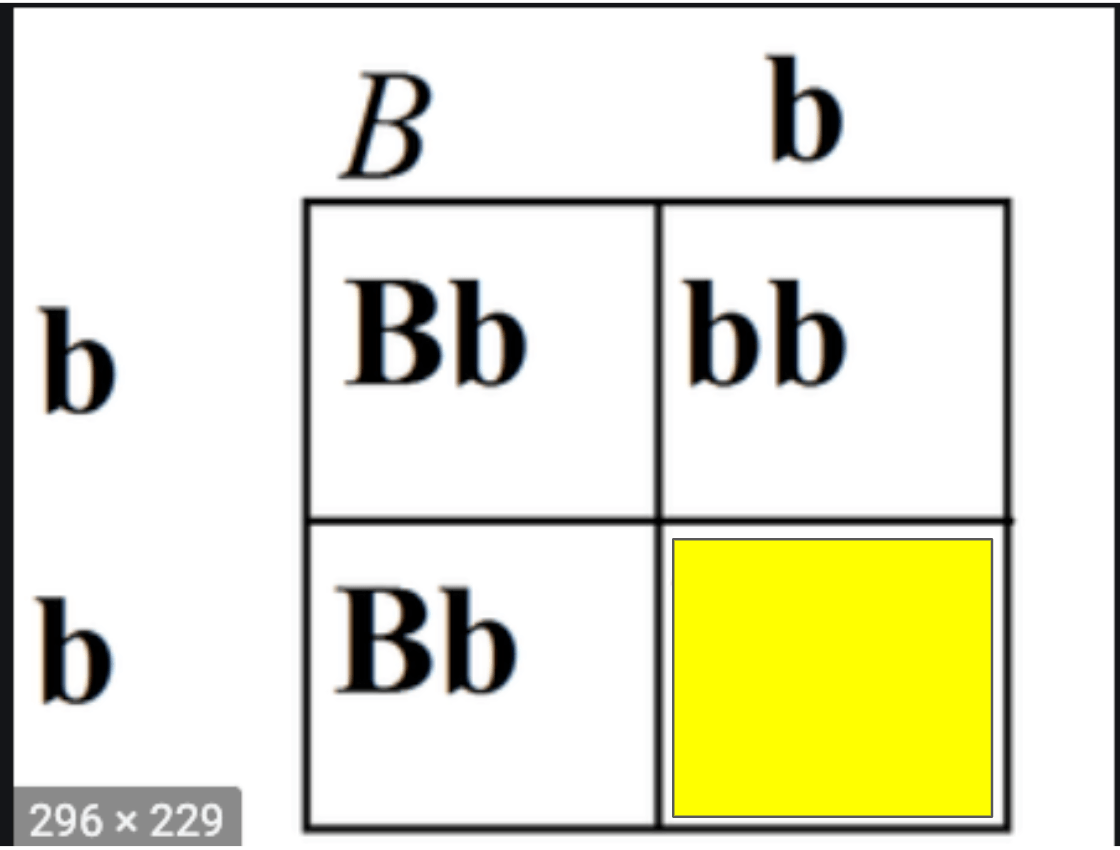
Fill in the Yellow Box
Bb
BB
bb
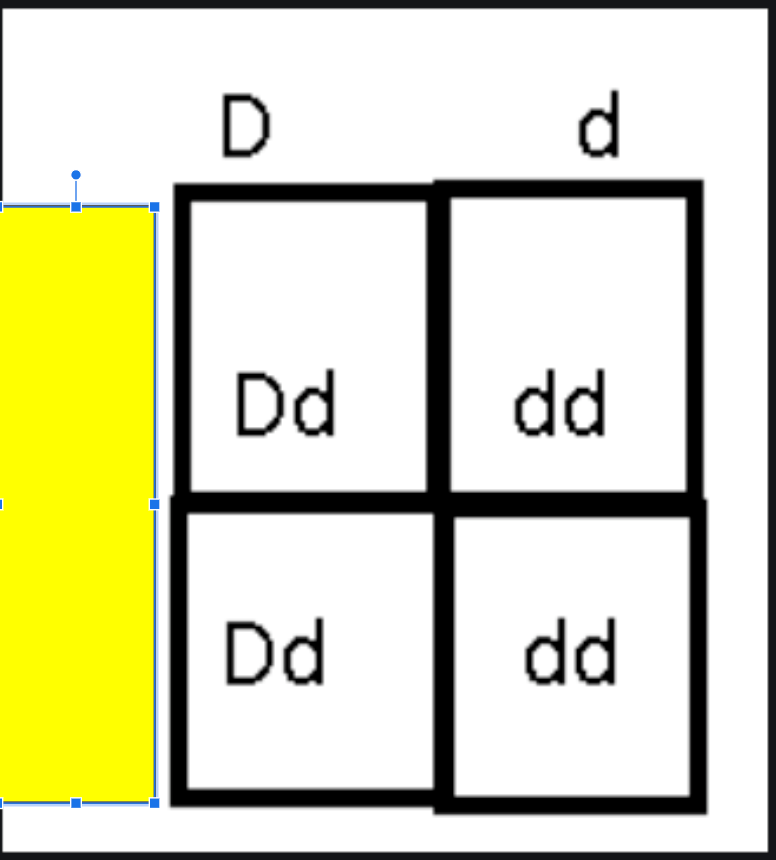
What is the mother's genotype?
DD
Dd
dd
What are the three possible consequences to changes in DNA? [check all that applies]
Improved trait
removal of trait
No change (neutral)
Harmful trait
Selective breeding is...
a process to create an organism with desired traits from parents with those desired traits
natural method of producing offspring with desired traits
creating a new species
making organisms reproduce during times of stress
Which of the following is an example of a beneficial mutation?
When an organism's lifespan becomes shorter.
When an organism becomes unable to reproduce.
When an organism's body becomes deformed.
When an organism develops immunity to a disease.

