wayground logo

Free Printable Worksheets

NEW

Font size

S
M
L
XL
Worksheets

Unit 4 Review

Total questions: 67

Worksheet time: 2hrs 38mins

Name
Class
Date
1.
A mass attached to a spring vibrates back and forth. At the equilibrium position, the
a)
acceleration reaches a maximum.
b)
velocity reaches a maximum.
c)
net force reaches a maximum.
d)
velocity reaches zero.
2.
The angle between the string of a pendulum at its equilibrium position and at its maximum displacement is the pendulum’s
a)
period.
b)
frequency.
c)
vibration.
d)
amplitude.
3.
For a system in simple harmonic motion, which of the following is the time required to complete a cycle of motion?
a)
amplitude
b)
period
c)
frequency
d)
revolution
4.
For a system in simple harmonic motion, which of the following is the number of cycles or vibrations per unit of time?
a)
amplitude
b)
period
c)
frequency
d)
revolution
5.
How are frequency and period related in simple harmonic motion?
a)
They are directly related.
b)
They are inversely related.
c)
Their sum is constant.
d)
Both measure the number of cycles per unit of time.
6.
A wave travels through a medium. As the wave passes, the particles of the medium vibrate in a direction perpendicular to the direction of the wave’s motion. The wave is
a)
longitudinal.
b)
a pulse.
c)
electromagnetic.
d)
transverse.
7.
Each compression in the waveform of the longitudinal wave shown above corresponds to what feature of the transverse wave below it?
a)
wavelength
b)
crests
c)
troughs
d)
amplitude
8.
Each stretched region in the waveform of the longitudinal wave shown above corresponds to what feature of the transverse wave below it?
a)
wavelength
b)
crests
c)
troughs
d)
amplitude
9.
Which of the following most affects the wavelength of a mechanical wave moving through a medium? Assume that the frequency of the wave remains constant.
a)
nature of the medium
b)
amplitude
c)
height of a crest
d)
energy carried by the wave
10.
Two waves traveling in opposite directions on a rope meet and undergo complete destructive interference. Which of the following best describes the waves a moment after the waves meet and coincide?
a)
The waves no longer exist.
b)
The waves continue unchanged.
c)
The waves reflect and travel backward.
d)
A single wave continues along the rope.
11.
When two mechanical waves coincide, the amplitude of the resultant wave is always ____ the amplitudes of each wave alone.
a)
greater than
b)
less than
c)
the sum of
d)
the same as
12.
Two mechanical waves that have positive displacements from the equilibrium position meet and coincide. What kind of interference occurs?
a)
constructive
b)
destructive
c)
complete destructive
d)
none
13.
Which of the following types of interference will occur when the pulses in the figure above meet?
a)
no interference
b)
constructive interference
c)
destructive interference
d)
total interference
14.
Consider two identical wave pulses on a rope having a fixed end. Suppose the first pulse reaches the end of the rope, is reflected back, and then meets the second pulse. When the two pulses overlap exactly, what will be the amplitude of the resultant pulse?
a)
zero
b)
same as the original pulses
c)
double the amplitude of the original pulses
d)
half the amplitude of the original pulses
15.
Standing waves are produced by periodic waves of
a)
any amplitude and wavelength traveling in the same direction.
b)
the same amplitude and wavelength traveling in the same direction.
c)
any amplitude and wavelength traveling in opposite directions.
d)
the same frequency, amplitude, and wavelength traveling in opposite directions.
16.
What is the fewest number of nodes a standing wave can have?
a)
1
b)
2
c)
3
d)
4
17.
How many nodes and antinodes are shown in the standing wave above?
a)
four nodes and four antinodes
b)
four nodes and three antinodes
c)
four nodes and five antinodes
d)
five nodes and four antinodes
18.
A mass-spring system can oscillate with simple harmonic motion because a compressed or stretched spring has which kind of energy?
a)
kinetic
b)
mechanical
c)
gravitational potential
d)
elastic potential
19.
The apparent change in frequency due to the motion of the source of the receiver is known as
a)
Frequency 
b)
Doppler Effect
c)
Shock wave
20.
How many nodes are in the picture?
a)
5
b)
4
c)
8
d)
3
21.
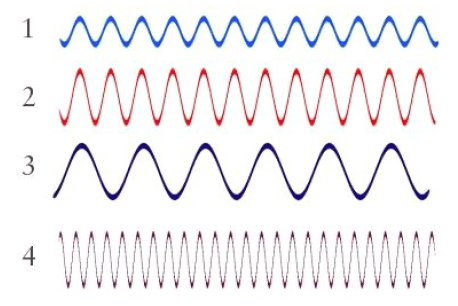
Which wave in the diagram has the greatest wavelength?
a)
1
b)
2
c)
3
d)
4
22.
Which wave in the diagram has the greatest frequency?
a)
1
b)
2
c)
3
d)
4
23.
Which vocabulary term is used to identify the distance between points C & G?
a)
Amplitude
b)
Crest
c)
Frequency
d)
Wavelength
24.
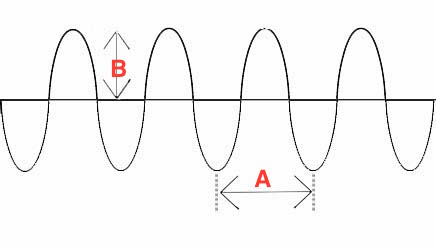
What property of the wave is represented by the letter "B"?
a)
amplitude
b)
crest
c)
trough
d)
wavelength
25.
High pitches are produced by objects vibrating _______________.
a)
quickly
b)
slowly
26.
Measure of how high or low a sound is
a)
amplitude
b)
compression
c)
speed of sound
d)
pitch
27.

True or False: Sound waves are produced when something vibrates.

a)

True

b)

False

28.

Sound waves are _______ waves.

a)

Transverse

b)

Seismic

c)

Longitudinal

d)

Slow

29.

Sound waves travel the fastest through _______.

a)

Gases

b)

Solids

c)

Liquids

d)

Plasma

30.

True or False: Sound waves can travel through space.

a)

True

b)

False

31.

The part of the ear that is spiral shaped and will send nerve impulses to the auditory nerve is the ________.

a)

Ear drum

b)

Cochlea

c)

Outer Ear

32.

Sound intensity is measured in _____.

a)

Hertz

b)

Nanometers

c)

Decibels

33.

True or False: According to the Doppler Effect, if an sound source is moving TOWARDS you, the pitch should be getting higher.

a)

True

b)

False

34.

The high pressure waves reflect as high pressure at the end of a....

a)

Closed pipe resonator

b)

Open pipe resonator

c)

Closed pipe harmonic

d)

Open pipe harmonic

35.

The length of the tube is 2 meters. How long is the wavelength of the wave?

a)

1 meter

b)

2 meters

c)

1/2 meter

d)

1/4 meter

36.
The full spectrum of light energy is called the__________
a)
broad spectrum
b)
electromagnetic spectrum
c)
helium spectrum 
d)
natural light spectrum
37.
What color has the shortest wavelength, or the highest frequency?
a)
yellow
b)
blue
c)
red
d)
violet
38.
Primary colors of light can combine to make
a)
black light
b)
white light
c)
primary pigments
d)
ultraviolet light
39.

Illuminance is measured in__________

a)

lumens

b)

candela

c)

lumen per square metre

d)

newton

40.

luminous intensity increases with _________ in distance between source of light and surface on which it falls.

a)

increase

b)

decrease

41.

complementary color for yellow is__________

a)

blue

b)

red

c)

green

d)

cyan

42.

When light is blueshifted, the observed frequency _________

a)

is lower

b)

is higher

c)

remains the same

d)

none of the above

43.
Allows little to no light through.
a)
Transparent
b)
Translucent
c)
Opal
d)
Opaque
44.
Blurs light as it passes through
a)
Transparent
b)
Translucent
c)
Opaque
d)
Refraction
45.
Allows most light through
a)
eflection
b)
Refraction
c)
Translucent
d)
Transparent
46.
Light bending as it passes from one medium (object) to another is...
a)
Refraction
b)
Reflection
47.
What causes light to appear refracted?
a)
temperature
b)
speed
c)
weather
d)
climate
48.

Which diagram represents diffuse reflection?

a)

A

b)

B

49.
What is the line MN called in the given diagram
                               
a)
incident ray
b)
reflected ray
c)
reflecting surface
d)
normal
50.

In the diagram, which letter represents the angle of incidence?

a)

A

b)

B

c)

C

d)

D

51.
........... – the angle between the normal and the reflected ray.
a)
Angle of incidence
b)
Angle of reflection
c)
Angle of coincidence
d)
Angle of direction
52.
The fact the two angles are the same is an example of....
a)
Refraction
b)
Angle of Incidence
c)
Law of reflection
d)
Magnification
53.
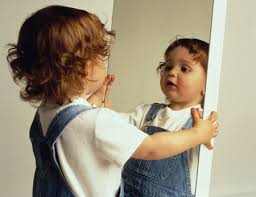
The image formed in a flat mirror is
a)
larger than the object and farther away.
b)
reduced and closer to the mirror.
c)
a real image of the object.
d)
equal to the height and distance of the object.
54.

A convex lens produces a _______ image whereas a concave lens produces a _______ image

a)

Virtual, real

b)

Virtual; diffused

c)

Real; refracted

d)

Real; virtual

55.

Total internal reflection is

a)

When lateral inversion occurs

b)

When the angle of reflection increases up to a critical point where all the light is reflected

c)

When the angle of incidence increases up to a critical point where all the light is reflected

d)

Used in surgery where a light is connected to an optical fibre

56.

The above image is an example of a ____________. They happen because cool and hot air have a different ___________________________.

a)

Mirage; angle of incidence

b)

Optical fibre; refractive index

c)

Lateral inversion; angle of reflection

d)

Mirage; refractive index

57.
The point where the rays meet is known as....
a)
Fire
b)
the focal point
c)
refraction
d)
Plane of the lens
58.
Which describes a convex lens?
a)
triangular in shape
b)
more transparent in the middle
c)
thicker on the edges than in the middle
d)
thicker in the middle than on the edges
59.
Is a concave lens thicker or thinner in the middle? 
a)
Thicker 
b)
Thinner 
60.

How does a concave lens differ from a convex lens?

a)

A convex lens is another way to describe a plane mirror; a concave lens is curved

b)

A concave lens is curved inward on both sides; a convex lens is on only one side

c)

A convex lens has a thick center and thin edges, a concave lens has a thin center and thicker edges

d)

A convex lens has a thin center and thick edges. a concave lens has a thick center and thinner edges
61.
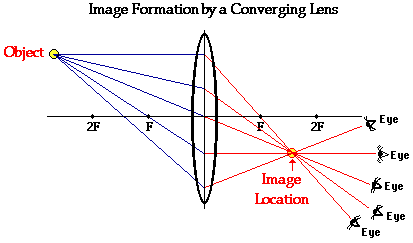
This image is.....
a)
inverted and smaller
b)
inverted and larger
c)
not inverted and smaller
d)
not inverted and larger
62.
This image is...
a)
Inverted and smaller
b)
inverted and bigger
c)
not inverted and smaller
d)
not inverted and bigger
63.
An image that you can see , but does not really exist is called which of the following?
a)
Real Image
b)
Fake Image
c)
Virtual Image
d)
Digital Image
64.
Convex Mirrors produce...
a)
only virtual images
b)
virtual or real images
c)
only real images
d)
inverted images
65.
What is Nearsightedness? 
a)
condition that has difficulty seeing things that are close 
b)
condition that has difficulty seeing things that are far away
66.

Which type of lens is thin in the middle, is used to correct nearsightedness, and spreads out the light which pushes the image back to the retina?

a)

convex lens

b)

concave lens

67.

A 25.0 m object is placed 30.0 m from a convex lens, which has a focal length of 5.0 m. What is the distance of the image?

a)

6 m

b)

7 m

c)

8 m

d)

9 m