
 Worksheets
Honors Unit 5 Work and Energy Review
Total questions: 71
Worksheet time: 1hrs 2mins
David picks up a 20kg box, carries it 10m across a room and puts it down.
The Net work performed on the box is:
Select one:
Impossible to know without knowing the height David lifted the box
200j
2000j
0j
A boy is running with his sled at the top of a hill, what type of energy does he have?
Select one:
Ug
Us
KE
Ug and KE
Ug KE and Us
A 5kg ball with 100j of Ug is dropped. What is the speed of the ball as it reaches the ground?
Select one:
20m/s
6.3m/s
40m/s
100m/s
A 10kg ball is dropped from a window 25m above the ground into a 10m deep hole. What is the change in KE of the ball during the fall?
2500j
3500j
1500j
350j
-3500j

A
B
C
D
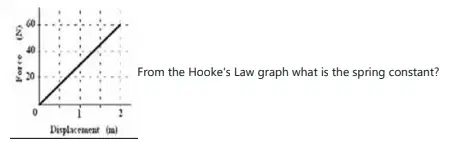
60Nm
60N/m
30N/m
120Nm
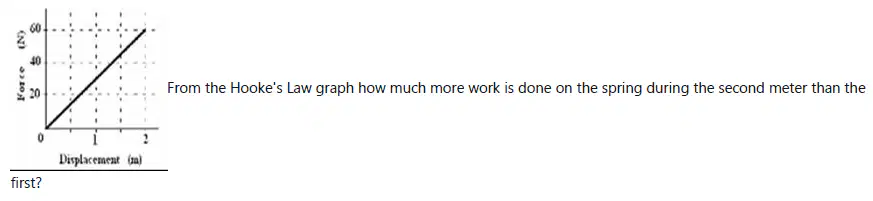
twice as much
three times as much
half as much
The same amount
four times as much
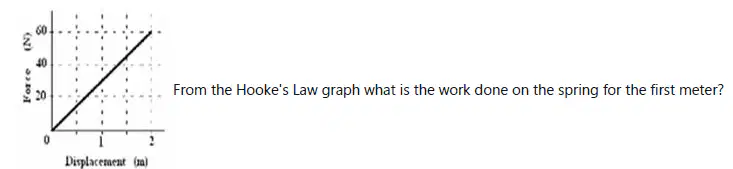
10J
15J
30J
60J
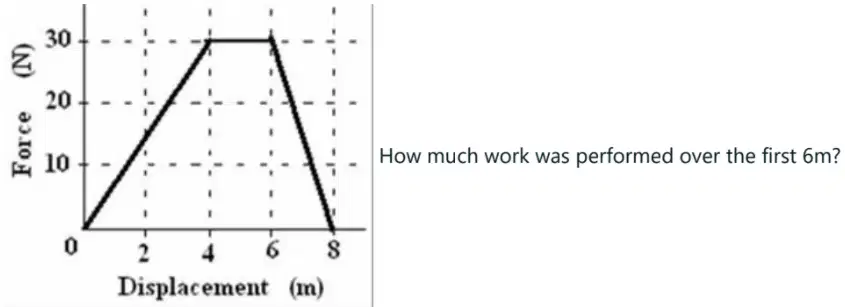
180J
30J
60J
120J

50J
700J
450j
536J

9m
8m
16m
11m
Staying constant
Getting larger
Getting smaller

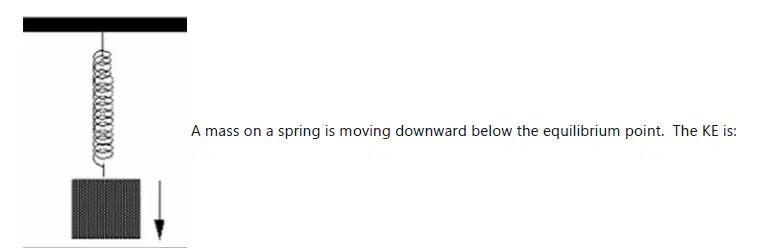
A mass on a spring is moving downward below the equilibrium point. The Us is
staying constant
getting larger
getting smaller
A mass on a spring is moving downward towards the equilibrium point. The Us is
staying constant
getting larger
getting smaller
A mass on a spring is moving downward towards the equilibrium point. The KE is
staying constant
getting larger
getting smaller
Which of the following angles between the force and displacement vectors would cause the quickest change in KE?
90 degrees
20 degrees
180 degrees
-10 degrees
A 2kg ball is dropped from the top of a 50m tall building At what height does the ball have equal amounts of Potential and Kinetic energy?
50m
25m
0m
12.5m
John applies a 50N parallel force to a box for 8m. The force of friction on the box is 20N. What is the Net work performed on the box?
400J
-160J
240J
160J
John applies a 50N parallel force to a box for 8m. The force of friction on the box is 20N. How much work did John perform on the box?
400J
-160J
240J
160J
John applies a 50N parallel force to a box for 8m. The force of friction on the box is 20N. How much work did friction perform on the box?
400J
-160J
240J
160J
A 2kg ball is dropped from the top of a 50m tall building What is its KE when the ball is 30m above the ground?
1000J
600J
300J
400J

When you pull back the lever on a pinball machine and then release it to launch the ball up a ramp, which of the following energy transformations occurred (while the plunger and ball are in contact)? (Select all that apply)
Kinetic --> Gravitational Potential
Elastic Potential --> Gravitational Potential
Kinetic --> Elastic Potential
Chemical Potential --> Kinetic
Elastic Potential --> Kinetic

A force of 80 N is used to pull a 10-kg block at an angle of 60 degrees (shown above) to the right. If the block moves 5 meters to the right, how much work was done on the block.
4000 N*m
200 N*m
2000 N*m
346.4 N*m
400 N*m

At which point is the total energy greatest?
W
X
Y
Z
All the same
If there is friction at which point is the total energy greatest?
W
X
Y
Z
All the same
At which point is the kinetic energy the greatest?
W
X
Y
Z
All the same


A student pushes a table across the floor. What is happening to the motion of the object between 35-40m?
Speeding Up
Slowing Down
Constant Speed
Turns around and slaps the student

What is the amount of work done between 0-4 m?
40 J
30 J
60 J
No clue...

What is the work done for the whole graph?
240 J
120 J
360 J
4 million J

If I wanted to find the velocity of the object whose motion is depicted in this graph, what other variable(s) would I need?
None
Potential Energy
Work
Mass
A student pushes a table across the floor. What is happening to the motion of the object between 15-30m?
Speeding Up
Slowing Down
Constant Speed
Turns around and slaps the student
The work-kinetic energy theorem says that the net work done by all the forces acting on an object is equal to the change in the ………. of the object.
mechanical energy
work
momentum
kinetic energy
A person holds a yo-yo above the ground before letting go. What type of energy is present before the person lets go?
Gravitational Potential Energy
Elastic Potential Energy
Kinetic Energy
Thermal Energy
An object is traveling at a set speed. How will the Kinetic Energy change if that speed is doubled?
It will double
It will quadruple
It will change by a factor of 1/2
It will change by a factor of 1/4
A man carries a box across a room at constant velocity. Is work being done on the box by the man?
Yes
No
Half of the time
Not enough information
A man lifts a box into the air. The work being done by gravity on the box is
Positive
Negative
equal to zero
Not enough information
A man pushes a boulder and the boulder does not move. Which statement correctly describes the scenario
work is being done by a single object
All work done is external to the system
by pushing on the rock, the man causes a transfer of energy
no work is being done on the object
A box is pushed at a constant velocity across a floor. The net work being performed on the box is
Positive
Negative
zero

Describe the mechanical energy of the rollercoaster-Earth system as it travels from a to b. Assume the track is frictionless
The total mechanical energy will remain the same
The external work will cause the mechanical energy to decrease
The external work will cause the mechanical Energy to increase
There is zero Mechanical energy for the coaster system
50.0 J of work is done lifting a 20.0 N book in the air. How high was it lifted?
2.50 m
3.50 m
0.400 m
25.0 m
If you push twice as hard against a stationary brink wall, the amount of work you do
doubles
is cut in half
remains constant but non-zero
remains constant at zero
You throw a ball straight up. Compare the sign of the work done by gravity while the ball goes up with the sign of the work done by gravity while it goes down.
work is + on the way up and + on the way down
work is - on the way up and - on the way down
work - on the way up and + on the way down
work is + on the way up and - on the way down
The area under the curve, on a force vs. position ( F vs. x ) graph, represents
work
kinetic energy
power
potential enery
If the net work on an object is zero, then the object's kinetic energy
decreases
remains the same
increases
is zero
A ball drops some distance and gains 30 J of kinetic energy. Do not ignore air resistance. How much gravitational potential energy did the ball lose?
more than 30 J
exactly 30 J
less than 30 J
cannot be determined from the given information
A horizontal force of 200 N is applied to move a 55-kg cart ( initially at rest ) across a 10 M level surface. What is the final speed of the cart?
73 m/s
36 m/s
8.5 m/s
6.0 m/s
Matthew pulls his little sister Sarah in a sled on an icy surface ( assume no friction and ignore the fact that Matthew would not be able to walk ), with a force of 60.0 N at an angle of 37.00 upward from the horizontal. If he pulls her a distance of 12.0 m, what is the work done by Matthew?
185 J
433 J
575 J
720 J
A spring has a spring constant of 330 N/m. How far is the spring compressed if 15.3 kg are placed on it?
2.2 m
22 m
5.0 m
0.45 m
A spring extends 1.5m when 1.03 kg are hung from it. What is its spring constant?
0.15N/m
10N/m
6.7N/m
15N/m

A spring with spring constant 16 N/m is compressed by 0.5 m. How much energy is stored in the spring?
1 J
0.25 J
2 J
16 J
A stiff spring stores _____ potential energy per meter of stretch.
more
less
Frank stretches a spring 5 cm from it's equilibrium position. Josie stretches an identical spring 10 cm from it's equilibrium position. Compared to Frank, Josie does
the same amount of work
twice the amount of work
quadruple the amount of work
half the amount of work

What is the Ug at point A
14 J
12 J
6 J
8 J

What is the KE at point B?
14 J
12 J
6 J
8 J

What is the Total Energy of the system?
14 J
12 J
6 J
8 J
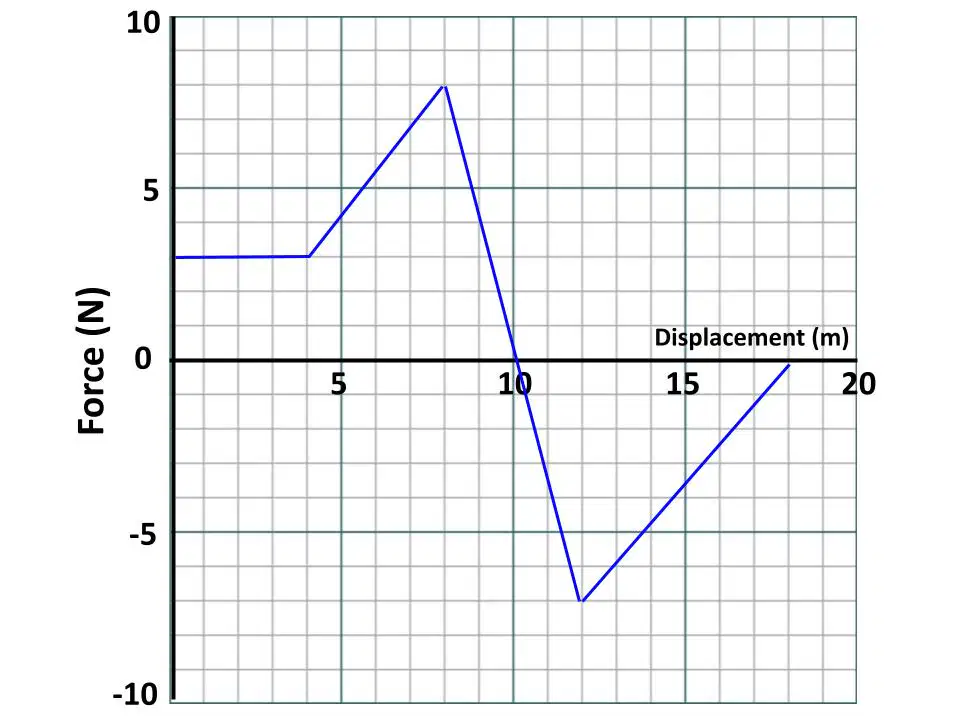
The Force versus displacement of a 10 kg object is shown. Based on this graph, what is the velocity of this object at 8 m?
6.8 m/s
2.2 m/s
2.6 m/s
Cannot be determined
The Force versus displacement of a 10 kg object is shown. Where does the object start slowing down?
8 m
10 m
12 m
4 m

