wayground logo

Free Printable Worksheets

NEW

Font size

S
M
L
XL
Worksheets

Acceleration and Speed

Total questions: 76

Worksheet time: 2hrs 47mins

Name
Class
Date
1.
__________________ is the rate at which velcoity changes. 
a)
speed
b)
acceleration
2.
Increasing speed, decreasing speed, or changing direction are examples of....
a)
speed
b)
acceleration
3.
A change in _____________ can involve a change in either speed or direction. 
a)
velocity
b)
force
c)
reference point
4.
True or False: Whenever an object's speed changes the object accelerates. 
a)
True 
b)
False
5.
When an object slows down, this is sometimes called ______________.
a)
decacceleration
b)
acceleration
6.
True or False: Even an object that is traveling at a constant speed is acceleration. 
a)
True
b)
False 
7.
What is the acceleration formula?
a)
Distance divided by time
b)
Final speed-initial speed/time 
8.
When you know the speed and direction of an object's motion, you know the _______________ of an object. 
a)
speed
b)
velocity
c)
acceleration
9.
___________________ divide the total distance traveled by the total time. 
a)
average speed
b)
instantaneous speed
c)
acceleration
10.
___________________ is the speed at which an object is moving at a given instant in time. 
a)
average speed
b)
instantaneous speed
11.
The ______________ of an object is the distance the object moves per unit of time. 
a)
speed
b)
acceleration
c)
average speed 
12.
Avery likes to walk 30 feet in 10 seconds. What is her speed?
a)
3 feet/sec
b)
6 feet/sec
c)
10 feet/sec
d)
2 feet/sec
13.
What is the person doing from 5 seconds to 10 seconds?
a)
Walking 
b)
Running
c)
Standing Still 
d)
Walking Fast
14.

According to the graph how far does the person travel in the first 5 seconds?

a)

2 m

b)

10 m

c)

0 m

d)

5 m

15.
How far is the person from the starting point after 3 seconds?
a)
0 m
b)
2 m 
c)
3 m
d)
6 m 
16.
A car accelerates from a standstill to 70 m/s in 10 seconds.  What is the acceleration?
a)
0.7m/s2
b)
7m/s2
c)
14m/s2
d)
none of the above
17.
Which graph represents zero acceleration (constant velocity)?
a)
A
b)
B
c)
C
d)
D
18.
In each of the following cases, determine where the car has no acceleration ?
a)
A car shortly after a stoplight turns green.
b)
A car approaching a red light
c)
A car with the cruise control set at 80 km/h
d)
A car turning a curve at a constant speed
19.
Which graph shows the object standing still?
a)
A
b)
B
c)
C
d)
D
20.
What is this graph showing?
a)
Constant Speed
b)
Acceleration (speeding up)
c)
Deceleration (slowing down)
d)
No motion
21.
What is this graph showing?
a)
Constant Speed
b)
Acceleration (speeding up)
c)
Deceleration (slowing down)
d)
No motion
22.
How many times does this object STOP moving?
a)
None
b)
Once
c)
Twice
d)
Three times
23.
How far does the object move?
a)
40m
b)
80m
c)
100
d)
100m
24.
Which of the following is a unit for acceleration?
a)
km/s
b)
m/s2
c)
mi/hr
d)
ft
25.
What is happening at C?
a)
Stationary
b)
Accelerating
c)
Fast steady speed; moving away from the starting position
d)
Slower steady speed; moving away from the starting position
26.
What is happening at D?
a)
Stationary
b)
Accelerating
c)
Fast steady speed; moving away from the starting position
d)
Slower steady speed; moving away from the starting position
27.
At what time did runner A pass runner B?
a)
0 seconds
b)
1 second
c)
2 seconds
d)
3 seconds
28.
Which runner won the race?
a)
A
b)
B
c)
C
29.
What is this graph showing?
a)
Constant Speed
b)
Acceleration (speeding up)
c)
Deceleration (slowing down)
d)
No motion
30.
What is happening in this graph from point A to B?
a)
The object is accelerating.
b)
The object is not moving.
c)
The object is decelerating.
d)
The object is moving at a constant speed.
31.
What is happening in the graph from point O to A?
a)
The object is moving SLOWLY
b)
The object is moving FAST
c)
The object is NOT moving
d)
The object is accelerating
32.

What does speed measure?

a)

How fast an object is going

b)

How far an object has traveled

c)

The rate at which an object slows down

33.

What units are used to measure speed?

a)

Air pressure and gravity

b)

Units of distance per unit of time, like kilometers per hour

c)

Centimeters and inches

34.

What is acceleration?

a)

How fast an object is going

b)

The fastest speed that an object can reach

c)

The rate at which speed or direction changes

35.

Which of these is an example of acceleration?

a)

A car coasts along at 40 km/h

b)

A car speeds up from 40 km/h to 80 km/h

c)

A car is parked on the side of the road

36.

How is acceleration measured?

a)

In joules or newtons

b)

In units of distance per unit of time squared

c)

In gallons of gas

37.

When an object slows down it is called:

a)

Natural acceleration

b)

Unacceleration

c)

Negative acceleration

38.

When would acceleration increase most?

a)

Rolling along a flat plane

b)

Rolling down a steep hill

c)

Rolling up a gently sloping hill

39.

Which variables must you know to calculate acceleration?

a)

Distance and force

b)

Change in speed and time

c)

Speed and distance

40.

Which of the following is a distance?

a)

10 km/h

b)

10 hours

c)

10 km

41.

Which of the following is a speed?

a)

80 km/h

b)

8 hours

c)

3000 km

42.

If a car travels at 40 km/h for 4 hours, what distance has it covered?

a)

160 km

b)

160 hours

c)

140 km

43.

If a train travels 1600 km in 16 hours, how fast is it moving'?

a)

60 km/h

b)

100 km/h

c)

120 km/h

44.

If a person ran 32 kilometers at a rate of 8 kilometers/hr, how long did he run?

a)

6 hours

b)

8 hours

c)

4 hours

45.
What does this graph represent?
a)
Constant Speed
b)
Acceleration
c)
Not moving
46.
What is happening at D?
a)
Stationary
b)
Accelerating
c)
Fast steady speed; moving away from the starting position
d)
Slower steady speed; moving away from the starting position
47.
What is happening at E?
a)
Stationary
b)
Accelerating
c)
Fast steady speed; moving away from the starting position
d)
Steady speed; returning to start position
48.
What is happening at A?
a)
Stationary
b)
Accelerating
c)
Slower steady speed; moving away from the starting position
d)
Steady speed; returning to start position
49.

A roller coasters accelerates from an initial speed of 6.0 m/s to a final speed of 70 m/s over 4 seconds. What's the acceleration?

a)

24 m/s2

b)

18 m/s2

c)

16 m/s2

d)

16 m/s

50.
A car accelerates from a standstill to 70 m/s in 10 seconds.  What is the acceleration?
a)
0.7m/s2
b)
7m/s2
c)
14m/s2
d)
none of the above
51.
When are you undergoing an acceleration in a car? 
a)
speed up
b)
slow down
c)
make turns
d)
All of the above 
52.
A dog runs with an initial speed of 7.5 m/s on a waxed floor.  It slides to a stop in 15 seconds.  What is the acceleration?
a)
-7.5 m/s
b)
-7.5 m/s2
c)
-0.5 m/s2
d)
7.5 mi//hr
53.
Why does a car accelerate as it round a corner at a constant speed?
a)
Its direction changes
b)
It doesn't
c)
It slows down
d)
Its speeds up  
54.
A car starts from rest at a stop light and reaches 20 m/s in 3.5 s. Determine the acceleration of the car.
a)
2.2m/s2
b)
7.0m/s2
c)
5.7m/s2
d)
70m/s2
55.
A drag racer accelerated from 0 m/s to 200 m/s in 5 s.  What was the acceleration?
a)
0 m/s
b)
40 m/s2
c)
-40 m/s2
d)
40 m/s
56.
A golf ball accelerates off a tee at 15m/s2, changing its velocity from 0m/s to 50 m/s down the fairway. How long did it take the golf ball to accelerate?
a)
750 seconds
b)
35 seconds
c)
0.3 seconds
d)
3.3 seconds
57.

speed of an object in a particular direction

a)

motion

b)

velocity

c)

speed

d)

acceleration

58.

when an object changes its position compared to a reference point.

a)

acceleration

b)

speed

c)

motion

d)

reference point

59.

total distance traveled divided by total time taken to travel that distance

a)

velocity

b)

motion

c)

acceleration

d)

average speed

60.

the rate at which speed or velocity changes

a)

acceleration

b)

average speed

c)

motion

d)

reference point

61.

A runner crossed the 1 mile marker of a race running at a speed of 9 miles per hour. She crossed the finish line running at a speed of 9.8 miles per hour. This is an example of...

a)

positive acceleration

b)

negative acceleration

c)

no acceleration

62.

At what speed would a car have to move in order to travel 20 kilometers in 2 hours.

a)

5 km/hr

b)

10 km/hr

c)

20 km/hr

d)

40 km/hr

63.

What is this?

"This airplane is traveling at 500 mph, West"

a)

Speed

b)

Velocity

c)

Acceleration

64.

A car travels 100km. The journey takes two hours. What is the average speed for the journey?

a)

40km/ h

b)

50km/ h

c)

60km/ h

d)

120km/ h

65.

The velocity of an object increases from 30 m / s to 50 m / s in 5.0 seconds.

What is the average acceleration of the object?

a)

0.10 m / s2

b)

0.25 m / s2

c)

4.0 m / s2

d)

10 m / s2

66.

A car travels at an average speed of 60 km / h for 0.25 hours. How far does the car travel?

a)

4.0 km

b)

15 km

c)

240 km

d)

900 km

67.

A car is travelling at a velocity of 2.0 m / s. It accelerates at a constant 0.20 m / s2 for 150 seconds. What is the final velocity of the car?

a)

2.5 m / s

b)

5.2 m / s

c)

30 m / s

d)

32 m / s

68.

In which of the following graphs below are both runners moving at the same speed?

a)
b)
c)
d)
69.

Why do the values on the graph form a straight line?

a)

The speed is constant

b)

The distance remains unchanged.

c)

The direction of motion stays the same.

d)

The speed gradually increases over time.

70.

Which graph BEST represents the motion of an object that was initially at rest and is accelerating uniformly?

a)
b)
c)
d)
71.

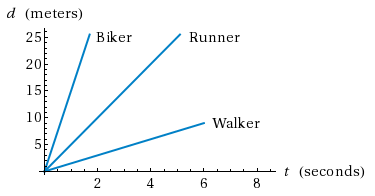
Which person moved the fastest in 2 seconds?

a)

biker

b)

runner

c)

walker

d)

they are all moving equally

72.

What is the speed after 2 seconds?

speed = distance/time

a)

40 m/s

b)

20 m/s

c)

10 m/s

d)

40 m

73.
Which graph shows an object not moving?
a)
A
b)
B
c)
C
d)
D
74.

If a car moves 12 miles North, 19 miles East, and 12 miles South, what is its displacement?

a)

12 miles

b)

19 miles, East

c)

31 miles

d)

43 miles, East

75.

Which of the following answer choices is NOT a measuring unit for speed?

a)

miles per hour

b)

miles per hour per hour

c)

kilometers per hour

d)

meters per second

76.

When an object slows down it is called:

a)

Natural acceleration

b)

Unacceleration

c)

Negative acceleration