
 Worksheets
Physics CIA 4 Test Prep
Total questions: 81
Worksheet time: 1hrs 28mins
In vibrating cord the points where the amplitude is maximum, are called:
Antinodes
Nodes
Troughs
Crests
What is the beat frequency of two waves with frequencies of 258 Hz and 262 Hz?
2 Hz
8 Hz
4 Hz
260 Hz
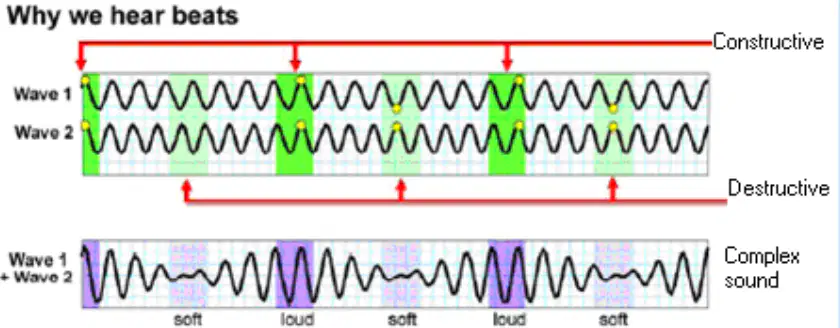
The REASON why Beats occur is due to:
Constructive interference (loud)
Destructive interference (quiet)
The Superposition Principle
The overall interference of different frequencies
All answers
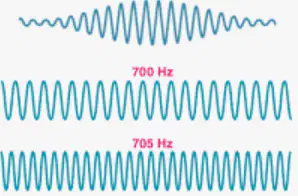
The TOP picture illustrates the Beat Pattern of two frequencies played simultaneously. IF the frequencies DIFFER by 5 Hertz, how many beats do you hear in 1 second?
0.2 Beats
2.5 Beats
5 Beats
10 Beats
How are we able to perceive an object as being the color white?
All colors of visible light are absorbed by an object and then reflected into our eye.
All colors of visible light are reflected off an object and then to our eye.
All colors of visible light are absorbed by an object and no light is being reflected into our eye.

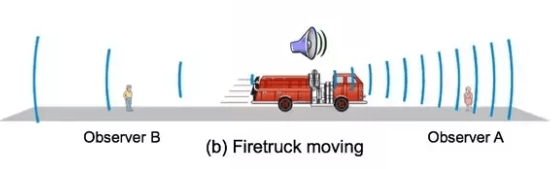
Look at the picture. Who is experiencing a lower pitched sound?
Observer A
Observer B
There is no difference
An astronomer looks at a star in the night sky. Based on his calculations the star's light is shifting towards the color blue. What does this mean about the star?
It's moving towards the astronomer
It's moving away from the astronomer
It's not moving at all


In a longitudinal wave, a ____ is an area where the particles are spread apart and a ____ is an area where the particles are close together.
crest, trough
compression, rarefaction
rarefaction, compression
trough, crest
Frequency is how many waves pass a point in 1 second. If 100 waves pass a given point in 4 seconds, what is the wave's frequency?
25 Hz
100 Hz
4 Hz
400 Hz
Frequency is measured in _______.
Hertz (Hz)
Meters per second
Meters
Newtons

The _______ of a wave is how many waves pass a given point every second.
Frequency
Wavelength
Amplitude

Standing waves are created by
Two identical waves reflecting off each other
Two identical waves being diffracted together
Two identical waves move through each other in opposite directions
Two identical waves are diffracted from two identical sources
In the diagram which letters represent the nodes
A B C
A C E
B D
B D E
A C D


The first harmonic has
1 antinode
1 node
2 antinodes
no nodes
Natural frequency is best described as
the frequency at which an object naturally vibrates at when it is disturbed
a vibration that can be heard in the wild
the radio frequency that astronauts naturally use when travelling into space
the material used to make a swing
Sound is produced by -----
Heat energy
Low temperatures
Vibrations
Friction
True or False: Sound waves are faster than light.
False
True
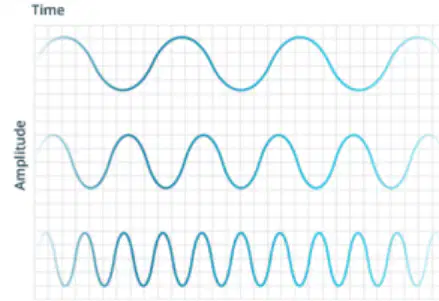
Based on the picture, WHICH sound would have the greatest pitch?
Top picture
Middle picture
Bottom picture
There is no way to determine
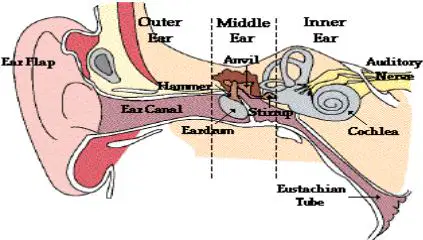
Based on what you've learned about Human Hearing: Which of the following is TRUE?
Human Hearing ranges from 20 Hz to 20,000 Hz
The lower end of hearing increases as one ages
The upper end of hearing decreases as one ages
The range of hearing changes over a lifetime
All answers are true
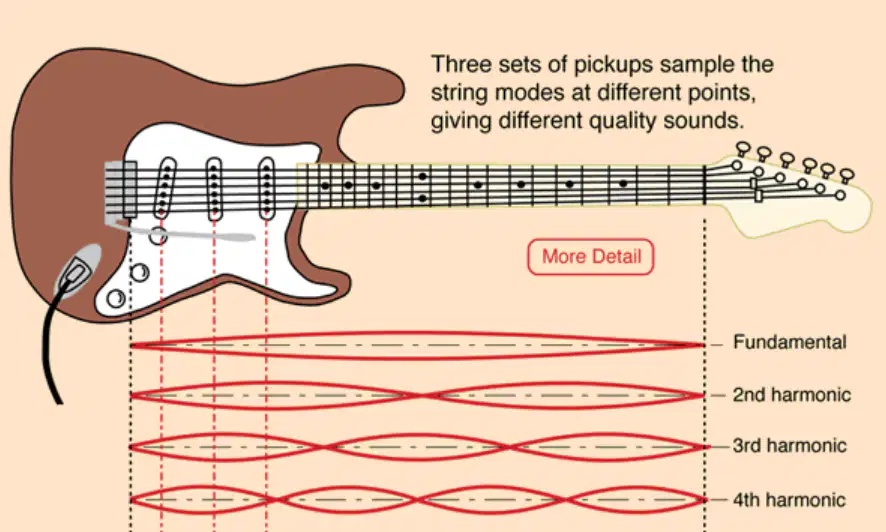
Suppose the beat frequency is 4 Hz and tightening the string causes the beat frequency to produce beat patterns of 6 Hz. What SHOULD you do in order to 'tune' the guitar string?
Loosen the string to decrease the tension
Tighten the string to increase tension
Smash the guitar against the nearest wall

You have TWO Tuning Forks with frequencies of 252 Hz and 248 Hz. What is the expected beat frequency that you would hear?
250 Beats per second
4 Beats per second
2 Beats per second
Which is faster?
The speed of light.
The speed of sound.
They are both equally fast
Impossible to determine.
What is the unit for wave length?
m/s
ft
Hz
None of these
What is the unit for wave speed?
m/s
m
Hz
None of these
You hear two pitches, one at 1000 Hz and one at 990 Hz. How many beats per second will you hear?
10 beats per second
1 beat per second
1000 beats per second
impossible to determine
You hear two pitches, one at 440 Hz and one at 444 Hz. How many beats per second will you hear?
444 beats per second
400 beats per second
4 beats per second
impossible to determine
You hear two pitches, one at 100 Hz and one at 101 Hz. How many beats per second will you hear?
100 beats per second
1 beat per second
0 beats per second
impossible to determine
You are walking down a street and car beeps its horn at you. As the car passes you, the pitch of the horn that the driver hears should...
Increase
Decrease
Remain constant
None of these
The apparent change in frequency due to the wavefronts bunching up ahead of a sound source is called the...
Hertz effect
Doppler effect
Lambda effect
None of these

What type of object is the black rim around the glasses considered?
opaque
transparent
translucent
Which pictures shows a translucent image?

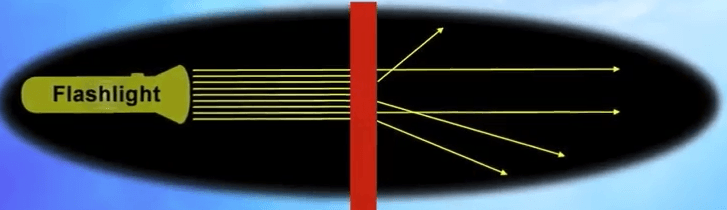
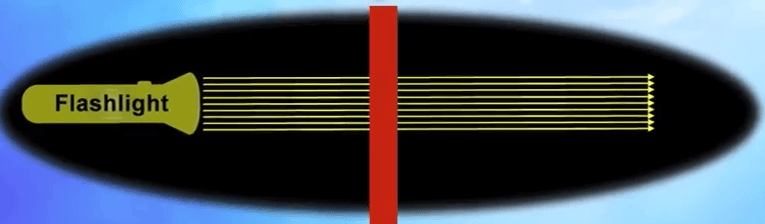

What is the best description of a translucent material?
no light passes through the material
some light passes through the material
all light passes through the material

What is the best description of a transparent material?
no light passes through the material
some light passes through the material
all light passes through the material

What type of object is a mirror considered?
opaque
transparent
translucent
According to Coulomb's Law, when the distance increases, the electrostatic force ____________.
increases
decreases
remains unchanged
has no relationship to distance
The Coulomb is the unit for:
Charge
Force
Distance
Mass

What happens to the force between two charged objects when you double the distance between them?
it doubles
it is cut in half
it quadruples
it is cut by 1/4

If one of the charges doubles, what happens to the force?
it doubles
it gets cut in half
it quadruples
it is cut by 1/4
What is the unit for electrostatic charge?
Coulombs
Newtons
Meters
Joules
Coulomb’s law states that the force between two charged objects will __________ when the magnitude (value) of the object’s charge increases.
increase
decrease
stay the same
first increase, then decrease

What would a negative value for Fe mean?
The particles are moving away from each other
The particles have the same charge
The particles have opposite charges
The particles are moving towards each other
Select all answer that apply:
What kinds of particles do Coulomb's Law apply to?
electrons
protons
neutrons
neutral atoms
A repulsive force exists between which two particles?
Two neutrons
An electron and a neutron
An electron and a proton
Two protons
The variable "r" in Coulomb's Law would have what units?
Joules
Coulombs
Newtons
Meters
Which is the value of the constant in Coulomb's equation?
ke = 9·10-9
ke = 9.8
ke = 6.67·10-11
ke = 9 ·109
What does "r" measure?
the distance between the two charged objects
the amount of charge carried by the objects
the amount of force between two charged objects
the constant value for forces between the objects
What does Fe stand for?
the electrostatic force
the symbol for iron
the constant for the charges
the charges of the particles
What will be the units of F (or Fe)?
Newtons
Meters
Coulombs
Joules

As the value of r increases, what happens to the value of F?
F increases
F decreases
F never changes, q does
Cannot know from the information
What does q measure?
the distance between the two charged objects
the amount of charge carried by the object
the amount of force between two charged objects
Why are there two q's in the equation?
because there are two charged objects
because there are protons and electrons
because the particles are moving away from each other
because the particles are moving towards each other
What can you do to increase the value of k?
change the force
change the distance
change the charge
nothing can be done to change the value of k; it is a constant
An attractive force exists between which two particles?
Two neutrons
An electron and a neutron
An electron and a proton
Two electrons
Coulomb's Law is __________ proportional.
directly
inversely
polymetrically
exponentially
Which of the following charges will attract each other?
-4 μC & -5 μC
4 μC & 5 μC
4 C & 5 C
-4 μC & 5 μC
What is the standard unit for charge?
Newtons (N)
Coulombs (C)
Electros (e)
Protos (P)
What letter is used to denote "charge"?
k
q
r
e
What does the "q" represent in Coulomb's Law?
quarks
quantum
charge
coulomb's constant
What does the "k" represent in Coulomb's Law?
charge
Coulomb's Constant
kilometers
distance between charges
What does the "r" represent in Coulomb's Law?
radius of the electron
distance between charges
radius of the proton
distance a charge will travel
What is the value of Coulomb's Constant?
9 x 10⁹ Nm2C-2
8.987 Nm2C-2
8.987 x 10¹¹ Nm2C-2
7.1 x 104.5 Nm2C-2
If two equal charges each of 1 C each are separated in air by a distance of 1 km, what is the magnitude of the force acting between them?
1 N
9 x 10⁹ N
9 x 10³ N
9 x 10⁶ N
1 x 10² N
How strong is the attractive force between a glass rod with a 0.700μC
charge and a silk cloth with a –0.600μC
charge, which are 12.0 cm apart, using the approximation that they act like point charges?
-3.5 x 10⁻² N
-263 N
-0.263 N
-3.5 x 10² N
-0.315 N
A point charge (q1) has a magnitude of 3x10⁻⁶ C. A second charge (q2) has a magnitude of -1.5x10⁻⁶ C and is located 0.12 m from the first charge. Determine the electrostatic force each charge exerts on the other.
-4.52 x 10⁻³ N
-83 N
-2.81 N
-9 x 10³ N

