
 Worksheets
F2017 Final Exam Review
Total questions: 74
Worksheet time: 1hrs 9mins
Name
Class
Date
1.

A car moves with a velocity of 10 m/s. The car's mass is 300 kg. Calculate the car's translational KE.
a)
3000 J
b)
15,000 J
c)
30,000 J
d)
1,500 J
2.
A car moves with a velocity of 10 m/s. The car's mass is 300 kg. Calculate the car's momentum.
a)
3000 J
b)
15,000 J
c)
30,000 J
d)
1,500 J
3.

A car moves with a velocity of 15 m/s. The car's mass is 250 kg. Calculate the car's translational KE.
a)
56,250 J
b)
3,750 J
c)
28,125 J
d)
12,250 J
4.
A car moves with a velocity of 15 m/s. The car's mass is 250 kg. Calculate the car's momentum.
a)
56,250 J
b)
3,750 J
c)
28,125 J
d)
12,250 J
5.
If the velocity of a moving object doubles (example: from 5 m/s to 10 m/s), the object's momentum will _____.
a)
Increase to 2-times the original.
b)
Decrease to 1/2 of the original.
c)
Increase to 4-times the original.
d)
Decrease to 1/4 of the original.
6.
If the velocity of a moving object doubles (example: from 5 m/s to 10 m/s), the object's translational kinetic energy will _____.
a)
Increase to 2-times the original.
b)
Decrease to 1/2 of the original.
c)
Increase to 4-times the original.
d)
Decrease to 1/4 of the original.
7.
If the mass of a moving object doubles (example: from 10 kg to 20 kg), the object's momentum will _____.
a)
Increase to 2-times the original.
b)
Decrease to 1/2 of the original.
c)
Increase to 4-times the original.
d)
Decrease to 1/4 of the original.
8.
If the mass of a moving object doubles (example: from 10 kg to 20 kg), the object's translational kinetic energy will _____.
a)
Increase to 2-times the original.
b)
Decrease to 1/2 of the original.
c)
Increase to 4-times the original.
d)
Decrease to 1/4 of the original.
9.
Which is Kinetic Energy?
a)
Energy in moving object.
b)
Inertia of moving object.
c)
Velocity of moving object.
d)
Direction of moving object.
10.
Translational kinetic energy depends on the ____ of the object.
a)
Mass only
b)
Velocity only
c)
Mass and velocity.
d)
None of the above.
11.
Which parameter has the biggest effect on translational kinetic energy?
a)
Mass
b)
Velocity
c)
Direction
d)
Mass and velocity
12.
Car #1 has a mass of 200 kg and moves at 10 m/s.
Car #2 has a mass of 200 kg and moves at 5 m/s.
Which is true?
Car #2 has a mass of 200 kg and moves at 5 m/s.
Which is true?
a)
Car #1 has 2-times the momentum as Car #2.
b)
Car #1 has 4-times the momentum as Car #2.
c)
Car #1 has equal momentum as Car #2.
d)
Car #2 has 2-times the momentum as Car #1.
13.
Car #1 has a mass of 200 kg and moves at 10 m/s.
Car #2 has a mass of 200 kg and moves at 5 m/s.
Which is true?
Car #2 has a mass of 200 kg and moves at 5 m/s.
Which is true?
a)
Car #1 has 2-times the KE as Car #2.
b)
Car #1 has 4-times the KE as Car #2.
c)
Car #1 has equal KE as Car #2.
d)
Car #2 has 2-times the KE as Car #1.
14.
Car #1 has a mass of 100 kg and moves at 10 m/s.
Car #2 has a mass of 200 kg and moves at 5 m/s.
Which is true?
Car #2 has a mass of 200 kg and moves at 5 m/s.
Which is true?
a)
Car #1 has 2-times the KE as Car #2.
b)
Car #1 has 4-times the KE as Car #2.
c)
Car #1 has equal KE as Car #2.
d)
Car #2 has 2-times the KE as Car #1.
15.
Car #1 has a mass of 100 kg and moves at 10 m/s.
Car #2 has a mass of 200 kg and moves at 5 m/s.
Which is true?
Car #2 has a mass of 200 kg and moves at 5 m/s.
Which is true?
a)
Car #1 has 2-times the momentum as Car #2.
b)
Car #1 has 4-times the momentum as Car #2.
c)
Car #1 has equal momentum as Car #2.
d)
Car #2 has 2-times the momentum as Car #1.
16.

In which direction does friction act?
a)
Direction opposite of object's motion.
b)
In same direction as object's motion.
c)
Up direction.
d)
Down direction.
17.

Which object has the most sliding friction with the sloping surface?
All have equal masses.
All have equal masses.
a)
Object #1
b)
Object #4
c)
Object #3
d)
All have equal friction.
18.

Which object has the most sliding friction acting upon it?
All objects move at the same speed.
All objects move at the same speed.
a)
Object #1
b)
Object #2
c)
Object #4
d)
All have equal friction.
19.

Which object has the most sliding friction acting upon it?
Only consider objects #1, #2, and #3. Do not consider object #4.
Only consider objects #1, #2, and #3. Do not consider object #4.
a)
Object #1
b)
Object #2
c)
Object #3
d)
Objects #1, #2, and #3 have equal sliding friction.
20.

Which object has the most friction acting upon it?
The masses are equal.
The masses are equal.
a)
Object #1
b)
Object #2
c)
Object #4
d)
All have equal friction.
21.

Object 1 and Object 2 will have an elastic collision. Which statement best describes the outcome of the collision?
a)
Object 1 will transfer momentum to Object 2.
b)
Object 2 will transfer momentum to Object 1.
c)
Object 1 and Object 2 will be motionless after the collision.
d)
Object 1 and Object 2 will exchange momentums and velocities during the collision.
22.
Object 1 and Object 2 will have an elastic collision. What is the total momentum of the system before the collision?
a)
150 kg⋅m/s
b)
100 kg⋅m/s
c)
50 kg⋅m/s
d)
-150 kg⋅m/s
23.
Object 1 and Object 2 will have an elastic collision. Which option best describes what will happen to Object 1 after the collision?
a)
Object 1's velocity will be slower than 5.0 m/s.
b)
Object 1's velocity will be faster than 5.0 m/s.
c)
Object 1 will be motionless after the collision.
d)
Object 1 will bounce to the left (backwards) after the collision.
24.

Which types of matter have gravity fields?
a)
Solids
b)
Solids & liquids
c)
Solids, liquids, & gases
d)
Solids, liquids, gases, & energy
25.

What is gravity?
a)
Attraction force between all matter in the universe.
b)
The force that holds protons and neutrons together in the nuclei of atoms.
c)
The repulsion force or attraction force between two magnets.
d)
The repulsion force or attraction force between two electrically-charged objects.
26.

You are in a room with air. You drop a feather and a rubber ball from the same position at the same time. Which object impacts the ground first?
a)
Feather
b)
Rubber ball
c)
Both impact at the same time
d)
Both float away.
27.

You are in a room with no air. You drop a feather and a rubber ball from the same position at the same time. Which object impacts the ground first?
a)
Feather
b)
Rubber ball
c)
Both impact at the same time
d)
Both float away.
28.

An astronaut is on the moon. He drops a hammer and a feather from the same height above the ground. Which object impacts the moon's surface first?
a)
Hammer
b)
Feather
c)
Both impact at the same time
d)
Both float away into space
29.

Object 1 and Object 2 will have an inelastic collision. They will conjoin. Which option is the best to describe the outcome of the collision?
a)
Object 1-2 will be motionless after the collision.
b)
Object 1-2 will move to the left after the collision.
c)
Object 1-2 will move to the right after the collision.
d)
Object 1-2 will break apart and move apart after the collision.
30.

What is feature H on this wave diagram?
a)
Wavelength
b)
Rarefaction
c)
Diffraction
d)
Compression
31.
What is feature F on this wave diagram?
a)
Wavelength
b)
Rarefaction
c)
Diffraction
d)
Compression
32.
What is feature G on this wave diagram?
a)
Wavelength
b)
Rarefaction
c)
Diffraction
d)
Compression
33.

Waves carry the _____ but do not carry the _____.
a)
Energy; Matter
b)
Matter; Heat
c)
Heat; Energy
d)
Energy; Friction
34.

Sound waves travel fastest through ____.
a)
Gases
b)
Liquids
c)
Solids
d)
Vacuum
35.

What are objects that move slower than the speed of sound?
a)
Subsonic
b)
Transonic
c)
Supersonic
d)
Infrasonic
36.

Sound waves cannot move through ____.
a)
Gases
b)
Liquids
c)
Solids
d)
Vacuum
37.

Sound waves travel slowest through ____.
a)
Gases
b)
Liquids
c)
Solids
d)
Vacuum
38.

What are objects that move faster than the speed of sound?
a)
Subsonic
b)
Transonic
c)
Supersonic
d)
Infrasonic
39.

What is the frequency range of human hearing?
a)
50-50,000 Hz
b)
20-20,000 Hz
c)
10-10,000 Hz
d)
40-40,000 Hz
40.

What is a device that allows doctors to use high frequency sound waves to view internal organs and developing babies in the womb?
a)
Ultrasonic imager
b)
Doppler radar
c)
Infrasonic photography
d)
X-ray imaging
41.

What are frequencies that are too low for humans to hear?
a)
Subsonic
b)
Infrasonic
c)
Supersonic
d)
Ultrasonic
42.

What are frequencies that are too high for humans to hear?
a)
Subsonic
b)
Infrasonic
c)
Supersonic
d)
Ultrasonic
43.

Which property of sound waves controls the pitch (how shrill or how bass the sound we hear)?
a)
Frequency
b)
Wavelength
c)
Amplitude
d)
Wave speed
44.

What are the two important factors that control the volume of sound--how loud we hear sound?
a)
The power of the sound source & the distance away from the sound source.
b)
The frequency of the sound source & the distance away from the sound source.
c)
The wavelength of the sound waves & the speed of sound through air.
d)
The wavelength of the sound waves & the frequency of the sound waves.
45.

What creates sound waves?
a)
Objects vibrate and the motion pushes molecules.
b)
Objects oscillate up and down, forcing molecules to travel.
c)
Objects move in circular motions, forcing molecules to move in circular motions.
d)
Objects move, then stop, then move, then stop, then move, then stop...
46.
What is the very compact pulse of energy in an electromagnetic wave? (quanta)
a)
Proton
b)
Photon
c)
Electron
d)
Neutrino
47.
What are the two alternating perpendicular forces that move with the light wave?
a)
Electric field & Magnetic field
b)
Electronic force & Neutronic force
c)
Gravity field & Photospheric field
d)
Turbulent force & Friction force
48.
Which is the correct order of the electromagnetic spectrum from highest frequency to lowest frequency?
a)
Gamma, X-ray, Ultraviolet, Visible, Infrared, Microwave, Radio
b)
Gamma, Ultraviolet, Visible, Infrared, X-ray, Microwave, Radio
c)
Ultraviolet, Microwave, Radio, Visible, X-ray, Gamma, Infrared
d)
Radio, Microwave, Infrared, Gamma, X-ray, Ultraviolet, Visible
49.
Which class of electromagnetic radiation has the longest wavelengths?
a)
Radio
b)
Gamma
c)
Infrared
d)
Visible
50.
Which class of electromagnetic radiation has the least energy?
a)
Radio
b)
Gamma
c)
Infrared
d)
Visible
51.
Which color light has the longest wavelength?
a)
Red
b)
Orange
c)
Green
d)
Violet
52.
Which is the correct order for the speed of light from fastest to slowest?
a)
Vacuum, Gas, Liquid, Solid
b)
Solid, Liquid, Gas, Vacuum
c)
Solid, Liquid, Gas (cannot move through vacuum)
d)
Gas, Liquid, Solid (cannot move through vacuum)
53.
Which is the correct order for the speed of sound from fastest to slowest?
a)
Vacuum, Gas, Liquid, Solid
b)
Solid, Liquid, Gas, Vacuum
c)
Solid, Liquid, Gas (cannot move through vacuum)
d)
Gas, Liquid, Solid (cannot move through vacuum)
54.

Two transverse waves overlap. Crests overlap with crests. Troughs overlap with troughs. The waves are
a)
In-phase
b)
Out-of-phase
c)
In-synchronicity
d)
Out-of-synchronicity
55.

Two transverse waves overlap. Crests overlap with troughs. Troughs overlap with crests. The waves are
a)
In-phase
b)
Out-of-phase
c)
In-synchronicity
d)
Out-of-synchronicity
56.

Two longitudinal waves overlap. Compressions overlap with compressions. Rarefactions overlap with rarefactions. The waves are
a)
In-phase
b)
Out-of-phase
c)
In-synchronicity
d)
Out-of-synchronicity
57.

Two longitudinal waves overlap. Compressions overlap with rarefactions. The waves are
a)
In-phase
b)
Out-of-phase
c)
In-synchronicity
d)
Out-of-synchronicity
58.

If two overlapping waves are in-phase, the resultant wave will have ______ compared to the two waves.
a)
Greater amplitude
b)
Greater frequency
c)
Greater wavelength
d)
Greater wave speed
59.

Constructive interference will result if parts of overlapping waves are _____.
a)
In phase
b)
Out of phase
c)
Moving in opposite directions
d)
Moving at the same wave speed.
60.

Destructive interference will result if parts of overlapping waves are _____.
a)
In phase
b)
Out of phase
c)
Moving in opposite directions
d)
Moving at the same wave speed.
61.

What does this graph represent?
a)
Constant Speed
b)
Acceleration
c)
Deacceleration
d)
Not moving
62.

According to the graph how far does the person travel in the first 5 seconds?
a)
2 m
b)
10 m
c)
0 m
d)
5 m
63.

What is the person doing from 5 seconds to 10 seconds?
a)
Walking
b)
Running
c)
Standing Still
d)
Walking Fast
64.

A runner races in the 100 meter dash. It takes her 10 seconds to finish. What is her average speed?
a)
10 m/s
b)
1000 m/s
c)
100 seconds
d)
10 seconds
65.
The tendency of an object at rest to stay at rest unless it is acted upon by a force is called ___________________
a)
inertia
b)
motion
c)
gravity
d)
lubricant
66.

A wheeled cart is moving to the right at a constant speed. Two forces of equal magnitude are acting upon the cart. Which of the following best describes the forces and motion of the cart?
a)
Balanced Forces, Constant Speed
b)
Balanced Forces, Acceleration
c)
Unbalanced Forces, Constant Speed
d)
Unbalanced Forces, Acceleration
67.
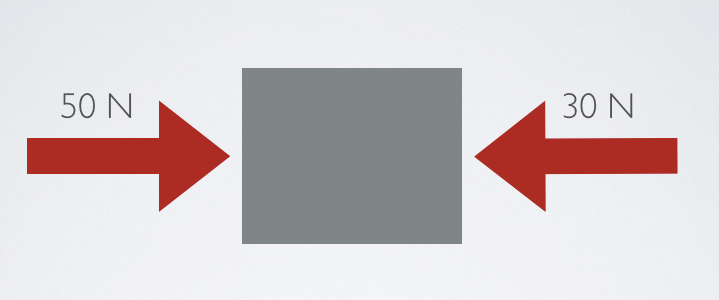
How will this object move?
a)
It won't move.
b)
It will move to the right.
c)
It will move to the left.
d)
It will move up.
68.

What is the net force?
a)
30 N left
b)
25 N right
c)
5 N left
d)
55 N right
69.
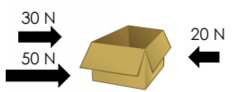
Calculate the Net Force.
a)
60N, Left
b)
40N, Right
c)
0N
d)
60N, Right
70.
Why does a car accelerate as it round a corner at a constant speed?
a)
Its direction changes
b)
It doesn't
c)
It slows down
d)
Its speeds up
71.
Acceleration of an object happens when things ________
a)
slow down
b)
go faster
c)
change direction (turn)
d)
All of the above
72.
If 150 Joules of work is needed to move a box 10 meters, what force was used?
a)
1500 N
b)
15 N
c)
1.5 N
d)
150 N
73.
How much work is produced when 350 N is used to move a car 5 m?
a)
70 J
b)
1750 J
c)
355 J
d)
175 J
74.
What law is best described by inertia?
a)
1st
b)
2nd
c)
3rd
100 %

