
NEW
Font size
 Worksheets
Electrostatics and Circuits
Total questions: 45
Worksheet time: 38mins

What would increase the voltage of this circuit?
Decreasing voltage
Decreasing current, constant resistance
Increasing current, constant resistance
Decreasing resistance, constant current

Which of the following is true about a parallel circuit?
Voltage drops occur in a parallel circuit.
If one part of a parallel circuit goes out, the entire circuit goes out.
Current splits in a parallel circuit.
Resistance is higher in a parallel circuit.
Which of the following is the most dangerous part of a circuit? (aka, what kills you bad?)
High voltage
High current
High resistance
High power
Which of the following light bulbs will have the lowest resistance?
40 W
100 W
150 W
200 W
Which of the following would not be a good conductive material for a wire?
Gold
Platinum
Copper
Rubber
In order to avoid being shocked by a live circuit, you should only touch...
insulated switches
bare wire
power terminal
voltage source
A 12 V battery is connected to three 4 ohm resistors in series. What is the total current flowing through the circuit?
1 ampere
3 amperes
48 amperes
144 amperes

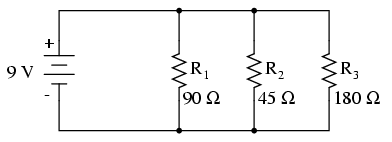
If the voltage supply for this circuit is 5 V, what is the power output of the circuit?
0.25 W
0.83 W
0.4 W
30 W
The current supplied by a battery is 0.17 amps. What would the voltage drop be across a 20 ohm resistor?
1.7 V
3.4 V
5 V
30 V
One light in the library goes out, and the entire school goes out. This would prove that the school is wired in...
series
parallel
reverse
separate circuits
Which direction does charge flow in a circuit?
Negative to positive
Positive to negative
in a zigzag
what
In a series circuit with two resistors, which of the following does not change?
Resistance
Voltage
Current
Power
In a parallel circuit with two resistors, which of the following does not change?
Current
Resistance
Voltage
Power
What is current measured in?
volts
amperes
ohms
watts
What is resistance measured in?
ohms
amperes
volts
watts

Wood is a _____?
conductor
insulator
Which of the following circuit diagrams is an open circuit?


What is the current drawn by a 5 ohm resistor when it is connected to a 1.5 V battery?
7.5 amperes
3.33 amperes
0.3 amperes
6.5 amperes
What is the current drawn by a 10 ohm resistor when it is connected to a 12 V car battery?
22 amperes
1.2 amperes
0.83 amperes
120 amperes
What is the resistance of an object that draws 0.24 A when connected to a 120 volt circuit?
0.024 ohms
28.8 ohms
124 ohms
500 ohms
Which of the following devices measures current in an electric circuit?
an ammeter
an ohmmeter
a voltage meter
a resistor
When an object gains electrons it becomes __________
Neutral
Positively charged
Negatively charged
What are the best conductors?
metals (copper, silver, and aluminum)
plastics, ceramics, rubber, wool, wood and glass
silicon, computer chips and electronic circuits
What is an insulator?
material that cannot move electrical charges
materials through which heat and electric charge can flow easily
material than can move electrical charges as well as prevent the flow of electrical charges
What are the best insulators?
metals (copper, silver, and aluminum)
plastics, ceramics, rubber, wool, wood and glass
silicon, computer chips and electronic circuits
In an electric field, Point A has more electric field lines moving through it than Point B. Which is true?
Point A and Point B will have the same Force, but A will be farther away
Point A will have a stronger Force, Point B is farther away and has a weaker Force
Point A and Point B will have the same Force, but B will be farther away
Point B will have a stronger Force, Point A is farther away and has a weaker Force

Label the charges respectively:
+; +
+; -
-; -
-; +

Label the charges respectively:
+; +
+; -
-; -
-; +

Label the charges respectively:
+; +
+; -
-; -
-; +

What is the missing charge?
positive +
negative -
impossible to tell
Two similar metal spheres, A and B, have charges of +2.0 x 10⁻⁶ coulomb and +1.0 x 10⁻⁶ coulomb, respectively. Calculate the magnitude of the electrostatic force on A due to B
2.0N
4.0N
8.0N
1.0N

