
Font size
 Worksheets
G8 - UT 7,8,11
Total questions: 50
Worksheet time: 2hrs 40mins
What is kinetic energy?
moving energy
potential energy
stored energy
renewable energy
What is NOT a renewable energy source?
coal
wind
solar
water
Which of these things are examples of renewable energy sources?
wind
solar
water
oil
Which of these things is an example of potential energy?
a car motor
firewood
battery
a fan

A hot air balloon rising is an example of ...
conduction
convection
radiation
connection

A snowman melting in the sun
convection
conduction
radiation
connection

A stove top will cook your food because of ___________.
convection
conduction
radiation
connection

Warming up near a campfire is an example of ...
conduction
convection
radiation
connection
Faster moving atoms and molecules are associated with...
Low thermal energy (cooler)
High thermal energy (hotter)
What affect the rate of evaporation
Humidity
Wind
Heat
Temperature
Boiling involves a change of state from ___ to ___.
Solid to Liquid
Liquid to Gaseous
Gaseous to Liquid
Liquid to Solid
What effect does Evaporation cause ?
Heating Effect
Magnetic Effect
Cooling Effect
Warming Effect
Rate of evaporation increases as?
exposed surface area of liquid increases
exposed surface area of liquid decreases
movement of air above surface of liquid decreases
atmospheric pressure increases

A salt is formed when nitric acid combines with sodium hydroxide. What are present in the salt that forms?
Sodium chloride
sodium ions and nitrate ions
only sodium ions
only nitrate ions

Salts that are made with hydrochloric acid are called ______________.
chlorides
sulfates
nitrates
carbonates

Which of the following statements best define the term ‘salt’?
Salt is formed when metal reacts with an alkali.
Salt contains sodium ions and chloride ions.
Salt is formed from a weak Van der Waals’ forces of attraction.
Salt is formed when the hydrogen ions in an acid is replaced by metal or ammonium ions.

What are the products if magnesium reacts with hydrochloric acid?
Magnesium chloride + Hydrogen
Magnesium sulfate + Hydrogen
Magnesium oxide + Hydrogen
Magnesium sulfide + Hydrogen

Which of the following preparation of salt is incorrect?
acid + alkali
acid + metal oxide
acid + carbonate
acid + acid
Which of the following methods is used to prepare zinc sulfate?
Add excess zinc chloride to aqueous sodium sulfate
Tiltrate dilute H2SO4 with aqueous Zn(OH)2 with an indicator, then again without
Add excess solid zinc oxide to dilute sulfuric acid
Mix aqueous zinc nitrate with aqueous potassium sulfate
Calcium carbonate reacts with nitric acid to form?
calcium oxide
calcium nitrate
calcium chloride
calcium sulfate
What is the scientific name for salt?
Sodium chloride
Hydrochloric acid
Acetic acid
Potassium chloride
What is it called when an acid and a base combine then form a salt and H2O
Neutralization
Acidification
Chemical Bonding
Ionic Reaction
Sulphuric acid + sodium carbonate
-->
Acids have a pH range of....
0 - 14
0,1 - 6,9
7
7,1 - 14
Metal carbonates react with acid to form....
Salt, carboxylic acid and water
Salt, carbon dioxide and water
Salt and carbonated water
Salt and hydrogen
Calcium carbonate + hydrochloric acid -->
Calcium chloride + hydrogen
Calcium choride + water
Calcium chloride + carbon dioxide + water
Calcium sulfate + carbon dioxide + water
Copper carbonate + hydrochloric acid -->
Copper chloride + hydrogen
Copper chloride + water
Copper chloride + water + hydrogen
Copper chloride + water + carbondioxide
Which of the following reactions occurs at the highest rate?
Photosynthesis
Rusting of iron
Combustion of hydrogen in oxygen
Combustion of magnesium in oxygen
The following equation shows the reaction between calcium carbonate, CaCO3 and hydrochloric acid, HCl:
CaCO3(aq) + 2HCl(aq) → CaCl2(aq) + CO2 (g) + H2O(l)
Which of the following is the suitable method to determine the rate of reaction?
Change in the temperature of the solution with time
Change in the volume of carbon dioxide gas with time
Change in the mass of water with time
Change in the concentration of hydrochloric acid with time

Diagram 4 shows the graph of volume of carbon dioxide gas against time when 5 g of marble chips is added to
50 cm3 of 0.2 mol dm-3 hydrochloric acid.
At what time the rate of reaction the highest?
t1
t2
t3
t4

Diagram 7 shows a graph of the volume of gas produced against time for the reaction between zinc granules and hydrochloric acid.
The gradient of the graph decreases with time because
catalyst is not used
volume of mixture decreases
temperature of reaction decreases
concentration of hydrochloric acid decreases

Table 9 shows the experiments carried out to study the rate of reaction between zinc carbonate and nitric acid.
Which of the following graph represents the two experiments?


What is the meaning of the rate of reaction?
Decrease in amount of product
Decrease in amount of product against time
Increase in amount of products against time
Increase in amount of reactants against time
Which unit is correct for the rate of reaction?
g mol-1
g min-1
mol dm-3
kJ mol-1
Which process has the highest rate of reaction?
Rusting
Respiration
Combustion
Photosynthesis
The following equation represents a chemical equation.
CaCO3 + 2HCl --> CaCl2 + CO2 + H2O
Which graph shows the correct change in mass of reactant used in excess against time?
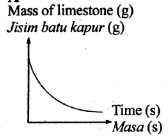
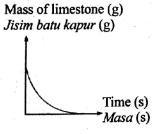
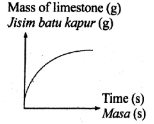
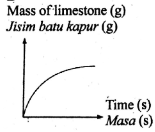
In which of the chemical reactions can the rate be determined by measuring the change in the gas volume?
Acidified potassium manganate (VII) solution with iron (II) sulphate solution
Sodium hydroxide solution with dilute hydrochloric acid
Silver nitrate solution with sodium chloride solution
Calcium carbonate with dilute hydrochloric acid
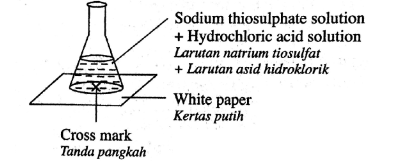
Diagram shows the apparatus set up for an experiment to determine the rate of reaction.
Which of the following techniques is the most suitable to determine the rate of reaction?
Record the time as soon as precipitate is formed
Record the time taken to obtain the maximum temperature
Record the times as soon as the cross mark cannot be seen
Record the times taken for the change of the pH value until a fixed pH value is obtained
The following equation represents the reaction between calcium carbonate, CaCO3 and hydrochloric acid, HCl.
CaCO3 + 2HCl --> CaCl2 + CO2 + H2O
Which changes can be used to determine the rate of reaction?
I : mass of calcium carbonate per unit time
II : Volume of carbon dioxide released per unit time
III : Colour of solution per unit time
IV : Mass of precipitate produced per unit time
I and II
I and III
II and IV
III and IV
The reaction between zinc, Zn and hydrochloric acid, HCl is represented by the following equation.
Zn + 2HCl --> ZnCl2 + H2
A student wants to determine the rate of reaction in a school laboratory. Which of the following methods is the most suitable?
Determine the change in temperature of the solution with time
Determine the change in the concentration of zinc chloride with time
Determine the volume of hydrogen gas given off with time
Determine the change in the concentration of hydrochloric acid with time
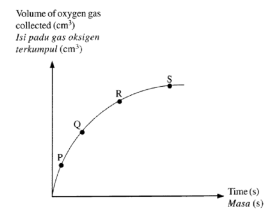
Diagram shows a graph of volume of oxygen gas collected against time in the decomposition reaction of hydrogen peroxide when using manganese dioxide as catalyst.
Which point shows the highest rate of reaction?
P
Q
R
S
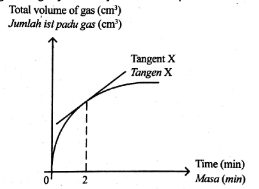
Diagram shows a graph to study the effect of total surface area on the rate of reaction.
What is represented by gradient tangent X?
Average rate of reaction in the first 2 minutes
Average rate of reaction in the 2nd minute
Overall average rate of reaction
Rate of reaction at the 2nd minute

