
 Worksheets
Review Rate of Reaction
Total questions: 50
Worksheet time: 38mins
What is meant by rate of reaction?
Decrease in the quantity of a reactant or product during a chemical reaction
Change in the quantity of a reactant or product over time
Change in the quantity of a reactant or product during a chemical reaction
Change in the quantity of a reactant or product per unit time
Which reactions has the highest rate of reaction?
Rusting of water pipe
Photosynthesis in green plant
Burning of a small piece of charcoal in the air
Formation of stalactites and stalagmites
List four factors that affects the rate of a reaction
temperature
concentration
surface area
volume
catalysts

Which factors increase the rate of a reaction?
increasing temperature
increasing concentration
increasing total surface area
All of these

Which Reaction would be the fastest?
A
C
D
E
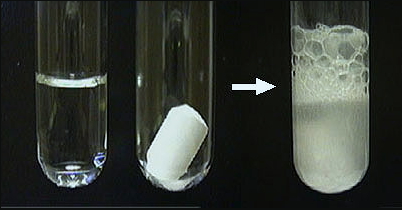
How could we make this reaction happen more quickly?
Decrease the concentration of the acid
crush the chalk to increase the surface area
Put the test tube in an ice bath
Which of the following will lower the rate
of reaction?
adding an enzyme to the reaction
decreasing the temperature from 40°C to
10°C
breaking a chunk of calcium up into
smaller pieces
increasing the amount of solute
dissolved in a solution
Na2S2O3(aq) + 2HCl(aq) → 2S(s) + SO2(g) + 2NaCl(aq) + H2O(l)
Which list below contains only changes that will decrease the rate of this reaction?
Which of the following explains the meaning of effective collision?
The collision where its energy is less than the activation energy
The collision that has a low energy
The collision which takes place before a reaction
The collision that causes a reaction
As the frequency of ______________ increases, the rate of reaction increases.
Time
Reactions
Collisions
Reactants
Increasing the temperature gives particles more __________.
time
energy
space
frequency
A temperature increase causes the particles ......
to slow down
move faster
collide higher
in the right order
Why does a higher temperature increase the rate of a reaction?
it increases both the frequency and energy of particle collisions
it only increases the frequency of particle collisions
it only increases the energy of particle collisions
it reduces the activation energy of the reaction
Why does a higher concentration increase the rate of reaction?
it increases the amount of reactants
it lowers the activation energy
it increases the energy of particle collisions
it increases the frequency of collisions
Why does breaking up a solid reactant increase the rate of reaction?
it creates more solid
it creates more energy
it increases the total surface area
it increases the concentration

Grinding a seltzer tablet into powder increases the rate of reaction due to...
increased concentration of reactants
increased total surface area
increased speed of particles.
better orientation of reactants
Smaller particle size allows for a _________ total surface area to be exposed for the reaction.
larger
smaller
equal
Which has more surface area?
Large chunks of chalk
Cube of sugar
Powdered sugar
Small chunks of sugar
Which manufacturing of the following is not a characteristic of catalyst?
A catalyst is specific in its reaction.
A catalyst influences the quantity of product of a reaction.
The chemical property of a catalyst remains unchanged at the end of the reaction.
Only a little amount of a catalyst is needed to influence the rate of reaction.

Which of the following is the meaning of activation energy?
The maximum energy that the particles need to produce effective collision
The amount of energy used by the particles during a collision
The minimum amount of energy that particles must have in order to react
The amount of kinetic energy of molecules during a collision
I. addition of a catalyst
II. grinding reactant lumps into a powder
III. increasing the concentration of reactants
We can measure the speed of reaction by measuring the
time taken for a reaction to be completed
volume of gas produced in a period of time
mass of reactants remaining in a period of time
mass of reactants remaining
Which of these is not a valid way of measuring reaction rate?
Mass loss
Gas syringe
Water displacement
Volume of sound
The following equation shows the reaction between calcium carbonate, CaCO3 and hydrochloric acid, HCl:
CaCO3(aq) + 2HCl(aq) → CaCl2(aq) + CO2 (g) + H2O(l)
Which of the following is the suitable method to determine the rate of reaction?
Change in the temperature of the solution with time
Change in the volume of carbon dioxide gas with time
Change in the mass of water with time
Change in the concentration of hydrochloric acid with time
The reaction between zinc, Zn and hydrochloric acid, HCl is represented by the following equation.
Zn + 2HCl --> ZnCl2 + H2
A student wants to determine the rate of reaction in a school laboratory. Which of the following methods is the most suitable?
Determine the change in temperature of the solution with time
Determine the change in the concentration of zinc chloride with time
Determine the volume of hydrogen gas given off with time
Determine the change in the concentration of hydrochloric acid with time
In which of the chemical reactions can the rate be determined by measuring the change in the gas volume?
Acidified potassium manganate (VII) solution with iron (II) sulphate solution
Sodium hydroxide solution with dilute hydrochloric acid
Silver nitrate solution with sodium chloride solution
Calcium carbonate with dilute hydrochloric acid
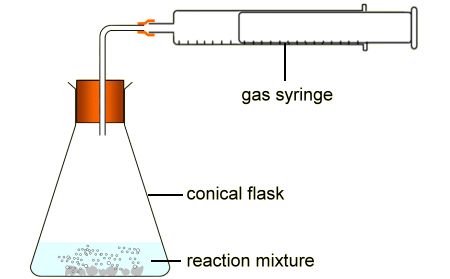
How is this equipment being used to measure the rate of reaction?
The gas syringe measures how much gas is produced in a certain time
The reaction mixture will increase in volume in a certain time
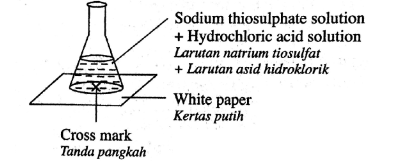
Diagram shows the apparatus set up for an experiment to determine the rate of reaction.
Which of the following techniques is the most suitable to determine the rate of reaction?
Record the time as soon as precipitate is formed
Record the time taken to obtain the maximum temperature
Record the times as soon as the cross mark cannot be seen
Record the times taken for the change of the pH value until a fixed pH value is obtained

Diagram 4 shows the graph of volume of carbon dioxide gas against time when 5 g of marble chips is added to
50 cm3 of 0.2 mol dm-3 hydrochloric acid.
At what time the rate of reaction the highest?
t1
t2
t3
t4
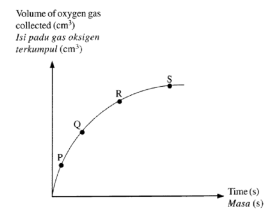
Diagram shows a graph of volume of oxygen gas collected against time in the decomposition reaction of hydrogen peroxide when using manganese dioxide as catalyst.
Which point shows the highest rate of reaction?
P
Q
R
S

At what time did reaction 2 (Square) finish
60s
70s
80s
90s

What total volume (in cm3) of CO2 was given off in reaction 3 (triangle)?
36
54
72
90
The equation represents the reaction between sodium carbonate and hydrochloric acid.
Na2CO3 + 2 HCl → 2 NaCl + H2O + CO2
The mass of the beaker and its contents is plotted against time.
Which graph represents what happens when sodium carbonate reacts with an excess of dilute hydrochloric acid?


CaCO3(s) + 2HCl(aq) → CaCl2(aq) + H2O(l) + CO2(g)
A plot of V(CO2) vs time for the reaction is shown. The graph is consistent with the observation that

Table 9 shows the experiments carried out to study the rate of reaction between zinc carbonate and nitric acid.
Which of the following graph represents the two experiments?


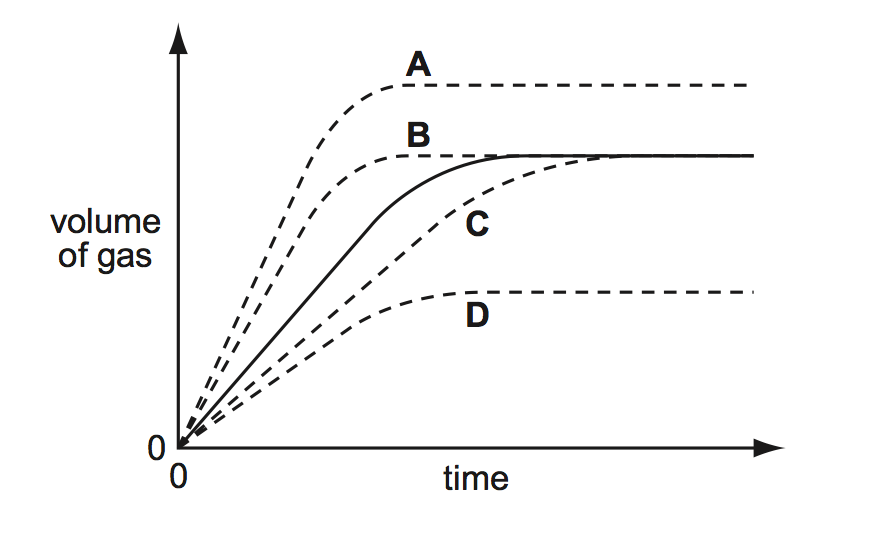
2 g lump and 2 g of powdered zinc are added to equal volumes of sulfuric acid. The solid line shows volume of gas given off when the lump is used.
Which line is obtained for powdered zinc?
A
B
C
D
The solid line represents rate of volume of gas produced during an experiment. Which graph best represents the same experiment conducted at a lower temperature?
A
B
C
D

Which catalyst is the most effective?
Silicon DIoxide
Copper (II) Oxide
Manganese (IV) Oxide

Diagram 7 shows a graph of the volume of gas produced against time for the reaction between zinc granules and hydrochloric acid.
The gradient of the graph decreases with time because
catalyst is not used
volume of mixture decreases
temperature of reaction decreases
concentration of hydrochloric acid decreases

