wayground logo

Free Printable Worksheets

Font size

S
M
L
XL
Worksheets

Industrial Revolution

Total questions: 61

Worksheet time: 35mins

Name
Class
Date
1.
Who Invented the cotton gin and interchangeable parts
a)
Eli Whitney
b)
Robert Fulton
c)
Slater
d)
Lowell
2.
What is the area of the United States where the Industrial Revolution began
a)
South
b)
Midwest
c)
New England
d)
South
3.
The invention of the cotton gin increased the efficiency of cotton production and actually increased the demand for this
a)
Water Power
b)
Coal
c)
FIre
d)
Slaves
4.
In which country did the Industrial Revolution begin?
a)
The United States
b)
England
c)
France
d)
Germany
5.
How did the Agricultural Revolution impact farmers?
a)
New farming methods required more workers on the farm.
b)
New farming methods produced bigger harvests with less farmers.
6.
Which 2 natural resources were the backbone of the Industrial Revolution?
a)
wood and peat
b)
oil and natural gas
c)
coal and iron
d)
cotton and tobacco
7.
England is an island. Why was this an advantage during the Industrial Revolution?
a)
It wasn't an advantage.
b)
It made it more difficult for other countries to steal England's ideas.
c)
England has many ports and rivers which allow easier worldwide trade.
d)
England had tropical weather, which allowed more crops to be grown.
8.
Which innovation  allowed factories to be built anywhere?
a)
flying shuttle
b)
spinning jenny
c)
cotton gin
d)
steam engine
9.
What is the movement of people from rural to urban areas called?
a)
ruralization
b)
colonization
c)
inflation
d)
urbanization
10.
The system in which the government owns and controls the means of production, such as mines and factories, is called?
a)
fascism
b)
socialism
c)
capitalism
d)
mercantilism
11.
Which of the following was NOT associated with early factory working conditions?
a)
Low wages
b)
Safe working conditions
c)
Dangerous working conditions
d)
Widespread pollution
12.
What product was first made using machines in factories?
a)
Steel
b)
textiles
c)
locomotives
d)
flying shuttles
13.
Which of the following groups would most likely benefit from the socialist ideas of Karl Marx?
a)
Entrepreneurs
b)
Factory Workers
c)
Large Business Corporations
d)
Factory Managers
14.
How did railroads impact the prices of goods & services?
a)
Made them more expensive & harder to ship
b)
made them cheaper & easier to ship
c)
Gave people a way of transportation
15.
How did the Industrial Revolution affect the cities?
a)
Made the crime rate decrease
b)
Led to an increase in farm workers
c)
Make the cities cleaner and safer
d)
Led to an increase in population in the cities
16.
Until the 1800s, how did most families get the items they needed for daily life?
a)
They made tools, clothing, materials, and food by hand.
b)
They bought them from factories.
c)
They bought them on the Internet.
d)
They bought them from stores.
17.
The _______________ is the name for the change from goods being made by hand at home to making them by machine in factories.
a)
French Revolution
b)
Machine Revolution
c)
Industrial Revolution
d)
Technological Revolution
18.
_______________ is a machine with sharp blades used to cut grain.
a)
The sower
b)
The reaper
c)
The cotton gin
d)
The sewing machine
19.
What did Samuel Morse invent?
a)
the steam engine
b)
the steamboat
c)
the telegraph machine
d)
the telephone
20.
the process of moving from an agricultural society, in which most goods are handmade, to a society that thrives on machine-manufactured goods
a)
textile
b)
economy
c)
industrialization
d)
technology
21.
the way that a society or nation produces and distributes goods and services
a)
textile
b)
economy
c)
technology
d)
industrialization
22.
Where were most factories built?
a)
in the mountains
b)
in the desert
c)
along rivers
23.
Who invented the steel plow?
a)
Cyrus McCormick
b)
John Deere
c)
Samuel Slater
d)
Robert Fulton
24.

Why was England the first to Industrialize?

a)

It already had large cities

b)

It had tons of natural resources like coal, iron and rivers

c)

It had very little natural resources

d)

It was located in the middle of Europe

25.

How did the move from farm to factories change peoples lives?

a)

land owners had to share their land

b)

urbanization was a myth

c)

cities grew as people moved to work in factories

d)

the cottage industry thrived

26.

What was the most important resource in England?

a)

Firewood

b)

Rivers

c)

Wind

d)

Coal

27.

Revolutions that sparked in the 1830's and 1840's were caused by attitudes of

a)

Utopianism

b)

Conservatism

c)

Nationalism

d)

Religion

28.

What did the assembly lines do for manufactured goods?

a)

goods were made quicker and cheaper

b)

goods were made quicker but not cheaper

c)

less goods were made

d)

it took longer for goods to be made but they were cheaper

29.

Select the negative effects of the Industrial Revolution:

a)

Pollution

b)

Overcrowded cities

c)

Poor working conditions

d)

Increase in wages

30.
Knights of Labor
a)
Craft Union
b)
Industrial Union
31.
American Federation of Labor
a)
Craft Union
b)
Industrial Union
32.
Were the most radical and socialist union of the time period
a)
National Labor Union
b)
American Federation of Labor
c)
American Railway Union
d)
The Wobblies (IWW)
33.
Who was the oil tycoon?
a)
Carnegie
b)
Morgan
c)
Rockefeller
34.
The labor union that only accepted skilled workers who were difficult to replace during strikes.
a)
Knights of Labor
b)
American Federation of Labor
c)
World Wide Federation of Labor
d)
Nights and Days of Labor
35.
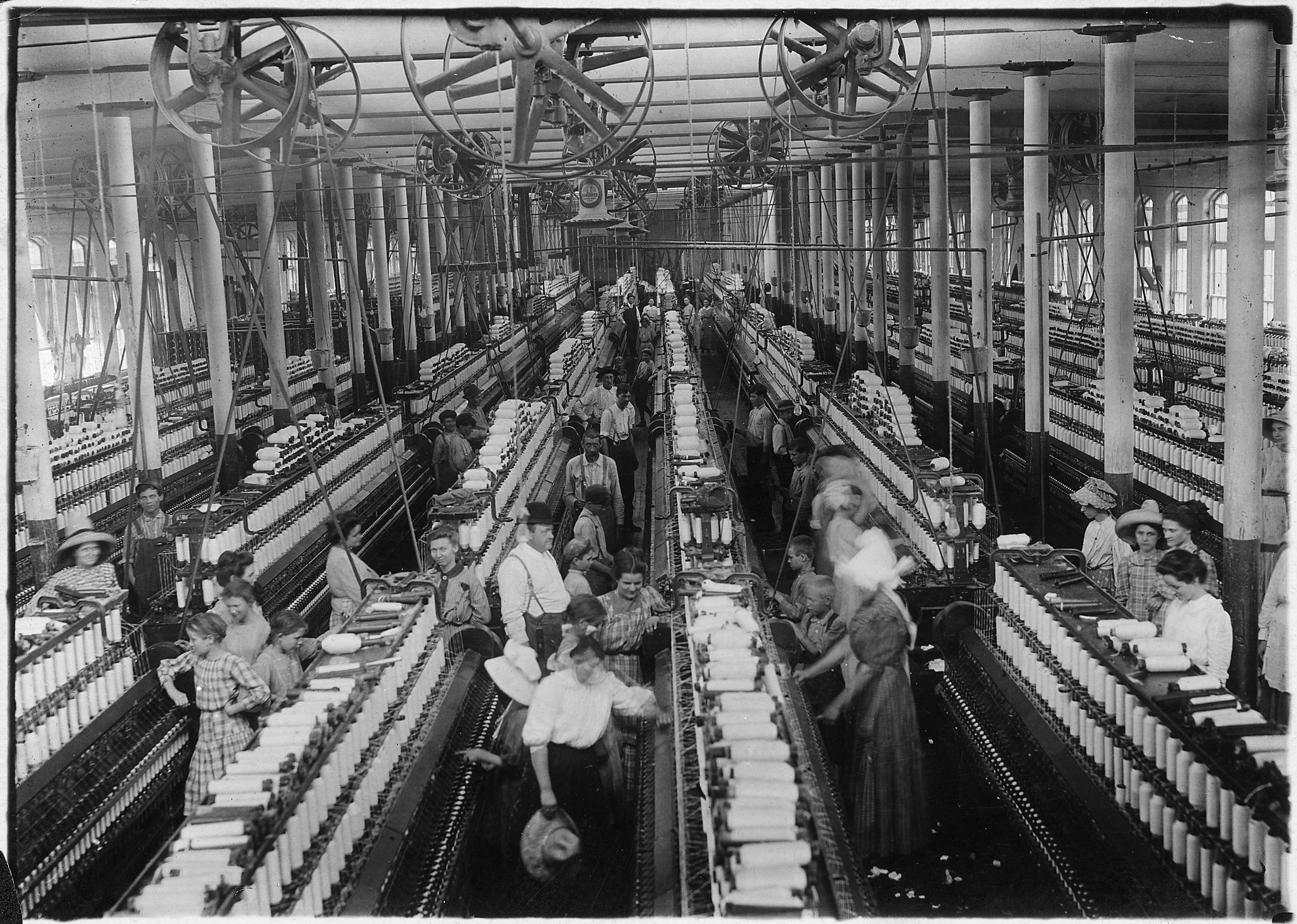
 Images such as this illustrate the position that many US companies were — 
a)
requiring vocational training programs for children
b)
employing children as a source of cheap labor
c)
seeking government regulation of child labor
d)
providing safe working conditions for child laborers
36.
How did industrialization in the US change the lives of women & children? 
a)
Women & children gained higher social status. 
b)
Women & children became better educated. 
c)
Women & children became wage earners for their families. 
37.
_______________ are formed with the idea that there’s strength in numbers.
a)
strikes
b)
organizations
c)
union leaders
d)
unions 
38.
Workers in Chicago after the Civil War were most concerned about what 2 issues?
a)
Working conditions and the length of the workday
b)
Pay and health benefits
c)
The length of the workday and holiday pay
d)
Working conditions and retirement benefits 
39.

Which technique of labor unions was the most effective for unskilled labor?

a)

Strikes

b)

Walk outs

c)

Arbitration

d)

Mediation

40.
One protester threw a bomb into a crowd, killing police officers
a)
The Great Strike of 1877
b)
The Haymarket Affair
c)
The Homestead Strike
d)
The Pullman Strike
41.

During the industrial Revolution in the U.S., laissez-faire economic policies led to what?

a)

Markets that were dominated by monopolies

b)

The creation of strong regulations that ensured businesses did not harm the general public

c)

Significant improvements in working conditions gained through collective bargaining by labor unions

d)

The government placing heavy taxes on the large monopolies and truasts

42.

Which Labor Union was hostile to women in the workforce?

a)

American Federation of Labor

b)

United Auto Workers

c)

United Steel Workers

d)

Knights of labor

43.

This political cartoon represents the idea of what?

a)

Workmen's Comp

b)

Capitalism

c)

Low wages

d)

Collective bargaining

44.
Industry led to unions because...
a)
Industrial Capitalist finally allowed them to form
b)
Once there were enough workers, they organized unions
c)
Bad working conditions and low pay finally forced workers to strike
d)
They wanted a way to socialize and discuss occupational topics
45.

Why would factory owners what to hire kids to work?

a)

Can easily get to places that adults cant when fixing a machine?

b)

Kids work harder

c)

Kids will have more energy

d)

Can pay the kids less thus saving money.

46.

A term or claim to apply biological concepts of natural selection and survival of the fittest to sociology and politics.

a)

Social Gospel

b)

Social Darwinism

c)

Social Contract

d)

Social Security

47.

It can be described as a set of ideas which make up one's beliefs, goals, expectations, and motivations.

a)

Imperialism

b)

Ideology

c)

Industrialisation

d)

Idiocracy

48.

An organization that advocates for workers' rights and benefits through collective bargaining.

a)

Labor Ready

b)

Labor Strike

c)

Labor Day

d)

Labor Union

49.

In 1886, a demonstration in Chicago to protest the slayings of two workers during a strike turned into a violent riot.

a)

Los Angeles Riot

b)

Haymarket Riot

c)

Watts Riot

d)

Detroit Riot

50.

An economic system based upon private ownership of the means of production and their operation for profit.

a)

Communism

b)

Socialism

c)

Capitalism

d)

Anarchism

51.

Ideology developed by Karl Marx, calling for a violent revolution by workers (proletariat) to overthrow the bourgeoisie.

a)

Communism

b)

Capitalism

c)

Socialism

d)

Anarchism

52.
Which Captain of Industry became the world's first billionnaire?
a)
Carnegie
b)
Rockefeller
c)
Ford
d)
Vanderbilt
53.
Which Captain of Industry used the assembly line method to make his products?
a)
Pullman
b)
Ford
c)
Rockefeller
d)
Armour
54.
Which Captain of Industry made his company a monopoly before the government made a law to break up companies that got too big?
a)
Carnegie
b)
Ford
c)
Rockefeller
d)
Armour
55.
Which Captain of Industry controlled all of the transportation from New York to Chicago?
a)
Armour
b)
Rockefeller
c)
Pullman
d)
Vanderbilt
56.
Which Robber Barron vertically integrated by buying ALL of the companies that helped make or ship his product?
a)
Rockefeller
b)
Pullman
c)
Carnegie
d)
Ford
57.
A less expensive and easier way to make steel.  It increased production and lowered the price of steel in the US dramatically. Allowed skyscrapers to be built.
a)
Industrial Revolution
b)
Bessemer Process
c)
JP Morgan
d)
Hull House
58.
The total or complete control of a service, product or industry that prevents competition
a)
Union
b)
Robber Barron
c)
Monopoly
d)
Captain of Industry
59.
Cornelius Vanderbilt made his fortune in...
a)
flight
b)
oil
c)
railroads
d)
automobiles
60.
Owned every step of the steel making process
a)
Rockefeller
b)
Morgan
c)
Carnegie
d)
All of them
61.
Banking industry
a)
Rockefeller
b)
Morgan
c)
Carnegie
d)
All of them