
 Worksheets
Unit 2 Quiz: Circular Flow-Biz Orgs-Market Structures
Total questions: 25
Worksheet time: 52mins
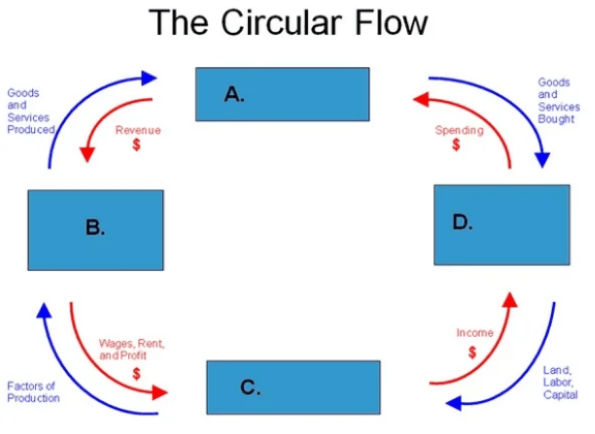
Point B represents
Product Market
Factor Market
Individuals
Businesses
What are the four main parts of the circular flow diagram?
Product Market, Stock Market, Factor Market, Fish Market
Product Market, House Market, Factor Market, Good Market
Factor Market, Product Market, Households, Firms
Factor Market, households, Stock Market, super market
Where are factors of production (land, labor, etc) exchanged in the circular flow model?
Factor Market
Product Market
Firms
Individuals
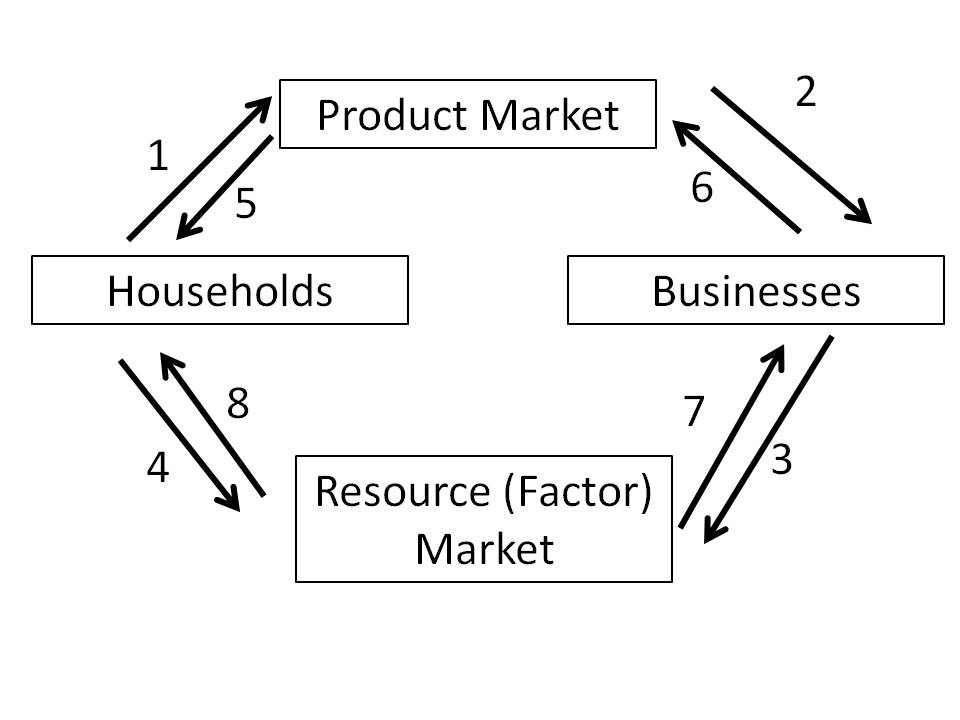
Arrows 4 and 7 on this circular flow diagram demonstrate
expenditures
finished goods and services
factors of production
factor payments
With respect to the circular flow model, businesses provide households with which of the following?
taxes and interest
labor and taxes
goods, services, and incomes
public goods and transfer payments


A merger is
Two business agreeing to becoming one new business
One business buying shares in another business
One business taking over control of another business
Two businesses co operating with each other.
A corporation is a business for which ownership is divided into shares or stocks that may be bought and sold through a stock exchange.
True
False
The shareholders may receive a part of the company's annual profit, if there is one, in the form of a dividend.
True
False

Public utilities are an example.
Perfect Competition
Natural Monopoly
Monopolistic Competition
Oligopoly

What letter on the graph represents the proper location for the market structure “oligopoly”?
W
Y
X
Z
On an average shopping trip, a consumer’s eye lingers on a product for only about 2.5 seconds. In order to stay competitive, companies experiment with new formulas, along with the color and size of the product’s packaging. These research and development costs can range from $100,000 for adding a new color to an existing product line to millions of dollars for the creation of a new product.
According to the passage, companies are trying to compete through
economies of scale
collusion
price-fixing
non-price competition

