
 Worksheets
Constructive & Destructive Forces Review
Total questions: 55
Worksheet time: 42mins
Mr. and Mrs. Jones built their house on the banks of the Chattahoochee River. Over time, the bank has begun to erode threatening their home. Which of the following should Mr. and Mrs. Jones consider doing in order to help save their home from collapse?
They should consider building a dam to control the flow of the water.
The town should consider using contour plowing to reduce the loss of rich soil.
They should consider constructing a levee.
They should consider contour farming their yard to prevent runoff.
This technology is used to prevent rivers from overflowing their banks.
Levees
Storm Drains
Dams
Contour Farming
This landform is created when over time waves carry sand toward a landmass and deposit it.
Beach
Sand Dune
Desert
Plateau
Weathering is an example of a
Constructive Force
Destructive Force
Both
The shaking of the Earth's surface caused by the release of energy along a fault is called a(n) __________________________.
Landslide
Volcano
Earthquake
Tornado
A ____________ occurs when gravity quickly pulls rocks and dirt downhill.
Sand Dune
Fault
Landslide
Volcanic Eruption
Which of the following is true about the Grand Canyon?
It was formed by earthquakes
It was formed by water erosion
It was formed by waves
It was formed by wind erosion
When rocks along a coastline are continually hit by waves, the waves erode the rock causing a hole in the rock formation. What is this called?
Sea Arch
Cliff
Sand Dune
Rockslide
Which of the following forces are considered both constructive and destructive? Choose all that apply.
Volcanos
Earthquakes
Weathering
Erosion

These landforms are created when ocean water deposits sand, creating a ridge of shallower water in the ocean.
Sand Dune
Sand Bar
Beach
Island
Which of the following pieces of technology is used by scientists to detect earthquakes?
Seismograph
Pictograph
Sattelite Imaging
Contour Farming
Which of the following are ways that farmers can help prevent topsoil from eroding? Choose all that apply.
Contour or Terrace Farming
Planting Trees
Having livestock only eat hay
Not farming on the land at all.
Which of the following happens when there is an earthquake? Choose all that apply.
The earth's surface suddenly moves.
A seismograph draws wavy lines.
Earth's plates slide past one another.
A crack opens on the other side of the Earth.
The Hawaiian Islands were formed as a result of:
Deposition
Glaciers
Hurricanes
Volcanic Activity
The Goddess Tefiti
Which of the following is an example of chemical weathering?
Ice expanding inside cracks on rocks
Roots of plants and trees growing into cracks in rocks.
Pollution that causes acid rain.
Sand particles being blown against rocks.
Erosion is caused by all of the following EXCEPT
Water
Heat
Wind
Gravity
Contour farming is an example of human technology that is used to help prevent:
Weathering
Erosion
Deposition
Crop Failure
Faults are an example of a
Constructive Force
Destructive Force
Both Constructive and Destructive Force
Deposition is an example of a
Constructive Force
Destructive Force
Both
Volcanoes are an example of a
Constructive Force
Destructive Force
Both
When an earthquake occurs, many things happen all at once. Which of the following happen during an earthquake?
The earth's surface suddenly moves.
A seismograph draws wavy lines.
Earth's plates slide past one another.
All of the above
Which of the following surface features is created through a constructive process?
Sand Dune
Canyon
Sea Arch
Volcano
Erosion is an example of an
Constructive Force
Destructive Force
Both
Which of the following types of erosion are responsible for the creation of sand dunes?
Water
Ice
Acid Rain
Wind
How were the Hawaiian islands formed?
Deposition
Glaciers
Volcanic Activity
Hurricanes
Which of the following does not cause erosion?
Water
Heat
Gravity
Wind
In which situation would a storm drain be helpful?
After a heavy rainstorm when water is pooling on a busy street
To distribute drinking water to far away communities.
To protect local animals from drowning.
To slow down river overflow.
The Grand Canyon was formed as a result of:
Volcanic Activity
Erosion from the Colorado Glacier
Erosion by the Mississippi River
Erosion by the Colorado River
Which of the following does not cause mechanical weathering?
Ice inside of rocks
Roots of plants or trees
Pollution
The movement of rocks by wind
A mudslide is an example of a ________________ process
Constructive
Destructive
Instructive
Both Constructive and Destructive
An earthquake is caused by an abrupt shift in the earth along a fracture. This fracture is called a:
Fracture Line
Crater
Crevasse
Fault
The surface feature that forms at the mouth of a river due to deposition is called a:
Sea Wall
Sand Dune
Delta
Sand Bar
Earthquakes are an example of a
Constructive Force
Destructive Force
Both
Which of the following forms of technology are used to control flooding?
Dams
Levees
Windbreaks
Both a and b
Scientists who study earthquakes in order to predict and prepare for them are called:
Meteorologists
Archaeologists
Seismologists
Cosmetologists
Which of the following best explains how mountain ranges are formed?
Wind has pushed rocks and soil into deep valleys that built up over time creating mountains.
Volcanoes erupted for long periods of time and slowly built up the mountains.
Rivers and streams flowing deposited soil in large amounts in one area until the mountains formed.
Part of the Earth's crust slowly collided until one part was on top of the other and pushed upwards.
Which of the following is a form of technology used to predict weather patterns including thunderstorms and tornadoes
Sea Wall
Doppler Radar
Seismograph
Levee
Which of the following forms of technology is used to protect beaches and other areas from the destructive forces of waves?
Sand bars
Sea Arches
Sand Dunes
Sea Walls
True or False, erosion is NEVER a fast process.
True
False
Sea Arches are formed by what type of erosion?
Water
Wind
Gravity
All of the above
What is sediment?
The process of rocks being broken down and carried away
Tiny pieces of rock and sand caused by the weathering of rocks
The top layer of soil
Decaying plant or animal material
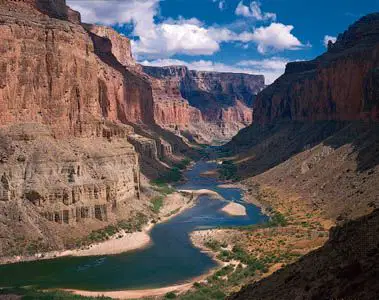
What landform is pictured here?
Mountain
Canyon
Plateau
Sand Dune

The fan-shaped landform pictured here is created by sediment being deposited at the mouth of a river. What is this landform called?
Delta
Canyon
Sand Dune
Sand Bar

A hill or ridge of sand that is formed when wind erodes sand and deposits it into a new location is called a _____________.
Sand Bar
Sand Dune
Delta
Plateau
Water getting into cracks, freezing, and breaking the rocks or pavement apart is called ___________________.
Mechanical Weathering
Chemical Weathering
Erosion
Deposition
Which of the following actions causes the deposition of sediment at a delta?
River water slowing down as it enters the ocean
Salt water and fresh water mixing together
Ocean waves transporting sand toward land
Ocean water slowing down as it reaches the coast
What is necessary for sand dunes to form?
Loose sand and strong wind
Waves reaching the shore
Strong Wind
Loose Sand
Rain washing away soil on a hillside is an example of ________________.
Weathering
Erosion
Deposition
These landforms are created when techtonic plates collide and push upward.
Mountains
Canyons
Plateaus
Sand Dunes
This landform looks like a mountain with a flat top. It was formed by weathering and erosion.
Mountain
Plateau
Canyon
Hill
Select three ways that sediment can be moved to a new location.
Snow
Ice
Water
Wind
The process of breaking up rocks on the Earth's surface is known as what?
Sediment
Erosion
Weathering
Deposition
Deltas forming at the mouths of rivers are examples of what?
Weathering
Erosion
Deposition
Compaction
Waves dropping sand on the beach is an example of what?
Weathering
Erosion
Deposition
Compaction
The process by which water, ice, wind, or gravity moves weathered rock and soil from one place to another is called ____________.
Weathering
Erosion
Deposition
Mudslide

