
 Worksheets
PHYSENG Diagnostic Quiz
Total questions: 50
Worksheet time: 3hrs 30mins
Which of the following are scalar quantities
Energy
Displacement
Electrical resistance
Force
Which of the following are vector quantities
Work
Current
Velocity
Acceleration
A car has travelled 6 Km East, followed by 3 Km east in 2 mins.
Calculate the cars speed and velocity.
A car reached a speed of 60 Km/S from rest in 2 mins. Its acceleration is
1 Km/S2
2 Km/S2
0.5 Km/S2
0.5 Km/S
Force is defined as
(a)
Contact force
is measured in Joules
occurs between objects in physical contact
such as gravity
occurs between objects not in physical contact
Distance force
Measured in Newtons
occurs between objects in physical contact
Such as friction
Occurs between objects not in physical contact
Power
is measured in Newtons
is the rate of work
is the product of force and velocity
is the product of force and displacement
Newtons first law states that
a moving object can randomly change speed
acceleration is dependent on the force
for every action there is a reaction
A stationary object will only move if a force acts on it
Newtons second law states that
Acceleration is independent on the force applied
Acceleration is directly proportional to mass
Acceleration is inversely proportional to mass
Acceleration is dependent on the force applied
Determine the significant figure(s) of: 0.01010
6
5
4
3
Determine the significant figure(s) of: 100010
6
5
4
3
Determine the significant figure(s): 111000
6
5
4
3
Match the factor with the prefix name: 1012
peta
tera
yotta
zetta
All fluids are:
gases
liquids
gases or liquids
non-metallic
To obtain the absolute pressure from the gauge pressure:
subtract atmospheric pressure
add atmospheric pressure
subtract 273
add 273
Several cans of different sizes and shapes are all filled with the same liquid to the same depth. Then,
The pressure on the bottom of each can is the same
The weight of the liquid on the bottom of each can is the same
The least pressure is at the bottom of the can with the largest bottom area
the force of the liquid on the bottom of each can is the same

The vessels shown above all contain water to the same height. Rank them according to the pressure exerted by the water on the vessel bottoms, least to greatest.
1,2,3,4
3,4,2,1
4,3,2,1
2,3,4,1
All pressures are the same

The diagram shows a U-tube with cross-sectional area A and partially filled with oil of density ρ . A solid cylinder, which fits the tube tightly but can slide without friction, is placed in the right arm. The system is in equilibrium. The weight of the cylinder is:
ALρg
L3ρg
Aρ(L+h)g
Aρ(L−h)g
According to Archimedes' principle, if a body is immersed partially or fully in a fluid then the buoyancy force is _______ the weight of fluid displaced by the body.
equal to
less than
more than
unpredictable
If the weight of an object is < the Buoyant Force, the object will ......................
Sink
Rise
Remain at the same level
According to Bernoulli's theorem in a flowing liquid
velocity is inversely proportional to pressure
velocity is directly proportional to pressure
velocity is directly proportional to volume
What is an ideal fluid?
A fluid which has no viscosity
A fluid which is incompressible
A fluid which has no surface tension
All the above
completely described by a magnitude with a direction.
MagLev trains...cool, huh?). The fastest trains travel about 250 km in a half an hour. What is their
average speed in km/hour?
for 8 s until it finally lifts off the ground.
Determine the velocity at take-off.
A vector is a ray with both ____________ and _____________.
Wings and halos
Space and time
Direction and magnitude
Radicals and exponents

Find the magnitude.
0
5
-5
4

Find the magnitude.
5
3
25
-4

Find the magnitude.
-10
-8
6
10

Find the magnitude.
4
5
3
square root of 5

Component Form
<-3, -7>
<3, -7>
<-3, 7>
<7, 3>
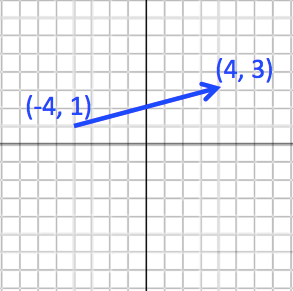
Write in component form.
<0, 4>
<8, 2>
<2, 8>
<0, 2>

Find the resultant vector.
<5, 3>
<1, 7>
<7, 1>
<3, 5>

