
Font size
 Worksheets
DNA and RNA Review
Total questions: 42
Worksheet time: 6mins
Who came up with the DNA model?
Franklin and Watson
Crick and Watson
Crick and Einstein
Newton and Watson
What does DNA stand for?
ribonucleic acid
diniate
denyrisonucleic acid
deoxyribonucleic acid
What shape is DNA?
double helix
single helix
triple helix
stepstool
What makes up the sides of the DNA twisted ladder?
nucleotides
sugar and nitrogen bases
sugar and phosphate
phosphate and nitrogen bases
What makes up the "rungs" (steps) of the ladder?
nucleotides
nitrogen bases
sugar and phosphate
nucleic acid
What does thymine always pair with?
adenine
cytosine
uracil
guanine
What does guanine always pair with?
adenine
cytosine
uracil
guanine
What are specific sections of DNA called?
nucleotides
traits
replication
genes
What holds the nitrogen bases together?
sugar
hydrogen bonds
phosphate
nucleic acid
What is the process by which one DNA molecule forms two DNA molecules?
duplication
transcription
replication
translation
Where is your DNA located inside a cell?
cytoplasm
mitochondria
nucleolus
nucleus
What does DNA code for?
makes mRNA which makes proteins
your traits like eye color
to make cell parts
all of the above
What does RNA have instead of thymine?
eracil
uracil
unical
urabel
RNA...
is a single chain of nucleotides (one side of the ladder)
is a double helix shape
is a twisted ladder
has deoxyribose sugar
DNA has _____________ sugar and RNA has ___________ sugar.
ribose, deoxyribose
phosphate, ribose
deoxyribose, ribose
deoxyribose, phosphate
The DNA unzips to replicate itself.
True
False
After DNA unzips and a mRNA code is made it stays attached to the DNA
True
False
What is a RNA molecule that contains a copy of the DNA's coded message?
cRNA
tRNA
rRNA
mRNA
What's a type of RNA that has a codon for bases and carries amino acids to the ribosomes?
cRNA
tRNA
rRNA
mRNA
What is the process of making a messenger RNA (mRNA) molecule?
translation
transcription
replication
protein synthesis
What is a 3 base code for a specific amino acid called that is attached to a tRNA?
codon
coder
cody
copier
Messenger RNA leaves the nucleus and goes to what cell part to make proteins?
mitochondria
lysosome
endoplasmic reticulum
ribosome
Transfer RNA (tRNA) match to the mRNA code & connects the amino acid to a chain to make a protein.
True
False
What is the process of making proteins inside a cell called?
replication
translation
transcription
protein synthesis

What is #1 in the picture an example of?
transcription
replication
translation
duplication

What is #2 in the picture an example of?
DNA
RNA
TNA
MNA
What is #3 in the picture an example of?
mRNA in the nucleus
DNA
tRNA
mRNA on a ribosome
What is #4 in the picture an example of?
transcription
translation
replication
duplication
What is #5 in the picture an example of?
protein
mRNA
tRNA
DNA
What is #6 in the picture an example of?
mRNA in nucleus
mRNA on a ribosome
tRNA
DNA

What is this picture an example of?
replication
duplication
transcription
translation
What process joins amino acids together to form proteins?
transcription
translation
replication
duplication
A gene is a part of the DNA molecule that codes for a unique __________.
base
nucleotide
sugar
protein
Which of the following determine(s) the protein that is built from a particular gene?
The nucleotides present in the gene
The number of sugar and phosphates used
The order the nucleotides are in
The type of ribosome that is used
Which RNA is produced during transcription?
transfer RNA
messenger RNA
ribosomal RNA
protein RNA
What is the first step in replication?
Ribosome reads the mRNA.
Enzyme unzips the DNA strand into two halves.
The tRNA brings an amino acid over.
Enzymes pair up nucleotides with their pairing partners.
Put the following evens in order for transcription.
a. An enzyme "reads" the order of the nucleotides in the DNA.
b. The mRNA leaves the nucleus.
c. An enzyme adds nucleotides to form the new mRNA.
d. An enzyme unzips part of the DNA molecule.
a, b, c, d
b, d, a, c
d, a, c, b
c, b, d, a
The process of transcription and translation can be considered engineered systems because they appear to be planned, designed, and built to work together.
True
False
Replication makes 2 different strands of DNA
True
False
Can DNA store information?
yes
no
Can DNA build cellular structures?
yes
no
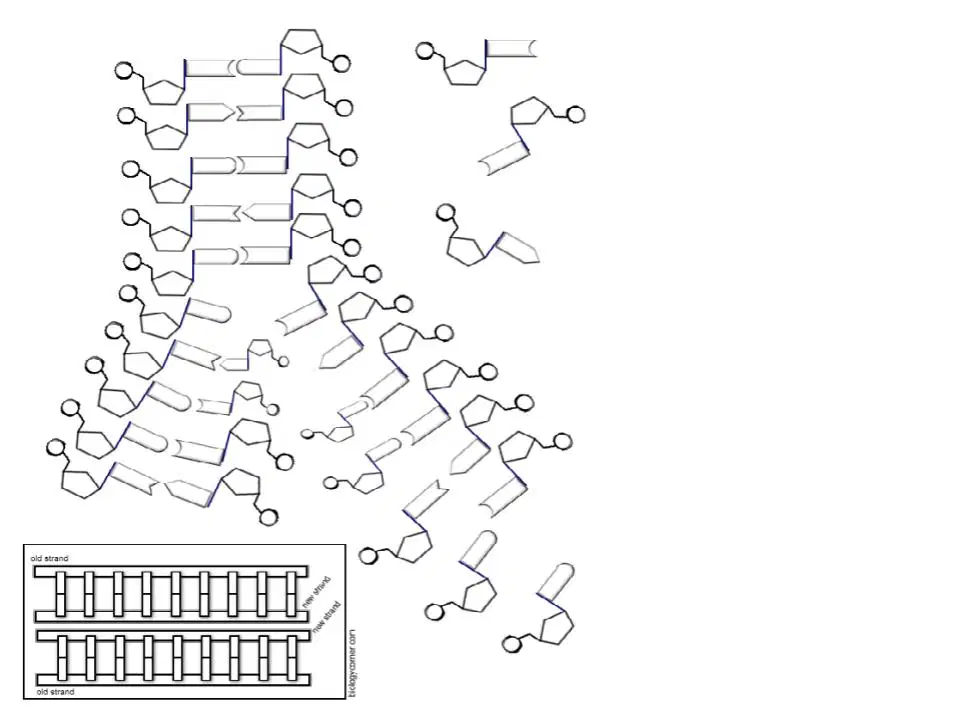
When DNA replicates which strands are the NEW DNA?
inside
outside

