wayground logo

Free Printable Worksheets

Font size

S
M
L
XL
Worksheets

Unit 4 APES Review

Total questions: 37

Worksheet time: 9hrs 15mins

Name
Class
Date
1.

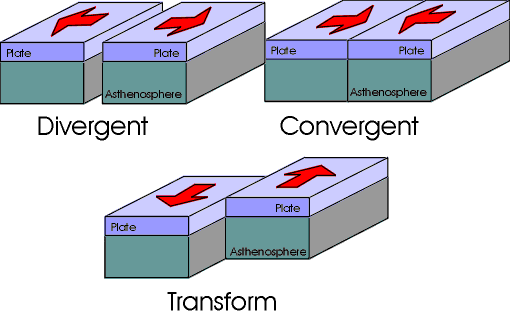
What is a convergent boundary and what do they create?

4 lines
2.

What is a divergent boundary and what do they create?

4 lines
3.

What is a transform boundary and what do they create?

4 lines
4.

What are the 6 soil horizons?

4 lines
5.

Which type of soil holds water really well?

4 lines
6.

What is a watershed?

4 lines
7.

What happens in El Nino and what happens in La Nina?

4 lines
8.

What is the percent of nitrogen and oxygen in the atmosphere?

4 lines
9.

What happens to the temperature in the troposphere and the stratosphere?
4 lines
10.

The surface of the earth, otherwise known as the ______, is broken into seven major pieces and sits atop a liquid layer called the _______

a)

lithosphere, asthenosphere

b)

astenosphere, mantle

c)

crust, litosphere

d)

asthenosphere, lithosphere

11.
What is "upwelling"?
a)
when wind near a shore pushes surface water away, nutrient rich cold water rises from the depths
b)
water rises from springs at the bottom of lakes
c)
it is when cold water sinks in the Norwegian Sea
d)
It is when the Coriolis effect makes currents go around in a circle
12.
One consequence of El Nino is _______ and increased rainfall in South America..
a)
flooding
b)
stronger Tradewinds
c)
strong winter storms
d)
drought
13.
The San Andrea's Fault in California is which type of boundary?
a)
Convergent
b)
Divergent
c)
Subductive Zone
d)
Transform
14.
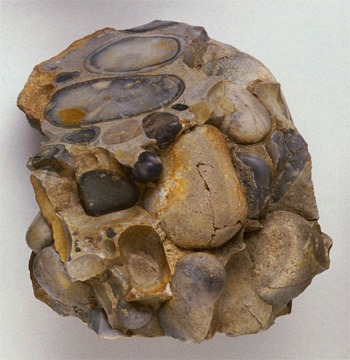
This rock was formed by smaller pieces of rock that settled at the bottom of a lake millions of years ago. What type of rock is this?
a)
Sedimentary
b)
Igneous
c)
Metamorphic
15.
Most of the freshwater around the world is used for the following purpose.
a)
industry
b)
residential
c)
agriculture
d)
recreation
16.
Which of the following contributes to the unequal warming of earth?
I. variation in the angle of sunlight that reaches Earth
II. variation in the amount of surface area over which the Sun's rays are distributed
III. variation in the amount of sunlight reflected from clouds
a)
I only
b)
I and II only
c)
II and III only
d)
III only
17.
The Coriolis effect is responsible for
a)
the convergence of two ascending Hadley cells
b)
the location of atmospheric currents caused by the unequal heating of Earth
c)
the cooling effect of air as it rises and expands
d)
the deflection of atmospheric currents
18.

The process by which the ocean floor sinks beneath a deep-ocean trench and back into the mantle is known as _______

a)

convection.

b)

continental drift.

c)

subduction.

d)

conduction.

19.

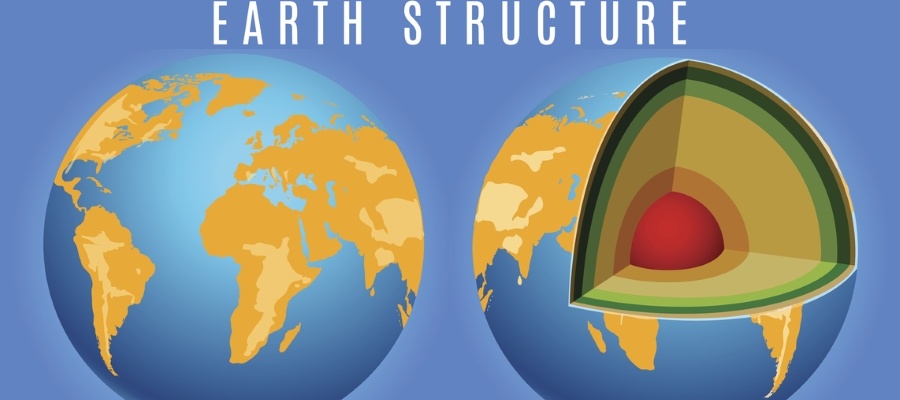
What is the correct order (starting from the surface) of Earth’s layers?

a)

crust, outer core, inner core, mantle

b)

mantle, outer core, inner core, crust

c)

crust, mantle, outer core, inner core

d)

outer core, inner core, crust, mantle
20.
The process when rocks break into smaller pieces due to exposure to natural elements is called
a)
erosion
b)
weathering
c)
sediments
21.
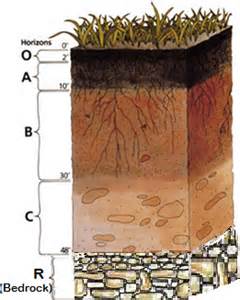
Which horizon is made up of partially weathered rocks?
a)
Horizon A
b)
Horizon B
c)
Horizon C
d)
Horizon D or R
22.
Which of the following is NOT one of the three types of soil?
a)
clay
b)
sand
c)
silt
d)
mud
23.
_______ is the type of soil used most often with plants. It is a mixture of clay, sand, and silt.
a)
loam
b)
humus
c)
mud
d)
dirt
24.
The two main agents of erosion are...
a)
wind and flowing water
b)
gravity and frost wedging
c)
oxygen and water
d)
carbon dioxiede and wind
25.
Which of the following is the correct order of soil particles in order of increasing particle size?
a)
clay-sand-silt
b)
sand-clay-silt
c)
silt-clay-sand
d)
clay-silt-sand
26.
Soil sample that is 60% clay, 30% silt, and 10% sand has which texture? 
a)
clay
b)
clay loam
c)
sandy loam
d)
silt 
27.
Which is the correct order of soil horizons starting at the surface?
a)
A, B, E,C, O
b)
O, A, B, C, E
c)
O, E, A, B, C
d)
O, A, E, B, C
28.

The rate at which water flows through the soil is called soil percolation or ______.

a)

Groundwater

b)

Permeability

c)

Soil Pores

d)

Porosity

29.

The movement of the tectonic plates is caused by

a)

the rotation of the Earth.

b)

convection currents in the Asthenosphere

c)

the gravity of the iron-nickel core.

d)

the Moho discontinuity.

30.

In some areas of the world, like California and Japan, earthquakes are a common occurrence. How can this best be explained?

a)

The strong ocean currents are undermining both areas causing earthquakes.

b)

Both areas are located near the edge of the Pacific Ocean, the unstable sand causes earthquakes.

c)

Both areas are subjected to strong ocean wind and waves that causes earthquakes.

d)

Both areas are on the boundary of active plates, the motion of the plates causes earthquakes.
31.

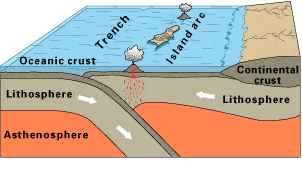
Observe this diagram of a plate boundary. One statement BEST describes what is happening. It is that

a)

the oceanic crust is melting.

b)

the denser ceanic crust is subducting under the less dense oceanic crust

c)

volcanic islands are forming.

d)

the tectonic plates are moving away from each other.

32.
Surface currents are a result of
a)
Global Wind Patterns
b)
Earth's Rotation
c)
Density
d)
All of the above
33.
Deep Ocean currents are a result of
a)
Global Wind Patterns
b)
Earth's Rotation
c)
Density
d)
All of the above
34.
The Coriolis Effect is caused by
a)
Earth rotating around the sun
b)
Earth rotating on its axis
c)
The tides
d)
Gravity
35.
Two types of water currents are
a)
local and global
b)
sea and land
c)
surface and deep
d)
warm and cold
36.

In which layer of the atmosphere does ozone help block UV radiation from striking the Earth?

a)

troposphere

b)

mesosphere

c)

stratosphere

d)

thermosphere

37.

In which layer of the atmosphere do all the pressure, wind, and precipitation changes occur?

a)

Outer space

b)

stratosphere

c)

troposphere

d)

mesosphere