wayground logo

Free Printable Worksheets

NEW

Font size

S
M
L
XL
Worksheets

Mitosis and Genetics

Total questions: 42

Worksheet time: 2hrs 6mins

Name
Class
Date
1.
Heterozygous is when...
a)
the alleles are the same
b)
the alleles are different
c)
the alleles are absent
d)
the alleles are present
2.
G = green, g = yellow
The genotype for a yellow plant is...
a)
GG
b)
Gg
c)
gg
d)
all of the choices result in yellow
3.
Which of the following alleles is homozygous (purebred) recessive?
a)
Tt
b)
tt
c)
TT
d)
t
4.
Aa, DD, bB, yy are all examples of
a)
genotypes
b)
phenotypes
5.
Which of the following genotypes is homozygous dominant?
a)
A
b)
Aa
c)
AA
d)
aa
6.
Which of the following genotypes is heterozygous?
a)
Bb
b)
BB
c)
bb
d)
B
7.
In a flowering plant species, red flower color (R) is dominant over white flower color (r). What is the genotype of any red-flowering plant resulting from this species?
a)
rr
b)
R
c)
RR
d)
RR or Rr
8.
What you see, or the physical appearance.
a)
Genotype
b)
Phenotype
c)
Homozygous
d)
Heterozygous
9.
How many alleles (letters) do each person carry for a trait?
a)
1
b)
2
c)
3
d)
4
10.
How many alleles (letters) does a child get from each parent for each trait?
a)
1
b)
2
c)
3
d)
4
11.
Which of the following is a phenotype?
a)
Aa
b)
red hair
c)
heterozygous
d)
DNA
12.
One form of a gene is called_______________
a)
a DNA
b)
a Phenotype
c)
a trait
d)
an allele
13.
W=white hair
w= non-white hair
If you cross a horse with WW and a horse with ww what fraction of the offspring would be expected to have white hair?
a)
none
b)
3/4
c)
1/2
d)
all
14.
this image is an example of
a)
codominance
b)
dominance
c)
incomplete dominance
15.
this image is an example of
a)
codominance
b)
dominance
c)
incomplete dominance
16.

A purebred horse with white hair is crossed with a purebred horse with brown hair. Each of their offspring has both white and brown hair. Why does this occur?

a)

several alleles work together to determine a trait

b)

two alleles for hair are dominant

c)

two alleles for hair are recessive

d)

the alleles for fur color are neither dominant or recessive

17.

What does a Punnett Square determine?

a)

all of Mendel's discoveries about genetic crosses

b)

all the outcomes of a genetic cross

c)

only the recessive allele combinations

d)

only the dominant allele combinations

18.

Scientists call an organism with two different alleles for a trait

a)

factor

b)

purebred

c)

trait

d)

hybrid

19.

If a homozygous black cat (BB) is crossed with a homozygous white cat (bb), what is the probability of having a cat with white fur?

a)

100%

b)

0%

c)

75%

d)

25%

20.

What does RR mean

a)

two dominant alleles

b)

heterozygous alleles

c)

at least one dominant allele

d)

one dominant and one recessive allele

21.

In a Punnett square, a lower case letter stands for a ____________ allele.

a)

dominant

b)

recessive

c)

homozygous

d)

heterozygous

22.

In animals, shaggy fur is dominant to short fur. The Punnett Square shows the genotypes of the offspring of a shaggy fur animal and a short fur animal. What were the genotypes of the parents?

a)

FF and FF

b)

Ff and ff

c)

ff and ff

d)

Ff and Ff

23.

In animals, shaggy fur is dominant to short fur. According to the genotypes shown, what percent of offspring will have short fur?

a)

0

b)

25

c)

50

d)

75

e)

100

24.

T = tall and t = short

In the punnett square shown, what belongs in the missing square

a)

tt

b)

Tt

c)

Bb

d)

TT

25.

In plants, tall (T) is dominant to short (t). Perform the following cross: Tt x Tt. What is the probability of producing a short plant?

a)

0%

b)

25%

c)

50%

d)

75%

26.
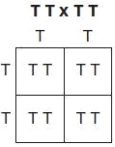
What ratio of the offspring from the cross shown will be homozygous recessive for the trait of tallness? 
a)
0 in 4
b)
1 in 4
c)
2 in 4
d)
4 in 4
27.

If a black guinea pig (BB) and a white guinea pig (bb) mate, there is a ______ chance that a white guinea pig will be born.

a)

0%

b)

25%

c)

50%

d)

75%

e)

100%

28.
The structure shown in the diagram is a _____________?
a)
chromatid
b)
chromosome
c)
centromere
d)
DNA
29.
Which stage of mitosis is shown in the diagram?
a)
Cytokinesis
b)
Interphase
c)
Anaphase
d)
Metaphase
30.
How many chromosomes do humans have?
a)
46
b)
21
c)
10
31.
Which stage of mitosis is shown in the diagram?
a)
Cytokinesis
b)
Anaphase
c)
Telophase
d)
Prophase
32.
Which stage of mitosis is shown in the diagram?
a)
Anaphase
b)
Cytokinesis
c)
Telophase
d)
Metaphase
33.
How many cells are made in the process of MITOSIS?
a)
one
b)
two
c)
four
d)
eight
34.
Cytokinesis happens at the end of mitosis. That is when
a)
the cell membrane splits
b)
the nucleus splits again
c)
the chromosomes merge
35.
In mitosis, the two resulting cells are
a)
different from the starting cell and identical to each other.
b)
different from the starting cell and different from each other.
c)
identical to the starting cell and different from each other.
d)
identical to the starting cell and identical to each other.
36.
Highly coiled strand of DNA
a)
Chromatin
b)
Chromosome
c)
Sister Chromatid
d)
Centeromere
37.

During prophase

a)

DNA lines up in the middle of the cell and DNA attaches to spindle fibers

b)

DNA condenses into chromosomes, centrioles and spindle fibers appear

c)

2 new identical cells are created

d)

DNA gets copied

38.

During cytokinesis

a)

DNA lines up in the middle of the cell and DNA attaches to spindle fibers

b)

Cell membrane pinches to make 2 new identical daughter cells

c)

Each DNA gets pull to the opposite sides of the cell

d)

2 new nuclei form

39.
a)

metaphase

b)

prophase

c)

anaphase

d)

telophase

40.
What is the purpose of mitosis?
a)
To increase the surface area of a cell
b)
To allow cells to divide for growth, repair, and renewal
c)
For increasing genetic variation within a species
d)
To allow for DNA replication and protein synthesis
41.
Which of the following describes cancer?
a)
Nondisjunction of gamete cells
b)
Cell division without replication of DNA
c)
Mitosis without cytokinesis
d)
Uncontrolled cell division
42.
What is the longest stage of the cell cycle called?
a)
Cytokinesis
b)
M phase
c)
Interphase
d)
G1 Phase