
 Worksheets
TRIAL CHAPTER 3: ELECTROCHEMISTRY
Total questions: 20
Worksheet time: 15mins
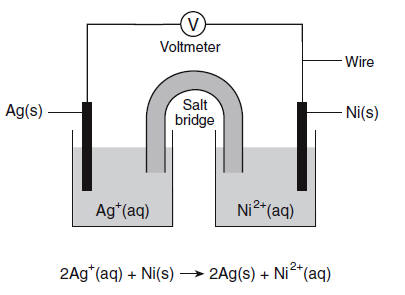
What reaction occurs at the anode?
Ag+/Ag = 0.80V
Ni2+/Ni = -0.25V
Ag+ + e- →Ag
Ag → Ag+ + e-
Ni2+ + 2e- → Ni
Ni → Ni2+ + 2e-
What would be the theoretical cell potential ( E cello ) of this electrochemical cell?
2Ag (ag)+ + Ni(s) → 2Ag(s) + Ni (aq)2+
Ag+/Ag = 0.80V
Ni2+/Ni = -0.25V
1.05V
-1.05V
0.55V
-0.55V
What is reduction?
It is the gain of electrons.
It is the loss of electrons.
It is the creation of electrons.
It is the destruction of electrons.
What is a reducing agent?
It is the species that gets reduced -- gains electrons.
It is the species that gets oxidized -- loses electrons.
It is the species that creates electrons.
It is the species that destroys electrons.
What is a cathode?
It is the electrode where oxidation takes place.
It is the electrode where reduction takes place.
It is an aqueous solution containing an electrode.
It is the salt bridge that connects half-cells.
What occurs to the mass of copper electrode in the following reaction?
Zn/Zn2+ // Cu2+/Cu
increases
decreases
remains the same

In the following reaction
Sn+2 + 2Fe+3 → Sn+4 + 2Fe+2,
the reducing agent is...
Fe+3
Sn+2
Sn+4
Fe+2

Galvanic cells convert
mechanical energy in to electrical energy
potential energy in to electrical energy
electrical energy in to chemical energy
chemical energy in to electrical energy

When water is electrolyzed, gas collected at cathode, is
sulphur
oxygen
hydrogen
sulphur dioxide
sodium liquid and chlorine gas
Which electrode is inert electrode.
Copper
Iron
Carbon
Zinc
Pick the CORRECT statement about S.H.E.
S.H.E is used as a reference electrode to measure standard reduction potential of half-cell.
S.H.E consists of a gold plate immersed in a basic solution.
Standard reduction potential for S.H.E. is 1.00 V.
Hydrogen gas at 1 atm and 0 ⁰C is pumped through S.H.E.
For cell notation : Cd (s)/Cd2+(aq) // Cu2+(aq)/Cu(s)
the voltage can be increased by
reducing [Cu2+]
reducing [Cd2+]
increasing [Cd2+]
reducing [Cu2+] and [Cd2+]
Faraday is the unit of
capacitance
current
power
electrical charge
An aqueous solution of zinc sulphate is electrolysed between zinc electrodes. Which of the following will not affect the mass of zinc deposited.
Concentration of zinc sulphate
Amount of current
Duration of electrolysis
Type of electrodes
Which of the species strong oxidizing agent?
Cl2(g) + 2e → 2Cl-(aq) Eocell = + 1.36 V
Cu2+(aq) + 2e → Cu(s) Eocell = + 0.34 V
Ni2+(aq) + 2e → Ni(s) Eocell = – 0.25 V
Ca2+(aq) + 2e → Ca(s) Eocell = – 2.87 V
Cl2(g)
Cu2+(aq)
Ni2+(aq)
Ca2+(aq)
Which of the following statement is TRUE about a Daniell cell?
Copper electrode is the anode.
Zinc electrode is the cathode.
Electron flows from anode to cathode.
Both electrodes used are graphite rods.

How to increase cell potential, Ecell based on this nearst equation:
Increase temperature
Decrease concentration Ni2+
Increase concentration Ni2+
Choose Eocell anode and cathode the positive value
Based on cell notation below, give the one electrolyte can be used in cathode?
Zn (s) /Zn2+ (aq,1M) // H+ (aq,1M) / H2 (g,1 atm)/graphite (s)
ZnSO4(aq)
H2(aq)
ZnCl2(aq)
HCl(aq)

