Wayground logo

Free Printable Worksheets

Font size

S
M
L
XL
Worksheets

B11 Quizziz

Total questions: 44

Worksheet time: 23mins

Name
Class
Date
1.

What is released by the pancreas when blood sugar is low?

a)

Glucose

b)

Insulin

c)

Glucagon

d)

Glycogen

2.

Sugar that is stored in the liver for emergency use

a)

Glucose

b)

Glycogen

c)

Glucagon

d)

Sucrose

3.

Hormone that lowers blood sugar

a)

Glucose

b)

Glucagon

c)

Glycogen

d)

Insulin

4.

Which gland produces insulin?

a)

Anterior pituitary

b)

Pancreas

c)

Posterior pituitary

d)

Adrenal

5.

A person that requires insulin shots has

a)

type 1 diabetes

b)

type 2 diabetes

c)

type 3 diabetes

d)

covid-19 patient

6.

In type 2 diabetes

a)

The body produces insulin but the liver and muscles don't respond properly to it

b)

doesn't produce insulin

c)

liver and muscle respond to it but its not made

d)

none of the above

7.

What does insulin promote in the liver?

a)

Breakdown of glycogen

b)

release of glucose

c)

Breakdown of glucagon

d)

production of glycogen

8.

What does glucagon promote in the liver?

a)

Breakdown of glycogen

b)

release of glucose

c)

Breakdown of glucagon

d)

production of glycogen

9.

What does insulin tell the fat cells to take in from the blood?

a)

Insulin tells fat cells to take in glucose from the blood

b)

Insulin tells fat cells to take in glucagon from the blood

c)

Insulin tells pancreas cells to divide

d)

Insulin tells fat cells to take in insulin from the blood

10.

Which organ do we store excess glucose in?

a)

Liver

b)

Heart

c)

Pancreas

d)

Brain

11.

What is glucose stored as?

a)

Glycogen

b)

Starch

c)

Glycerol

12.

Which organ monitors blood glucose level?

a)

Liver

b)

Pancreas

c)

Brain

d)

Heart

13.

Where does glucose travel?

a)

In the blood

b)

Using neurones

c)

Tissue fluid

14.
What is mean by homeostasis?
a)
Controls and coordinates body activities through chemical 
b)
controls and coordinates body activities through electrical impulses
c)
For maintenance of a steady state in the internal environment
d)
remove metabolic waste products from the cel
15.
How blood osmotic pressure will regulate in our body?
a)
regulate the glucose level in the body
b)
regulate the amount of water and concentration of salt in the blood
c)
regulate concentration of carbon dioxide and oxygen
d)
regulate the level of hydrogen ions, hydroxide ions, hydrogen carbonate ions
16.
what will produce if osmotic pressure is less? 
a)
Blood vessels will expanded
b)
Breating increase to make more air go in
c)
Sweet glands secrete more swe
d)
More diluted urine is produced
17.
what is the function of integumentary system to control body temperature high?
a)
arterioles in the epidermis dilate so that more blood flow to the skin
b)
produce hormones to reduce the metabolic rate
c)
sweat glands in the skin produce more sweat and hair erector mucles relax to let the hair lie down
d)
detect the temperature and send to nerve impulses to the brain
18.

Which body system controls the body to maintain homeostasis?

a)

excretory

b)

nervous

c)

circulatory

d)

skeletal

19.
The maintenance of an organism’s internal environment is called:
a)
compensating
b)
homeostasis
c)
balancing
d)
routine
20.
a body system that controls growth and homeostasis by secreting hormones from glands.
a)
skeletal system
b)
nervous system
c)
endocrine sytem
d)
integumentary system
21.
organ of the endocrine system that secretes hormones.
a)
heart
b)
gland
c)
brain
d)
skin
22.
chemical made by glands that tell cells to make something or respond in some way.
a)
acid
b)
enzyme
c)
perspiration
d)
hormone
23.
What is the endocrine system?
a)
senses the hormone levels in the blood
b)
controls all other endocrine glands
c)
A group of glands that work together with the nervous system to coordinate all body functions
d)
decreases bone calcium levels
24.
Negative Feedback Loops:
a)
amplify processes
b)
prevent small changes from getting larger
c)
are initiated during childbirth
d)
are found only in plants
25.
Negative Feedback Loops:
a)
amplify processes
b)
prevent small changes from getting larger
c)
are initiated during childbirth
d)
are found only in plants
26.
Name the levels of organization in the human body in order from smallest to largest:
a)
Tissue, organ, organ system
b)
Organ system, tissue, organs, cells
c)
Cells, tissue, organs, organ system
d)
Cells , organs, tissue, organ system
27.
Insulin causes
a)
a decrease in the concentration of blood glucose
b)
a decrease in the permeability of cell membranes to glucose
c)
an increase in the production of glucose from glycogen
d)
none of these is correct
28.

Too low insulin can cause ?

a)

Type 1 diabetes

b)

Type 2 diabetes

c)

Type 3 diabetes

29.

The diagram shows the mechanisms that control the concentration of glucose in the blood.


Which row identifies the glands and hormones labelled W, X, Y and Z?

a)

W - adrenal gland, X - adrenaline, Y - adrenal gland, Z - glucagon

b)

W - adrenal gland, X - adrenaline, Y - pancreas, Z - insulin

c)

W - pancreas, X - glucagon, Y - adrenal gland, Z - insulin

d)

W - pancreas, X - insulin, Y - pancreas, Z - glucagon

30.

Which hormone is produced in the testes

a)

Insulin

b)

Adrenalin

c)

Testosterone

d)

Thyroxine

31.

Which hormone controls the metabolic rate?

a)

Adrenalin

b)

Thyroxin

c)

Insulin

d)

Testosterone

32.

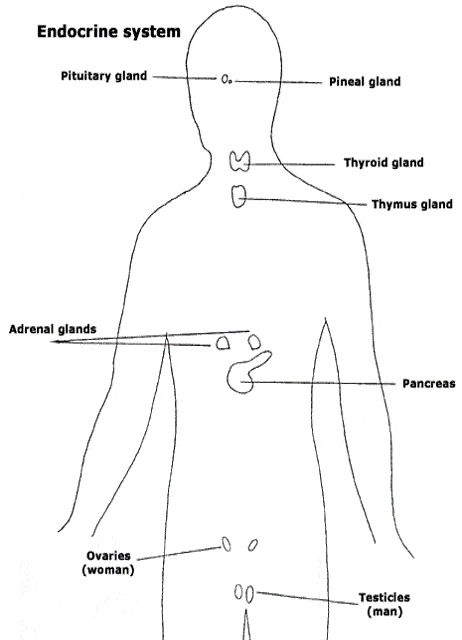
Where is the pancreas? (pick the correct number in diagram)

a)

3

b)

2

c)

6

d)

8

33.

Where are the adrenal glands? (pick the correct number in diagram)

a)

2

b)

4

c)

6

d)

5

34.

Where is the adrenal glands (pick the correct number in diagram)

a)

3

b)

4

c)

5

d)

9

35.

Which gland(s) is sometimes referred to as the master gland?

a)

Adrenal

b)

Pituitary

c)

Testes

d)

Ovaries

36.
Estrogen
a)
Controls sleep cycle
b)
Develops testis
c)
Development of female characteristics
d)
Raises blood glucose level after a meal
37.

Junction between two neurons is called ___________________

a)

Synapse

b)

Neuromuscular junction

c)

Epinephrine

d)

Interneuron

38.
Diabetes type I (mellitus) is caused by a lack of what pancreatic hormone:
a)
ADH
b)
Glucocorticoids
c)
Insulin
d)
Glucagon
39.
What usually causes hypothyroidism?
a)
Increased secretion of the thyroxine hormone
b)
No secretion of the thyroxine hormone by the thyroid
c)
Increased secretion of the growth hormone by the pituitary gland
40.
The thyroxine hormone regulates:
a)
The secretion of the adrenal cortex
b)
The use of sugar by the cells (metabolism)
c)
The level of calcium in the bloodstream
d)
The reaction of the body to stress
41.
Name of the hormone that breaks down glycogen into glucose.
a)
Aldosterone
b)
Insulin
c)
Glucagon
d)
Cortisol
42.
Hormone that maintains/reabsorbs the water in the body.
a)
Norepinephrine
b)
Adrenaline
c)
Melatonin
d)
ADH
43.

What are the functions of the pituitary gland?

a)

Excess inhibits TTH secretion,

Insufficient Thyroxin causes swelling of thyroid gland.

b)

Egg Production,

Lack of insulin Causes diabetes

c)

Stimulates thyroid for thyroxine,

Controls growth and controls activity for endocrine glands,

d)

Calcium Metabolism,

Stimulates Respiration and growth rate

44.

What is maintained during Homeostasis?

a)

Hair Colour

b)

Mitochondria per cell

c)

Blood Pressure

d)

Glucose