
 Worksheets
Optics 2.0 Review
Total questions: 68
Worksheet time: 1hrs 8mins

A student placed a pencil in a cup of water. The pencil appears broken because light
always travels in a straight line.
bends when it passes through water.
makes the water in the glass evaporate.
reflects the pencil on the water's surface.


In the ray diagram below, which line represents the incident ray?
A
B
N

In the ray diagram below, which angle represents the refracted angle?
A
B
C
What is a line drawn at 90° to a surface called?
incident ray
normal line
refracted ray
tangent
Light has the lowest speed in which medium? (n= index of refraction)
diamond
n=2.45
water
n=1.33
flint glass
n=1.70
crown glass
n=1.523
When light passes at an angle to the normal from one medium into another in which its speed is higher
it is bent toward the normal.
it always lies along the normal.
it is unaffected.
it is bent away from the normal.
What direction does the ray bend when entering a more optically dense material, where the wave travels more slowly?
Towards the normal.
Away from the normal.
No change.
Answer is not listed above.
If all other variables are held constant, what happens to the angle of refraction if the angle of incidence increases?
the angle of refraction stays the same
the angle of refraction decreases
the angle of refraction increases
cannot be determined from the information provided

Based on the image, which medium has a larger index of refraction?
Medium 1 has a larger index of refraction.
Medium 2 has a larger index of refraction.
Both mediums have the same index of refraction.
Cannot be determined.
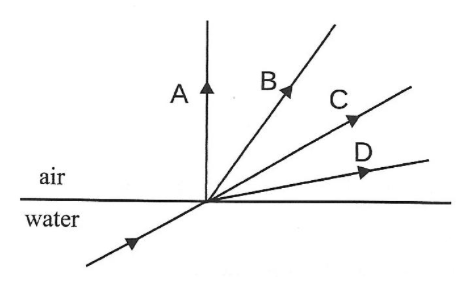
A light ray is incident from water to air. Which of the refracted rays is correct?
A
B
C
D


A concave lens has an inward curved shape. It refracts light outward from the lens. They light rays spread apart as they exit the lens. Which represents a concave lens?
A
B
A and B
neither A or B


The type of image formed in the screen by the projector.
Real image
Virtual image


which type of lens
concave
convex

Type of image formed in the picture
real image
virtual image

Which lens is more powerful?
A
B
What type of lens is used to produce an upright and small image of the object such as the one used in peepholes?
convex lens
concave lens
This lens is used in overhead projectors to produce an enlarged image of an object that can be projected on a white screen.
convex lens
concave lens
meniscus lens
bifocal lens

What type of lens is the droplet acting like?
convex
concave

which type of lens
concave
convex
Which figure represents the path light takes through a converging lens?
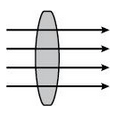
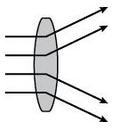
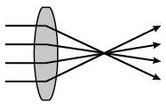
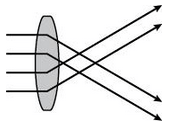

The lens pictured is exhibiting _______ behavior and is ______ in shape.
converging, convex
converging, concave
diverging, convex
diverging, concave
The image formed by ................... is always virtual, erect and small.
convex lens
concave mirror
plane mirror
concave lens

A person standing in front of a lens creates an image that is both smaller than the original and closer to the lens. Classify the image formed in this scenario.
real, inverted
real, upright
virtual, inverted
virtual, upright

Classify the image formed in this scenario.
real, inverted, larger than original
real, inverted, smaller than original
virtual, upright, larger than original
virtual, upright, smaller than original

The back part where the image is formed
retina
cornea-lens
pupil
iris

the black part that light goes through
pupil
iris
cornea-lens
retina

the colored part of the eye
pupil
iris
cornea-lens
retina


why pupil gets smaller in bright light?
to get as much light as possible.
to prevent damaged to eye due to bright light.
to make sure light gets refracted.
The image formed on the retina is _____________
upside
upside down
rotated at 90 degrees angle.

It is a common vision condition in which you can see objects near to you clearly, but objects farther away are blurry.
Hyperopia or Farsightedness
Myopia or Nearsightedness
Sty

The distance from the lens to the retina is shortened because the shape of the eyeball is more flattened. Light rays focus behind the retina instead of directly upon it.
nearsightedness
far farsightedness
Many farsighted people wear glasses because the shape of their eyeball is shorter than normal. What kind of lenses would be in those glasses?
convex
concave

Which of these is the cause of nearsightedness?
Eyeball is too long
Eyeball is too short

which type of lens will help correct this vision problem
convex
concave
opaque
plano
Which part of the camera focuses light?
sensor
shutter
lens
What is the function of sensor in a digital camera?
stops the light hitting it.
detects light falling on it.
adjusts the amount of light that enters into camera.
Which one of the following is true both for human eye and digital camera?
the sensor detects light.
the aperture controls the amount of light that enters.
the lens focuses the light.

Which part of your eye is most like the film in a camera?
The iris
The retina
The pupil
The lens
Which of the following is INCORRECTLY MATCHED?
retina - film
iris - diaphragm
pupil - aperture
none of these

This type of telescope is referred to as a ________________ telescope.
reflecting
refracting


Scientists use telescopes to make distant objects appear closer. Some parts of a telescope are shown here. Which of the following best describes how the objective lens of this telescope helps a scientist observe the moon? (5.6C)
The objective lens produces light.
The objective lens blocks light.
The objective lens reflects light.
The objective lens refracts light.

The picture shows a child standing in a swimming pool. Why does the lower part of the child appear so much different in size from the upper part? (5.6C)
The light rays that travel through water and then into air are refracted.
The light rays that travel through water and then into air are enlarged.
The light rays that travel through air and then into water are reflected.
The light rays that travel through air and then into water are reduced.
A student is building a model of a lens that will spread light over the biggest space. Which best describes the type of model the student should make?
The student should make a convex lens model because it breaks light down into bands of color.
The student should make a concave lens model because it breaks light down into bands of color.
The student should make a convex lens model because it directs light away from the center of the lens.
The student should make a concave lens model because it directs light away from the center of the lens.

A model of a concave lens is shown below.
Which of the following describes a possible application of this type of lens?
Concave lenses can be used in mirrors to make objects appear closer than they truly are.
Concave lenses can be used in laser pointers to converge the projected light to a single point.
Concave lenses can be used in microscopes to make small objects appear larger.
Concave lenses can be used in car headlights to spread the projected light outwards.

The time line below shows how the use of lenses to magnify objects has changed over the last 2,000 years. What does the time line suggest about scientific knowledge throughout the years?
It suggests that scientific knowledge began when the first convex lens was developed, since complex lenses opened the door to all scientific studies.
It suggests that scientific knowledge changes over time, as shown by the new discoveries made about lenses leading to changes in their uses.
It suggests that scientific knowledge does not change, as scientists work independently of each other and do not build on each other's ideas.
It suggests that scientific knowledge is replaced and not modified, as exemplified by the single lens replacing multiple lenses.

Which correctly describes the path of light through a microscope?
eyepiece - specimen on stage - convex objective lens - eye
convex objective lens - eyepiece lens - eye - specimen on stage -
specimen on stage - convex objective lens - eyepiece lens - eye
specimen on stage - eyepiece lens - path of convex objective lens - eyepiece lens - eye

Which correctly describes the path of light through a camera?
sensor/film - lens - aperture
sensor/film - lens - aperture
lens - aperture - sensor/film
aperture - lens - sensor/film

What is the manipulated variable in the data table shown?
medium
refractive index
medium vs. refractive index
What effect does the medium have on the refractive index?

What was the manipulated variable in this experiment?
distance from object to lens
height of the object
height of the image
type of lens
What was the responding variable in this experiment?
distance from object to lens
height of the object
height of the image
type of lens
What were controlled variable in this experiment?
distance from object to lens
height of the object
height of the image
type of lens
What claim could you make from this experiment?
When the distance from the object to the lens increases...
the height of the image increases
height of the image decreases
the height of the image stays the same
the height of the object decreases

