
 Worksheets
Scientific Enquiry
Total questions: 100
Worksheet time: 1hrs 15mins
The dependent variable is the variable that will be changed during an investigation.
True
False
Independent variable is usually the variables that we will keep constant.
True
False
Controlled variable
will be measured/observed during an experiment
will be changed during an experiment
will be kept constant during an experiment

What is the independent variable in the diagram above?
surface
type of surface
friction
size of friction
Which of the following is not a type of variable?
Independent variable
Controlled variable
Measured variable
Dependent variable

Describe the result shown.
Accurate and Precise
Not Accurate and Precise
Accurate and Not Precise
Not Accurate and Not Precise

Describe the result shown.
Accurate and Precise
Not Accurate and Precise
Accurate and Not Precise
Not Accurate and Not Precise

Describe the result shown.
Accurate and Precise
Not Accurate and Precise
Accurate and Not Precise
Not Accurate and Not Precise

Describe the result shown.
Accurate and Precise
Not Accurate and Precise
Accurate and Not Precise
Not Accurate and Not Precise

State one change that you would make to the table of results shown.
The decimal places are consistent and should not be changed
The units should be written beside all the values
The units should be written in the table headings
The heading of the table should be interchanged.
What do you do if you have an anomalous result?
Include the result in when taking an average
Exclude the result when taking an average
Edit and change the result without anyone knowing
What is the first step in a scientific enquiry?
Question
observation
conclusion
experiment
How can we make an experiment fair?
by keeping all the factors same.
by keeping all the factors different
by keeping all the factors same except one
by keeping all the factors same except two
Which one is the last step in a scientific enquiry
observation
conclusion
experiment
fair test
Which is true about hypothesis?
A. It may reject or accepts your prediction.
B. It is an educated guess or possible answer to the question.
C. It summarizes the result on the experiment.
D. It is the final answer to the question.
Which is the second step in scientific method?
A. Making a conclusion
B. Identifying the problem
C. Formulating hypothesis
D. Do background research
Maria wants to know if tomato seed grows faster than a monggo seed. She then ask her father, which is a farmer about her question. Which steps of scientific method does Maria performs?
A. Identify the problem and make a conclusion.
B. Identify the problem and make a hypothesis.
C. Identify the problem and conduct an experiment.
D. Identify the problem and do background research.
The scientific method starts when you ___________ about something that you observe.
A. ask a question
B. do background research
C. construct hypothesis
D. construct a conclusion
All hypothesis are accepted.
TRUE
FALSE
What are you going to do to test the hypothesis?
A. Do background research
B. Do an experiment
C. Construct a conclusion
D. Both A and C are correct
It is also known as manipulating variable. The condition you change during the investigation.
A. Control variable
B. Dependent variable
C. Independent variable
D. Responding variable
Which step of the scientific method uses an "If...Then..." statement to provide a possible answer to the question?
Purpose
Research
Hypothesis
Conclusion
Which type of variable must always stay the same in order to make the experiment accurate?
Controlled Variable
Manipulated Variable
Dependent Variable
Responding Variable
When we investigate the rate of reaction we are looking at the...
amount of product formed
speed of reaction
concentration of reacting particles
combining reactants with products
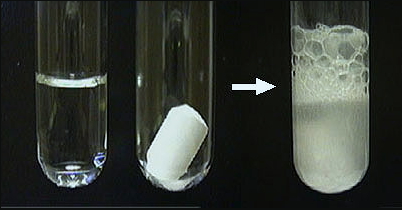
How could we make this reaction happen more quickly?
Decrease the concentration of the acid
crush the chalk to increase the surface area
Put the test tube in an ice bath
Grinding a effervescent tablet into powder increases the rate of reaction due to increased
concentration
surface area
temperature
reactants
Increasing the temperature gives particles more __________.
Time
Energy
Space
Frequency
As the frequency of ______________ increases, the rate of reaction increases.
Time
Reactions
Collisions
Reactants
Adding a catalyst ___________ the activation energy.
Raises
Lowers
Doesn't affect
Inreases
The minimum amount of energy needed for colliding particles to react is called
Chemical Energy
Kinetic Energy
Activation Energy
Potential Energy

Icing sugar has a greater ______ _____ than a solid cube of
sugar.
Surface Area
Catalyst
Temperature

A temperature increase causes the particles to ......
to slow down
move faster
collide higher
in the right order
Which out of the following is NOT a factor that affects the rate of a reaction
temperature
concentration
surface area
volume
catalysts
How does a catalyst work in speeding up a reaction?
by lowering the activation energy (minimum energy needed for the reaction to take place)
by giving the reactants more energy
by increasing the number of reactant particles
by increasing the temperature

Why does a higher concentration increase the rate of reaction?
it increases the amount of reactants
it lowers the activation energy
it increases the energy of particle collisions
it increases the frequency of particle collisions
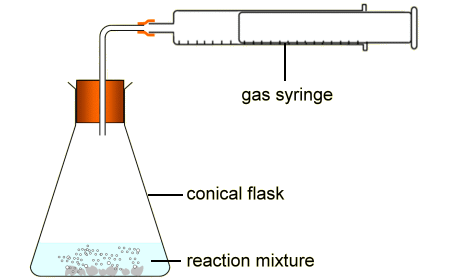
How is this equipment being used to measure the rate of reaction?
The gas syringe measures how much gas is produced in a certain time
The reaction mixture will increase in volume in a certain time
What must ALWAYS be measured to calculate the rate of reaction?
Mass of product
Mass of reactant
Volume of gas produced
Time
When is a reaction rate fastest?
At the start
In the middle
Towards the end
It is the same rate all the way through
How can the volume of a gas be measured?
Beaker
Measuring cylinder
Gas syringe
Volumetric Pipette

How many birds are represented by the green sector?
5
20
9
13

How many employees travelled by car to work?
22
8
10
12

What is the maximum number of computers that someone said they had?
8
10
4
1

How many times was the number 3 rolled?
6
2
3
4
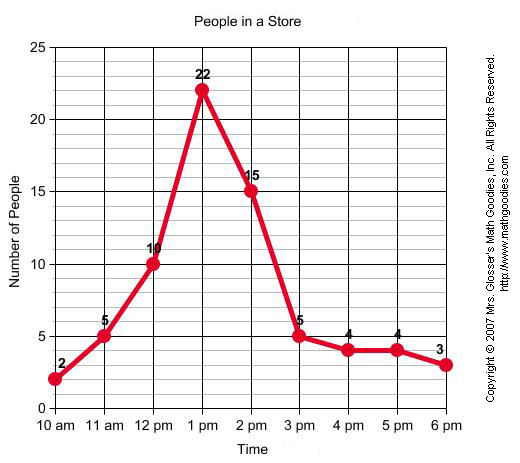
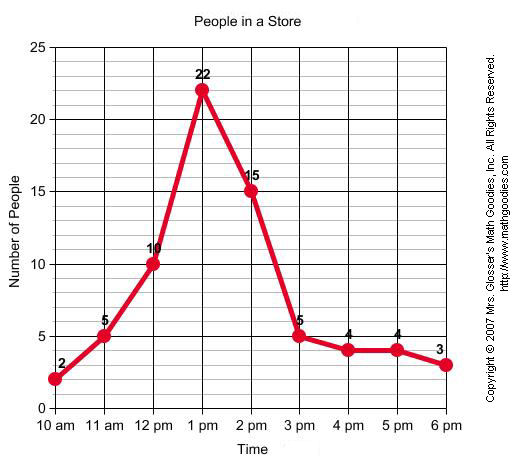

How many members planted at least 3 seeds?
19
36
55
72

Which list has the players arranged from highest-scoring to lowest scoring?
Dave, Kalid, Liza
Dave, Liza, Kalid
Kalid, Dave, Liza
Kalid, Liza, Dave

What kind of graph is this called?
Circle graphg
Line graph
Pie chart
Bar graph

What is the independent variable in this graph?
Tadpoles
Year
Frogs
Number of tadpoles in the pond
What type of graph shows change over time?


Which month had the biggest difference between the high and low temperatures?
January
April
October
November


Why are graphs and charts important to analyze data?
Graphs and charts are important to analyze data because we would never be able to know what is going on with the data.
Graphs and charts are important to analyze data because teachers say they are important.
Charts and graphs is something good to do because they are nice to look at.
Charts and graphs allow a person to visualize data and find patterns and trends in the data.


What is the independent variable on the graph (x-axis)?
Metro Bicycle Shop Weekly Sales
Bicycles Sold
Types of Bicycles

What is the dependent variable on the graph (y-axis)?
Metro Bicycle Shop Weekly Sales
Bicycles Sold
Types of Bicycles
It is used to measure the temperature of an object or a substance.
barometer
thermometer
hygrometer
milliliter
Which laboratory apparatus would you use to measure 75ml of water accurately?


The laboratory apparatus above are used to measure _____________ .
mass
length
volume
temperature
Apparatus used for heating small quantity of chemicals
Beaker
Flask
Test tube
Gas jar

Mention the use and the material from which it is made of.
Plastic and for crushing solids
Steel and for mixing chemicals
Porcelain and for crushing and grinding solids
Used to heat liquids for evaporation.
mortar and pestle
glass watch
evaporating dish
funnel
What laboratory apparatus are you going to use if you want to pour liquids into containers with small openings?
test tube
evaporating dish
glass funnel

Name the use of the give picture.
used for the measurement of an amount of a liquid
mainly used to store and mix solutions
used for transferring liquids from one container to another
Ali would like to heat a test-tube containing chemical X over a Bunsen burner. How should Ali carry put the heating?
Holding the test tube with his bare hands
Holding the test tube with a piece of cloth
Holding the test tube using a test tube holder
Holding the test tube with tongs
It is used to measure masses very precisely
weighing scale
burette
dropper
beam balance
State the function of beam balance
To measure mass
To measure weight
To measure distance
To measure time

What is the name of this apparatus?
Beaker
Measuring cylinder
Pipette
Test tube

What is the name of this apparatus?
Tripod
Conical flask
Pouring glass
Filter funnel

Match the symbol to the correlating hazard
EXPLOSIVES


This lab student is wearing her googles and an apron. But what is she doing wrong?
Pointing the test tube toward her while heating it.
She actually is doing everything correctly.
Her loose hair is too close to the fire.
Not paying attention

What does this hazard symbol mean?
Harmless to trees and fish
Harmful to non living things
Harmful to living things
Harmless to non living things

What does this hazard symbol mean?
flammable
oxidising
hot
explosive

What does this hazard symbol mean?
cross
harmful / irritant
sharp
chemical


What does this symbol indicate?
Corrosive substances
Wash your hands.
Wear appropriate gloves.
Bacteria are present.
Some chemicals cause skin rash as they are ..........
Poisonous
flammable
Irritant
oxidizing
Which picture represent eye safety?


what is a hazard?
Something that has the potential to cause harm
The possibility that harm may occur
Something that can make you fall over
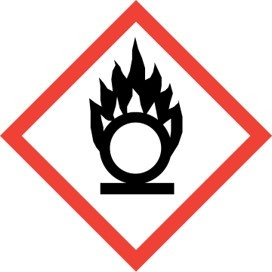
What does this symbol stand for?
Flammable
Oxidising
Non-flammable
Explosive

