
 Worksheets
G10 Chemistry Unit 11 Quiz
Total questions: 23
Worksheet time: 18mins
"Water and sulfur trioxide vapor combine to form sulfuric acid." Which is the correct skeleton equation?
H2SO4(s) --> H2O(l) + S3O(g)
H2O(aq) + SO3(g) --> H2SO4(s)
H2O(l) + S3O(v) --> H2SO4(aq)
H2O(l) + SO3(g) --> H2SO4(aq)
"When heated, solid mercury (II) oxide decomposes into mercury liquid and oxygen gas." What is the correct skeleton equation for this reaction?
Hg(l) + O2(g) --> Hg2O(s)
Hg2O(s) --> Hg(l) + O(g)
HgO(s) --> Hg(l) + O2(g)
What type of reaction is this?
Two Reactants and One Product
Decomposition
Combination/Synthesis
Combustion
Single Replacement
What type of reaction is this?
One reactant into several products.
Decomposition
Combination/Synthesis
Combustion
Single Replacement
What type of reaction is this?
One element replaces another in a compound.
Combination/Synthesis
Combustion
Single Replacement
Double Replacement
What type of reaction is this?
Starts with a Hydrocarbon that reacts with oxygen and produces carbon dioxide and water.
Decomposition
Combination/Synthesis
Combustion
Single Replacement
What type of reaction is this?
The metal ions in two compounds switch.
Combination/Synthesis
Combustion
Single Replacement
Double Replacement
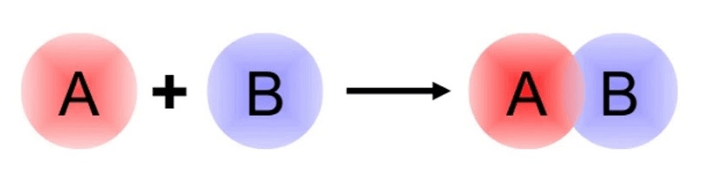
What is the type of reaction shown above?
Combination/Synthesis
Decomposition
Single Replacement
Double Replacement
Identify the reaction type:
C2H6(g) + O2(g) --> CO2(g) + H2O(l)
Double replacement
Combination/Synthesis
Acid base
Combustion
Identify the reaction type for the following equation:
K(s) + F2(g) --> KF(s)
Double replacement
Single Replacement
Combination/Synthesis
Decomposition
Identify the type of reaction:
ZnCl2(aq) + Mg(s) --> Zn(s) + MgCl2(aq)
Precipitate
Single Replacement
Double Replacement
Decomposition
Identify the reaction type:
NaCl(s) + KOH(aq) --> KCl(aq) + NaOH(aq)
Double replacement
Combustion
Synthesis
Decomposition
Identify the reaction type:
H2O2 (g) --> H2O (l) + O2 (g)
Decomposition
Combination/Synthesis
Combustion
Acid Base
An ion that does not take part in the chemical reaction and is found in solution both before and after the reaction.
cation
spectator ion
skeleton equation
precipitate
Which of the following reactions does NOT have a net ionic equation?
C9H20 + O2 --> CO2 + H2O
AgNO3 + CaCl2 --> AgCl + Ca(NO3)2
NH4I + PbOH --> NH4OH + PbI2
Fe(NO3)2 + KOH --> KNO3 + FeOH
Which of the following shows the correct net ionic equation for the reaction of Ba(MnO4)2(aq) + (NH4)2SO4?
Ba2+ + SO42- --> BaSO4
2NH4+ + 2MnO4- --> 2NH4MnO4
Ba + MnO4- --> Ba(MnO4)2
2MnO4- + SO42- --> BaSO4
A solid which is formed after a reaction in liquid solution.
cation
spectator ion
skeleton equation
precipitate
Which of the following have compounds which are all soluble in water?
Sodium
Potassium
Ammonium
Nitrate

