wayground logo

Free Printable Worksheets

Font size

S
M
L
XL
Worksheets

Chem Reactions Practice Test

Total questions: 45

Worksheet time: 1hrs 11mins
Name
Class
Date
1.
The substances at the beginning of a chemical equation are called the ____
a)
product
b)
yield
c)
chemical symbol
d)
reactants
2.
In a chemical reaction, everything to the right of the arrow is called ______________.
a)
Products
b)
Yields
c)
Molecules
d)
Reactants
3.
Which of the following is evidence of a chemical reaction?
a)
fizzing
b)
water changing to ice
c)
saltwater
d)
paper being cut in half
4.
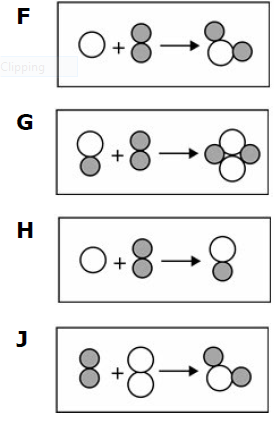
Which of the following models best demonstrates a balanced chemical equation?
a)
F
b)
G
c)
H
d)
J
5.
What are Chemical Reactions?
a)
It's when you mix substances.
b)
a process in which atoms rearrange to form new substances
c)
When something bubbles.
d)
letter and numbers showing the types and number of atoms
6.
Which of the following is NOT evidence that that a chemical reaction has occurred?
a)
produces light/heat
b)
production of a gas
c)
formation of a precipitate
d)
melting
7.
A different chemical substance is formed when _____.
a)
water boils
b)
metal rusts
c)
ice melts
d)
rock is crushed
8.
A teacher is demonstrating physical and chemical changes to her class. Which action should she use to demonstrate a chemical change?
a)
cutting a piece of paper
b)
folding a piece of paper
c)
tearing a piece of paper
d)
burning a piece of paper
9.

What is the conservation of mass?

a)

mass of reactants > mass of products

b)

mass of reactants < mass of products

c)

mass of reactants = mass of products

10.
P4 + 3O--> 2P2O3
a)
Synthesis 
b)
Decomposition
c)
Single displacement
d)
Combustion
11.
2NO2 --> N2 + 2O2
a)
Synthesis
b)
Decomposition
c)
Single displacement
d)
Combustion
12.

The glow stick glowed brighter in hot water because

a)

The chemical reaction slowed down in hot water

b)

The chemical reaction sped up in hot water

c)

Temperature has no effect on the glow stick chemical reaction

d)

All of the above

13.

When you combine vinegar and baking soda, a gas is produced. The gas produced is considered evidence that a chemical reaction occurred.

a)

True

b)

False

14.

What is the little number after an element in a chemical equation called.

Example: H2

a)

Coefficient

b)

Subscript

c)

Atom

d)

Equation

15.

How many different ELEMENTS are in C6H12O6?

a)

1

b)

2

c)

3

d)

4

16.

How many Hydrogens are in 4H2O?

a)
6
b)
8
c)
2
d)
4
17.
How many atoms of Hydrogen are in this compound
a)
1
b)
2
c)
3
d)
4
18.
How many total atoms are in the compound C2H8O ?
a)
11
b)
2
c)
8
d)
1
19.
How many Aluminum are in Al2O3?
a)
3
b)
2
c)
5
20.
How many atoms are there TOTAL in:
H2SO4
a)
6
b)
5
c)
7
d)
3
21.
What does the arrow in a chemical equation stand for?
H2 + O --> H2O
a)
Reactants
b)
Products 
c)
Yields 
d)
Chemical Equation 
22.
The red numbers in the image represent _____.
a)
subscripts
b)
coefficients
c)
charges
d)
oxidation states
23.
The substances at the beginning of a chemical equation are called the ____.
A + B --> AB
a)
product
b)
yield
c)
chemical symbol
d)
reactants
24.

Melting solid butter to a liquid is what kind of change?

a)

physical

b)

chemical

c)

neither

25.

A change in state of matter is a

a)

chemical change

b)

physical change

c)

neither

26.

when all matter is contained; it cannot enter or leave a system

a)

open system

b)

closed system

c)

Cass Junior High

27.

a way to show a chemical reaction with symbols instead of words

a)

subscript

b)

coefficient

c)

chemical equation

d)

elements

28.

a reaction in which compounds break down into simpler products

a)

synthesis

b)

replacement

c)

decomposition

29.

What elements are in the formula: C6H12O6

a)

Cobalt

b)

water

c)

reactant

d)

carbon, hydrogen, oxygen

e)

calcium and sugar

30.

Amount of energy needed to start a reaction

a)

catalyst

b)

inhibitor

c)

activation energy

d)

coffee

31.

Substance used to lower the activation energy and speed up a reaction

a)

caffeine

b)

catalyst

c)

inhibitor

d)

activation energy

32.

Atoms are neither created nor destroyed; they can rearrange to form new substances

a)

synthesis reaction

b)

chemical reaction

c)

physical change

d)

law of conservation of mass

33.

Substance used to slow down a reaction

a)

sleep

b)

inhibitor

34.

Which of the following 2 are chemical reactions?

a)

sugar dissolving in water

b)

water turning into steam

c)

burning wood

d)

mixing baking soda and vinegar

e)

tearing paper

35.

Some chemical reactions require a substance called a catalyst. The purpose of a catalyst is

a)

to warm up the reaction

b)

to speed up the reaction

c)

to create more reactants

d)

to stop the reaction

36.
a copper penny turning greenish after a few years.
a)
Chemical Change
b)
Physical Change
37.
Which is the name of the kind of solid substance formed in this figure?  
a)
aqueous 
b)
precipitate
c)
acid
d)
synthesis 
38.
The smell made from spraying perfume on yourself. 
a)
Chemical Change
b)
Physical Change
39.

Which one shows that a chemical reaction has occurred?

a)

dissolving

b)

melting

c)

formation of a gas

d)

bending

40.
The process going from a gas to a liquid is called ...
a)
evaporation 
b)
melting 
c)
condensation 
d)
sublimation 
41.
The only way you can be certain that a chemical reaction has occured is by? 
a)
Light has been emitted 
b)
a colour change has occurred 
c)
bubbles appear 
d)
identifying one or more new chemical products 
42.

The wax melts from a candle

a)

physical change

b)

chemical change

43.

Are you ready for the test Wednesday?

a)

yes

b)

no

c)

ugh oh, I don't know

44.

Black smoke coming from a candle is a sign of a chemical reaction.

a)

yes

b)

no

45.

All matter is contained; it cannot enter or leave

a)

open system

b)

products

c)

closed system

d)

reactants