
 Worksheets
MSE Quiz 1
Total questions: 105
Worksheet time: 1hrs 22mins

Choose the best answer from the choices given. Write the letter that corresponds to your answer on the space provided.
Q: Identify the type of defect shown below.
Edge dislocation
Screw dislocation
Mixed dislocation
Grain boundary
It is a normally occupied lattice point from which an atom is missing.
Self-interstitial
Interstitial impurity
Vacancy
Frenkel defect
In this process, impurity atoms are added into a material to improve its properties.
Strain hardening
Cold working
Alloying
Grain boundary strengthening
Basic geometric grouping of atoms that is repeated
unit cell
crystal
non-crystal
amorphous

What kind of crystalline structure does the image depicts?
simple cubic
bcc
fcc
hip

what kind of crystalline structure does the image depicts?
simple cubic
bcc
fcc
hcp

What kind of crystalline structure does the image depicts?
simple cubic
bcc
fcc
hcp
Which of the following is the characteristic of a crystalline structure?
ductile
malleable
brittle
elastic
Crystalline or amorphous: diamond
(a)
crystalline or amorphous: glass
(a)
crystalline or amorphous: graphite
(a)
Which of the following is an example of ionic bonding?
ammonia
water
lithium iodide
copper
Which of the following is an example of covalent bond?
lithium bromide
sodium bromide
potassium fluoride
carbon dioxide
Which of the following is an example of metallic bonding?
iron
copper
gold
all of the given choices
Which of the following elements is a nonmetal?
oxygen
neon
radon
all of the given choices
Which of the following elements is a metal?
chlorine
molybdenum
argon
radon
Which of the following elements is a metalloid?
boron
helium
gold
tungsten
Refers to the atomic interaction where valence electron/s is/are donated.
ionic bonding
covalent bonding
Van Der Waals
London forces
Which of the following bonds occurs in molecules containing hydrogen atoms covalently bonded to another form?
metallic bonding
covalent bond
Van Der Waals
London forces
Which of the following is considered physical property of a material?
thermal expansion
conductivity
permeability
phase transition
Choose all materials that are less dense than water.
granite
rubber
ice
cork
Choose all materials that has lower thermal conductivity compared to water.
carbon dioxide
paper
glass
fiber glass
What is the SI unit for electrical resistivity?
siemen
mho
ohm
ohm-meter
These defects are associated with only one or two atomic positions.
Interfacial defects
Line defects
Dislocations
Point defects
Materials made by man using both organic and inorganic substances.
Synthetic materials
Natural materials
Optical materials
Biomedical materials
Materials that have high thermal and electric conductivity, as well as forming bonds and cations of non-metals.
Alloys
Metals
Ceramics
Nanomaterials
These materials are good insulators and strong di-electric. They are usually found in transmission lines.
Alloys
Ceramics
Nanomaterials
Composites
An interstitial impurity must be .
smaller than the host atom
similar in size to the host atom
larger than the host atom
more electronegative than the host atom
In this process, a metal undergoes plastic deformation to introduce dislocations in the lattice and improve the metal’s strength.
Alloying
Grain boundary strengthening
Strain hardening
Annealing
These defects are associated with only one or two atomic positions.
Interfacial defects
Line defects
Dislocations
Point defects
Forms of matter that constitute an object.
Polymers
Materials
Composites
Ceramics
Large molecules made by boding a series of building blocks.
Nanomolecules
Polymers
Composites
Ceramics
An inorganic non-metallic solid made up of either metal or non-metal compounds, primarily used in pottery.
Alloy
Composite
Ceramics
Polymer
Materials that have high thermal and electric conductivity, as well as forming bonds and cations of non-metals.
Alloys
Metals
Ceramics
Nanomaterials
A collection of several strands of glass that are mixed with plastic to make it durable.
Graphene
Prosthetic
Fiberglass
Polystyrene
What is material science?
Focus is on how to translate or transform materials into useful devises or structures.
Involves designing or engineering the structure-property correlations of a material to produce a predetermined set of properties.
A branch of science that focuses on materials; interdisciplinary field composed of physics and chemistry.
Relationship between the synthesis and processing, structure and properties of materials.
These are the components of material science tetrahedron EXCEPT ...
Performance
Properties
Processing
Structure
Characterization
Listed below are non-ferrous metals EXCEPT ..............
aluminium
zinc
hydrogen
copper
These are the reasons why you need to study material science and engineering EXCEPT
able to select the best material for certain application
able to create a new material
able to predict the properties of new found material
able to select the most expensive material for certain application
A good electrical and heat conductor, strong and ductile. This statement refers to :
metal
polymer
ceramic
glass
Semiconductor is a material that
change color when temperature is changes
respond to magnetic field
conducts and insulates electrical current
conducts and insulates heat
Which one of these is NOT a metal?
mercury
steel
aluminium
helium
These are the characteristics of polymeric materials EXCEPT
Lightweight
Low densities
Good thermal insulator
Good electrical conductor
Below are the example of polymers EXCEPT?
Polycarbonate
Polyethylene
Silicon carbide
Nylon
Copper, titanium and nickel are the ________________ materials.
polymer
metal
semiconductor
composites
It is measured by the area under stress-strain curve.
Toughness
Elasticity
Resilience
Hardness
It is defined as ability to absorb energy without suffering permanent deformation.
Toughness
Strength
Elasticity
Resilience
It is defined as ability to carry stress without suffering a permanent deformation.
Resilience
Elasticity
Toughness
Stiffness
It is defined as the ratio of the measured force to the original cross-sectional area.
Engineering stress
Stiffness
True Stress
Shear stress
It is defined as ability to carry stress without changing dimension.
Stiffness
Hardness
Toughness
Elasticity
It is defined as ability to sustain dead load
Strength
Resilience
True Stress
Ruptures
The amount of elastic energy per unit volume that is sustained on loading and released upon unloading of a test specimen.
Resilience
Stress
Strength
Tensile stress
Force per unit area within a structure subjected to a force or pressure
Strength
Stress
Strain
Elasticity
The deformation per unit of length as a result of force.
Stress
Strain
Deformation
All of these
An internal force which resists a load which tend to compress or shorten a body.
Tensile stress
Compressive stress
Shearing stress
Bending stress
An induced force which resists a deformation caused by a load which tends to stretch or elongate a body.
Compressive stress
Tensile stress
Shearing stress
Bending stress
Dental materials can withstand one type of stress while fail under another.
True
False
Maximum stress required to fracture a material.
Ultimate strength
Ultimate stress
Strength
Yield strength
The ability to stretch and not break.
Flexibility
Elasticity
Resilience
Toughness
The resistance of material to indentation or abrasion.
Toughness
Hardness
Strength
Elasticity
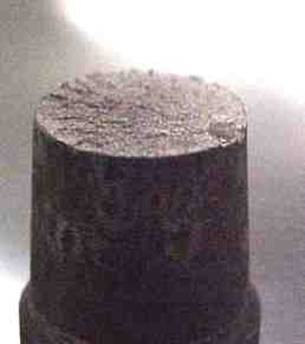
This image is an example of a material with...
Low Ductility
High Ductility
Low Brittleness
High Brittleness
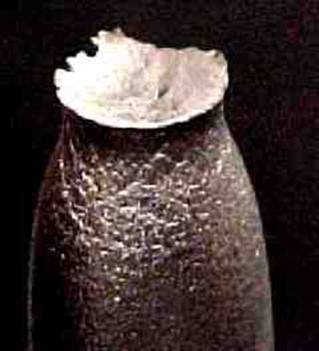
This image is an example of a material with...
Low Ductility
High Ductility
Low Brittleness
High Brittleness
Which of these are true?
Hardness is tested using a standard machine to make an hole in the surface of the material
Hardness is tested using a standard machine to make an indentation in the surface of the material
The width of the hole determines the hardness of the material
The size of the indentation determines the hardness of the material

A chemical bond between two atoms where one or more electrons are passed from one atom to another. When they give up electrons, each of the atoms should have a filled shell. An example is the sodium chloride bond.
Ionic bond
Hydrogen bond
Element
Covalent bond

A chemical bond that has hydrogen covalently bonded to an electronegative atom. It happens when oxygen bonds to hydrogen.
Ionic bond
Hydrogen bond
Molecule
A chemical bond where electrons are shared between two atoms. In this type of bond no ions are. You will find these bonds when carbon bonds to other elements.
Covalent bond
Element
Hydrogen bond

On the periodic table, the horizontal (side to side) rows are called and the vertical (up and down) columns are called .
Families, groups
groups, periods
families, periods
periods, groups
Which of the following is an example of ionic bonding?
ammonia
water
lithium iodide
copper
Which of the following is an example of covalent bond?
lithium bromide
sodium bromide
potassium fluoride
carbon dioxide
Which of the following is an example of metallic bonding?
iron
copper
gold
all of the given choices
Which of the following elements is a nonmetal?
oxygen
neon
radon
all of the given choices
Which of the following elements is a metal?
chlorine
molybdenum
argon
radon
Refers to the atomic interaction where valence electron/s is/are donated.
ionic bonding
covalent bonding
Van Der Waals
London forces
Which of the following bonds occurs in molecules containing hydrogen atoms covalently bonded to another form?
metallic bonding
covalent bond
Van Der Waals
London forces
Choose the correct answer about Atom
A combination of two or more of one kind of atoms bonding together
Basic unit of an element formed for all materials whether in solid, gas or liquid.
Various kinds of atoms are combined chemically
Various / different kinds of atoms combined together but not chemically bond
Choose the correct answer about Compound
Various / different kinds of atoms combined together but not chemically bond
A combination of two or more of one kind of atoms bonding together
The basic unit of an element formed for all materials whether in solid, gas or liquid
Various kinds of atoms are combined chemically

The horizontol rows of elements on the periodic table are called PERIODS.
TRUE
FALSE
Select the right statement for the Covalent bonding.
Can be done by sharing two electrons between pairs of atoms
Force of attraction between the opposite charges of an ion
Each atom would like to gain an electron and form a stable octet
Each atom contributes one electron for the sharing process
Spheres representing nearest-neighbor atoms touch one another.
Atomic hard-sphere model
Bohr Model
Reduced sphere model
Lattice
means a three-dimensional array of points coinciding with atom positions
Lattice
Amorphous
Unit Cells
FCC
the sum of the sphere volumes of all atoms within a unit cell (assuming the atomic hard-sphere model) divided by the unit cell volume
Atomic packing factor (APF)
Total unit cell volume
Volume of atoms in a unit cell
What kind of crystalline structure does the image depicts?
simple cubic
bcc
fcc
hip
What kind of crystalline structure does the image depicts?
simple cubic
bcc
fcc
hcp
Which of the following is the characteristic of a crystalline structure?
ductile
malleable
brittle
elastic
Which of the following is an example of ionic bonding?
ammonia
water
lithium iodide
copper
Which of the following is an example of covalent bond?
lithium bromide
sodium bromide
potassium fluoride
carbon dioxide
Which of the following is an example of metallic bonding?
iron
copper
gold
all of the given choices

