
 Worksheets
3RD 9 WEEKS TEST REVIEW
Total questions: 90
Worksheet time: 3hrs 0mins
Supporters – North (Cities)/Business people. Wanted a strong federal government & supported industry & trade, supported the constitution.
Federalists
Democratic-Republican Party
Monroe Doctrine
Capitalism
Supporters – South/Farmers. Wanted to limit the federal government’s power.
Federalists
Democratic-Republican Party
Monroe Doctrine
Capitalism
This speech warned of foreign countries & political parties as the greatest threats to U.S.A.
WASHINGTON’s FAREWELL ADDRESS (1796)
ALIEN & SEDITION ACTS (1798)
HENRY CLAY
ERA of GOOD FEELING
Made becoming a citizen harder & allowed President to jail/deport illegal immigrants.
WASHINGTON’s FAREWELL ADDRESS (1796)
ALIEN ACT (1798)
HENRY CLAY
ERA of GOOD FEELING
SEDITION ACTS (1798)
Made false/scandalous/hateful writing vs. the United States government a crime.
WASHINGTON’s FAREWELL ADDRESS (1796)
ALIEN ACT (1798)
HENRY CLAY
ERA of GOOD FEELING
SEDITION ACTS (1798)
The Chief Justice of the Supreme Court negotiated a treaty with Great Britain that settled the British exit of the Ohio Valley & debts owed to each other. France got MAD!
JAY TREATY (1794)
XYZ AFFAIR (1798)
WAR HAWKS
WAR OF 1812 (- 1815)
BATTLE of NEW ORLEANS (1815)
France would only discuss a treaty with the U.S.A. for a $250,000 bribe & a $12 million loan.
JAY TREATY (1794)
XYZ AFFAIR (1798)
WAR HAWKS
WAR OF 1812 (- 1815)
BATTLE of NEW ORLEANS (1815)
The practice or act of force-ably assigning men or property into service, esp. into military or naval service
capitalism
impressment
indentured servitude
oligarchy


What did the President create to help solve the challenges of the new nation?
Cabinet
Think Tank
Brain Trust
Board of Directors
Who was the first vice-president and then elected to be the second President of the United States?
John Adams
Thomas Jefferson
George Washington
Benjamin Franklin
Who was Washington's Secretary of Treasury?
Thomas Jefferson
Henry Knox
Alexander Hamilton
John Adams
What were the steps to Hamilton's plan for the economy? (3 points)
Tariffs on imports
Excise tax on domestic goods
Establish a national bank
Excuse everyone's debts
Where was the first capital of the United States?
Washington D.C.
Philadelphia, PA
New York City, NY
Harrisburg, PA
The South agreed to help pay the Northern states' debt if
the North would give them fair prices on manufacturing
they would not oppose slavery.
they would agree to build a new capital in the South.
North agreed to maintain the capital in NYC.
a certificate issued by a government for an amount of money that the government promises to pay back with interest.
sedition
faction
neutral
bond
Contrary to what is permitted by the Constitution
nullify
alien
unconstitutional
precedent
people who invest in a risky venture in the hope of making a large profit
tariff
impressment
speculator
alien
a ceremony in which the President takes the oath of office
unconstitutional
inauguration
neutral
impressment
a tax on imported goods
faction
nullify
speculator
tariff
an organized political group
faction
nullify
impressment
bond
not favoring either side in a dispute
nullify
bond
neutral
speculator
It was easy to become a new nation.
True
False
A country that is governed by representative and leaders elected by the people is called a
Common Good
Republic
Nation
State
To pay in return for protection is called
a loan.
bribery.
smuggling.
tribute.
The leader who encouraged Native American tribes to unite against western settlement was
York
William Henry Harrison
Sacagawea
Tecumseh
Supporters of the War of 1812 who tended to be southerners were called
explorers.
war hawks.
Federalists.
smugglers
The Sedition Act punished people who openly disapproved of the government. When Thomas Jefferson took office,
he founded a newspaper to publish information about them.
he released people who had been imprisoned under the Sedition Act.
he supported the passage of a "freedom of the press" bill in Congress.
The United States purchased the Louisiana Territory from
Canada
Great Britain
Spain
France
Thomas Jefferson was uncomfortable about buying the Louisiana Territory because
he did not have the constitutional power to buy land from another country.
he worried about angering farmers who shipped their crops to New Orleans.
he worried that the land in the territory would be of poor quality
Which of the following is an example of judicial review?
Congress votes to approve a Supreme Court appointment.
A decision by a lower court is appealed to the Supreme Court.
The Supreme Court rules that a new law violates the Constitution.
The Mississippi River was especially important to farmers because it
encouraged new settlers to come north on barges and steamboats.
protected them from Native American attacks.
allowed them to ship their crops to market in New Orleans.
The significance of the Supreme Court case Marbury v. Madison is that the decision:
advanced civil rights for minorities
limited Presidential control of foreign policy
upheld the constitutionality of a national bank
established the power of judicial review
Which of the following was one of the major effects of the Louisiana Purchase?
It made Jefferson a dictator.
It doubled the size of the United States.
It put the port of New Orleans in danger.
It started a war between France and Britain.
What is impressment?
When Americans went back on their promises to Native Americans
A ban on trade with ALL foreign goods
A tax on imported goods
Forcing captured sailors to serve in the military
Which of the following words means to prohibit trade with a foreign nation?
Impressment
Tariff
Embargo
Blockade
Which country is Lewis referring to in this excerpt from his journal?


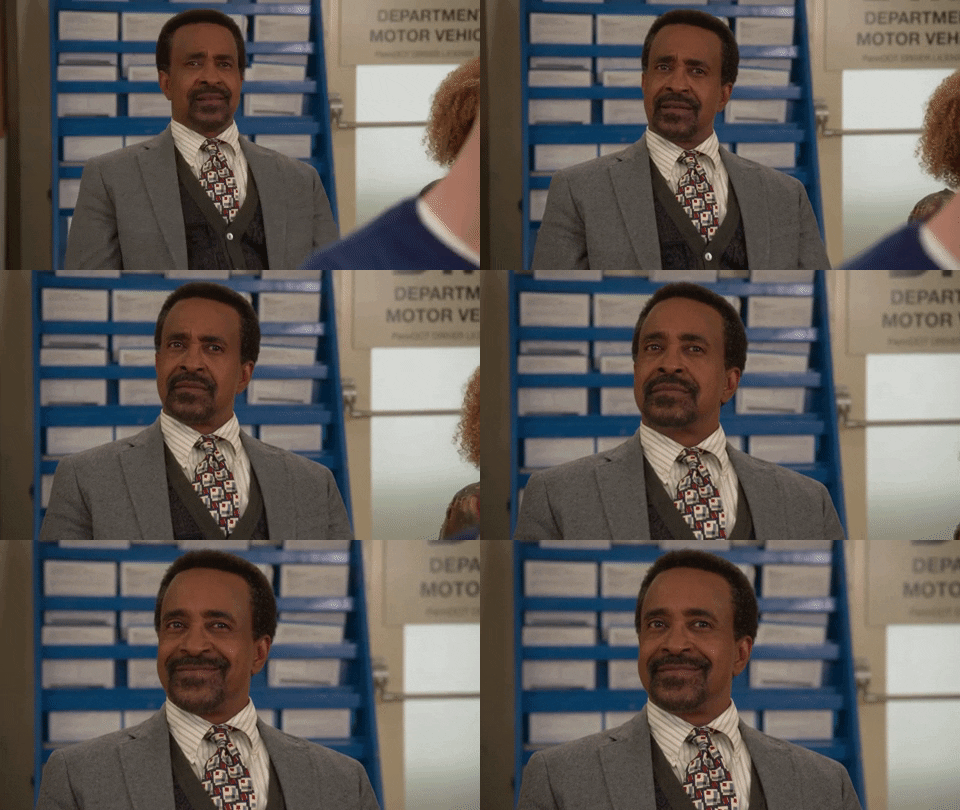


The idea that the United States will expand from coast to coast is?
"Manchurian Destiny"
"Macadamia Destiny"
"Manifest Destiny"
"Marinara Destiny"
Which of the following images wasn't a danger to Lewis and Clark?


Hero of New Orleans and Horseshoe Bend
William Henry Harrison
James Madison
Andrew Jackson
Oliver Hazard Perry
What does "Laissez Faire" mean?
The government should be more involved in the economy.
The government should not interfere in the economy.
How did the United States react to the war between France and Great Britain?
the U.S. sided with France
the U.S. remained neutral
the U.S. sided with the British
What issue was the cause of the battle of Tippecanoe?
slavery
taxes
conflict with Native Americans
shipping rights

Which branch determines if laws are constitutional?
legislative
executive
judicial
all branches have this power

Which is a job of the President?
make laws
enforce (carry out) laws
interpret laws
declare war

What is the electoral college?
a school all presidents must attend
a way to override a veto
the way we elect the president
popular sovereignty

What is the legal process to become a citizen?
impeachment
naturalization
interpretation
popular sovereignty

Where in the Constitution would you find the Bill of Rights?
Preamble
Articles
Amendments
it is not in the Constitution
Which are steps to becoming naturalized? Check all that apply.
Living in the US at least 5 years
filing appropriate paperwork and paying fees
taking a test over civics and history
submitting to a background check, interview, and taking an oath
All of the above
Who is in charge of the executive branch?
Chief Justice
The President
Majority Whip
Speaker of the House
How many US Senators are there?
50
200
100
435
If the President can no longer serve, who becomes President?
The First Lady
Speaker of the House
Senate Majority Leader
The Vice President
How old do citizens have to be to vote for President?
16
21
18
25
How many amendments does the Constitution have?
21
23
27
10
What are the first 10 Amendments to the Constitution called?
Bill of Rights
First 10 corrections
Judicial Review


The Legislative Branch is the _______________ branch of the federal government.
Lawmaking
Law enforcing
Law ignoring
Court
In the Preamble, We the People means the ___.
Constitution was written for all the people of the United States
Constitution was only written for the delegates at the Constitutional Convention.
people who actually authored the constitution.
people of Philadelphia

How many Branches of Government are there?
3
4
5
6
To formally approve a plan or an agreement.
Ratify
Sign
Accept
Accomplish


