wayground logo

Free Printable Worksheets

NEW

Font size

S
M
L
XL
Worksheets

GCA Reactions & Energy Test Review Physical Science

Total questions: 50

Worksheet time: 2hrs 33mins

Name
Class
Date
1.
How many Hydrogen are in 4H2O?
a)
6
b)
8
c)
2
d)
4
2.
How many HCl molecules do you need to balance this equation? 
Mg +  __HCl --->  MgCl2 + H2
a)
1
b)
2
c)
3
d)
4
3.

Balance this equation:

___CF4 + ___Br2 --> ___CBr4 + ___F2

a)

2,1,2,1

b)

1,2,2,1

c)

1,2,1,2

d)

2,2,2,2

4.
The substances listed on the right side of a chemical equation are the
a)
Yields
b)
Reactants
c)
Products
d)
Precipitates
5.
The substances listed on the left side of a chemical equation are the
a)
Products
b)
Coefficients
c)
Precipitates
d)
Reactants
6.

In chemical reactions, what does the principle of conservation of mass mean?

a)

Matter is not created or destroyed.

b)

The total mass of the reactants is greater than the total mass of the products.

c)

The total mass of the reactants is less than the total mass of the products.

d)

Matter is not changed.

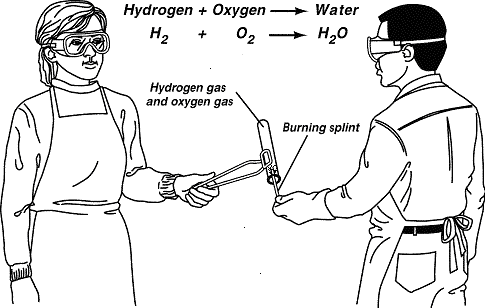
7.
Identify the reactant(s) and product(s) of the reaction.
a)
All three are reactants and none are products.
b)
Hydrogen and water are the reactants, and oxygen is the product.
c)
Water and oxygen are the reactants, and hydrogen is the product.
d)
Hydrogen and oxygen are the reactants, and water is the product.
8.
Which one is a compound?
a)
Co
b)
Br
c)
Fe
d)
CO
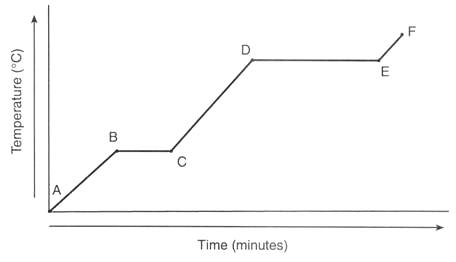
9.
What line segment represents only the solid state?
a)
A-B
b)
B-C
c)
C-D
d)
D-E
10.

In which segment is the kinetic energy remaining constant while the potential energy increases?

a)

A-B

b)

B-C

c)

C-D

d)

E-F

11.
What state(s) of matter are present at D-E?
a)
Solid-liquid
b)
Liquid
c)
Liquid-gas
d)
Gas-Solid
12.

Between which points is the average kinetic energy of the substance increasing?

a)

A-B only.

b)

A-B, C-D, E-F

c)

B-C only.

d)

B-C, D-E

13.

Between which points is the substance increasing its potential energy by changing state?

a)

A-B only.

b)

A-B, C-D, E-F

c)

B-C only.

d)

B-C, D-E

14.
In nature, heat always flows from a:
a)
cold object to a warm object.
b)
small object to a big object.
c)
warm object to a cold object.
d)
large object to a small object.
15.
Heat energy from the sun is transferred to Earth by:
a)
conduction.
b)
radiation.
c)
convection.
d)
insulation.
16.
Heat is the movement of ______.
a)
radiation
b)
thermal energy
c)
cold
d)
fire
17.
Heat moves by ______ when it travels from one solid to another solid.
a)
radiation
b)
convection
c)
thermal energy
d)
conduction
18.
The way heat moves in liquids and gases is called _______.
a)
convection
b)
radiation
c)
conduction
d)
temperature
19.
The heat from a hot burner to a pot is transferred by ______.
a)
convection
b)
insulation
c)
radiation
d)
conduction
20.
The measure of average kinetic energy of all the particles within an object is called ____________. 
a)
temperature
b)
conduction
c)
radiation
d)
heat 
21.
The amount of energy required to raise the temperature 1ºC for every kilogram is called____?
a)
Thermal Energy
b)
Specific Heat
c)
Temperature
d)
Kinetic Energy
22.
What is the symbol for Thermal Energy?
a)
Q
b)
t
c)
m
d)
C
23.

What is the equation to measure a change in Thermal Energy?

a)

Q=mc∆T

b)

Q=mc

c)

Q= ∆mcT

d)

m=QC

24.
Water has a specific heat of 4184 J/KgºC.  Wood has a specific heat of 1760 J/KgºC.  What material needs more energy to raise the temperature 1ºC
a)
Wood
b)
Water
c)
Both are the same
25.
Copper, Stainless Steel, Carbon Steel, and Zinc were all heated using the same thermal energy.  What material would be the coolest after being heated?
a)
Copper
b)
Carbon Steel
c)
Zinc
d)
Stainless Steel
26.
A material was cooled from 100ºC to 40ºC.  What is the temperature change?
a)
60ºC
b)
40ºC
c)
-60ºC
d)
-40ºC
27.
The handle of a frying pan is often coated in rubber because rubber provides...
a)
Heat insulation
b)
Heat conduction
c)
A low melting point
d)
A nonstick surface
28.
Conductors are materials that...
a)
Allow heat to pass through
b)
Stop heat from passing through
c)
Allow cold to pass through
d)
Stop cold from passing through
29.

Which will heat up faster?

a)

copper

b)

granite

c)

iron

d)

basalt

30.

Which of the following best explains why the sand at the beach is hotter than the water?

a)

Sand has a higher specific heat than water.

b)

Sand has a lower specific heat than water.

c)

There is more water than sand at the beach.

d)

There is more sand than water at the beach.

31.
Object A has a specific heat of 4.45 J/g⁰C and object B has a specific heat of 1.82 J/g⁰C. Which object will heat up faster?
a)
Object A, it has a lower spefici heat
b)
Object B, it has a lower specific heat
c)
Object A, it has a higher specific heat
d)
Object B, it has a higher specific heat
32.
Graphite has a specific heat of 0.709 J/g⁰C. If a 20 gram piece of graphite is cooled from 38⁰C to 18⁰C, how much energy was lost by the graphite?
a)
283.6 J
b)
183.6 J
c)
203 J
d)
109 J
33.

What does "ΔT" stand for?

a)

A change in time

b)

A change in temperature

c)

A change in mass

d)

A change in trajectory

34.

What are the accepted units for specific heat capacity?

a)

J/g * C

b)

J/g

c)

g/J * C

d)

J

35.

Which of the following describes suitable values of specific heat capacity of insulator and conductor?

a)

insulator = low

conductor = low

b)

insulator= low

conductor = high

c)

insulator = high

conductor = low

d)

insulator = high

conductor = high

36.
4Si + S8 --> 2Si2S4
a)
Synthesis
b)
Decomposition
c)
Single displacement
d)
Double displacement
37.
3Ca + 2AlCl3 --> 3CaCl2 + 2Al
a)
Synthesis
b)
Decomposition
c)
Single diplacement
d)
Double displacement
38.
3KOH + H3PO4 --> K3PO4 + 3H2O
a)
Synthesis 
b)
Decomposition
c)
Single displacement
d)
Double displacement
39.
2Pb(NO3)2 --> 2PbO + 4NO2 + O2
a)
Synthesis 
b)
Decomposition
c)
Single displacement
d)
Combustion
40.

Which reaction type is the following: C5H10O4 + O2 --> CO2 + H2O

a)

Decomposition

b)

Single Replacement

c)

Combustion

d)

Double Replacement

41.
Evidence of a chemical reactions is anything that shows - 
a)
a new substance has formed
b)
a solid dissolved in a liquid
c)
interaction between 2 gases
d)
a change in the state of matter
42.
Which of the following describes a precipitate?
a)
a liquid forms when a block of metal is heated
b)
a solid forms when one liquid is poured into another
c)
a gas forms when a solid is placed in a liquid
d)
bubbles form when an acid is poured on a rock
43.

Which is NOT an indication of a chemical change?

a)

temperature change

b)

formation of a precipitate

c)

shape change

d)

production of a gas

44.

Which is not a chemical reaction?

a)

Mixing baking soda and vinegar, bubbles are formed

b)

Boiling water, bubbles are formed

c)

Alkaseltzer tablet in water, bubbles are formed

d)

Cake baking in over, bubbles are formed

45.
The Best Friend's Club uses "invisible ink" to write notes to each other. The invisible ink is actually lemon juice that is clear when it dries on paper, but turns brown when a club member holds a burning candle under the paper. Once it is heated, it is never invisible again.
 What type of change is occurring when the paper is heated?
a)
chemical change
b)
elemental change
c)
physical change
d)
temperature change
46.

Substances giving off a smell (____________) while being combined is also an indicator of a chemical reaction.

a)

light

b)

odor

c)

molecule

d)

precipitate

47.
When a liquid reaches the temperatures of its ___, it can become a gas.
a)
melting point
b)
freezing point
c)
boiling point
d)
density
48.

This curve indicates what about the heat energy?

a)

Heat energy is being absorbed

b)

Heat energy is being released

49.

What is the freezing point of the substance?

a)

0oC

b)

60oC

c)

120oC

d)

180oC

50.

Which equation is not balanced?

a)

3Ca + 2AlCl3 --> 3CaCl2 + 2Al

b)

3KOH + H3PO4 --> K3PO4 + 3H2O

c)

C5H10O4 + O2 --> CO2 + H2O

d)

4Si + S8 --> 2Si2S4