
 Worksheets
Nervous System CH 9 (sec 1-10) Test
Total questions: 47
Worksheet time: 38mins
What are the main types of cells that make up the nervous system?
axons & dendrites
neurons and neuroglial cells
central and peripheral cells
somatic and autonomic cells
Signals enter a neuron through small extensions. A neuron usually has many of these small extensions, known as _______.
dendrites
axons
myelin
ganglia
Neurons have long projections to transmit impulses. What is the name of these projections?
dendrites
axons
myelin
ganglia
The __________ sheath is an electrical insulator, made of layers of lipids that covers the axon.
lipid
microglia
myelin
ganglia
Sodium and potassium ions reverse membrane orientation during an action potential. How do they return to their resting potential positions?
They are pumped across the membrane.
They diffuse across the membrane.
What protein maintains the resting potential of a neuron?
the sodium-potassium pump
the magnesium-potassium pump
the sodium-phosphorus pump
the magnesium-phosphorus pump
The human nervous system can be most generally broken down into the following two major parts:
the autonomic and somatic nervous systems
the central and peripheral nervous systems
the sympathetic and parasympathetic nervous systems
the brain and spinal cord
Transmit information from the CNS to muscles, organs, and glands. Also called efferent nerves.
Sensory nerves
Motor nerves
Mixed nerves
Transmit information from receptors in the body to the CNS. Also called afferent nerves.
Sensory nerves
Motor nerves
Mixed nerves
Primarily senses the internal environment and controls involuntary activities.
somatic nervous system
autonomic nervous system
Primarily senses the external environment and controls voluntary activities about which decisions and commands come from the cerebral cortex of the brain.
somatic nervous system
autonomic nervous system
Controls the fight-or-flight response.
sympathetic division
parasympathetic division
enteric division
Returns the body to normal after the fight-or-flight response has occurred.
sympathetic division
parasympathetic division
enteric division
What is the gap between two neurons called?
Impulse
Synapse
CNS
Inter neuron
What are the chemical messages stored in vesicles inside the axon terminal called?
synape
dendrite
neurotransmitter
axon

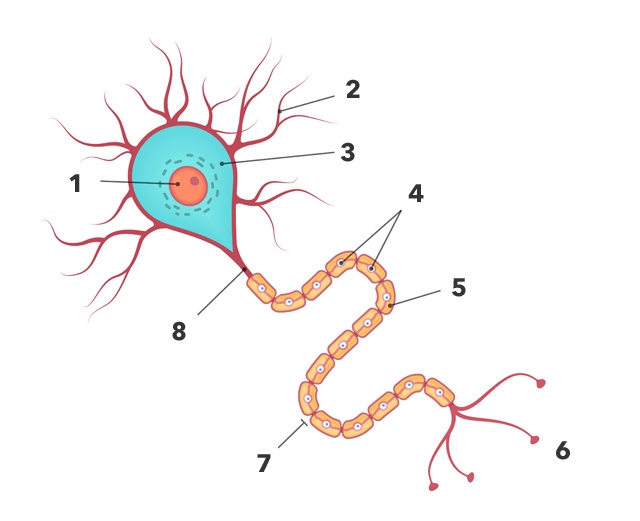
Identify #2
axon
cell body
dendrite
myelin sheath
Identify #3
axon
cell body
dendrite
myelin sheath
Identify #6
axon terminals
dendrites
dendrite
schwann cells
Gaps between Schwann cells that increase the speed of the transmission of the signal down the neuron are called
axon terminals
dendrites
myelin
nodes of Ranvier


Label the Neuron-What space does the letter "G"
represent?
Axon Terminal
Node of Ranvier
Nucleus
Myelin Sheath

Neuroglia that produce myelin on axons in the peripheral nerves are
schwann cells
astrocytes
oligodendrocytes
microglia
Neuroglia that produce myelin on axons in the brain and spinal cord are
schwann cells
astrocytes
oligodendrocytes
microglia

The blue nerve in the image represents a
sensory neuron
motor neuron
interneuron
An electrical impulse within a single neuron is called a
synapse
membrane potential
action potential
cell body
Depolarization occurs when
sodium channels open
potassium channels open
sodium channels close
potassium channels close

Depolarization is occuring at number
1
2
4
5


Small cells that engulf and destroy microbes and cellular debris in the CNS
microglia
horns
neuroglia
astrocytes
CNS neuroglial cells that wrap around axons to create myelin
Oligodendrocyte
Schwann
Satellite
Astrocyte

Cells that are found between neurons and blood vessels and control what nutrients pass to and from neurons in the CNS.
oligodendrocyte
microglial cell
astrocyte
ependymal cell

Support neurons and phagocytize bacterial cells as well as maintaining the health of the neuron.
microglia
astrocytes
ependymal cells
oligodendrocytes

