
 Worksheets
Alternative Energy Sources Quiz- P. Stew
Total questions: 49
Worksheet time: 30mins
Why is nuclear energy considered a nonrenewable alternative energy source?
Because it is derived from the sun's energy
Because it can be extracted faster than it is replenished
Because it requires a mineral fuel mined from Earth
Because it is unlimited
Why is geothermal energy considered a nonrenewable alternative energy source?
Because it is derived from the sun's energy
Because it requires a mineral fuel mined from Earth
Because it is unlimited
Because heat can be extracted faster than it is replenished
Which of the following is not a source of renewable energy?
Solar
Fresh water
Ocean
Nuclear
What do solar, fresh water, wind, ocean, and biofuels have in common as energy sources?
They are all nonrenewable
They all require mineral fuels
They all derive from the sun's energy
They can all be extracted faster than they are replenished
Which renewable energy source is noted for being rapidly growing with strong potential?
Hydropower
Biomass
Wind
Solar cells (photovoltaics)
What is the main use of biomass as a renewable energy source according to the diagram?
According to the diagram, what is the primary benefit of hydropower?
It is used today and is an important energy source.
It has the potential to transition from fossil fuels.
It produces most electricity from renewable solar energy.
It is rapidly growing at 30% per year.
What is the significance of solar cells (photovoltaics) in the context of renewable energy?
Which renewable energy source is identified as potentially a very important fuel to transition from fossil fuels?
Wind
Solar cells (photovoltaics)
Hydropower
Biomass
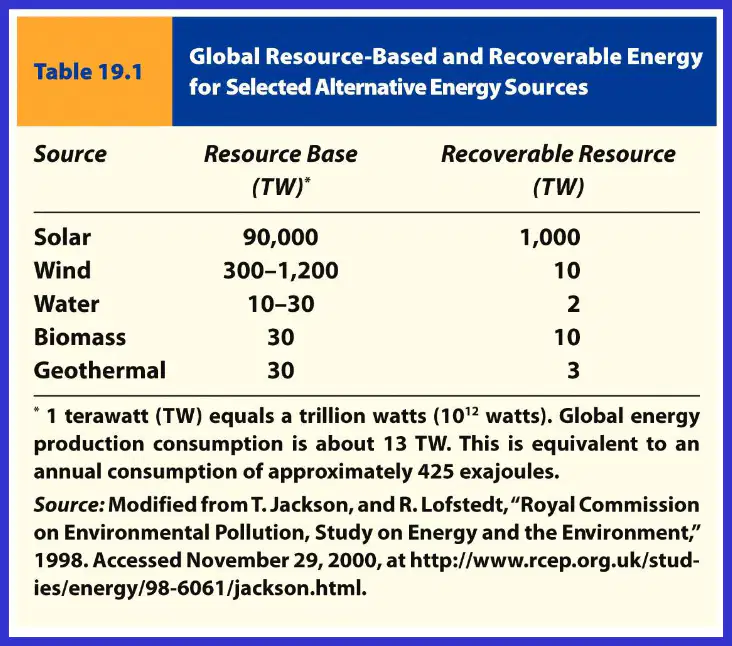
According to the table, which alternative energy source has the highest recoverable resource in terawatt-hours (TW)?
Solar
Wind
Biomass
Geothermal
What is the approximate global energy production consumption mentioned in the text?
13 TW
425 exajoules
90,000 TW
1,200 TW
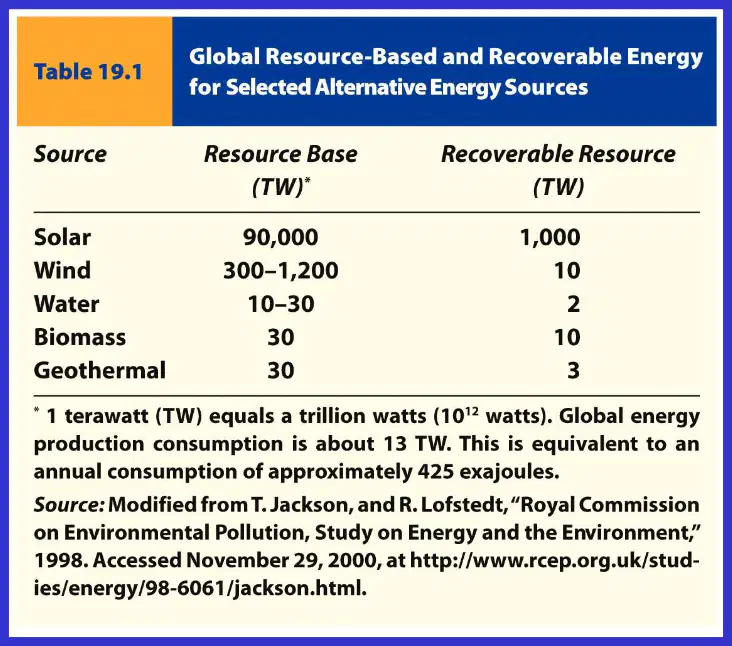
How much recoverable resource is estimated for wind energy?
1,000 TW
10 TW
2 TW
3 TW
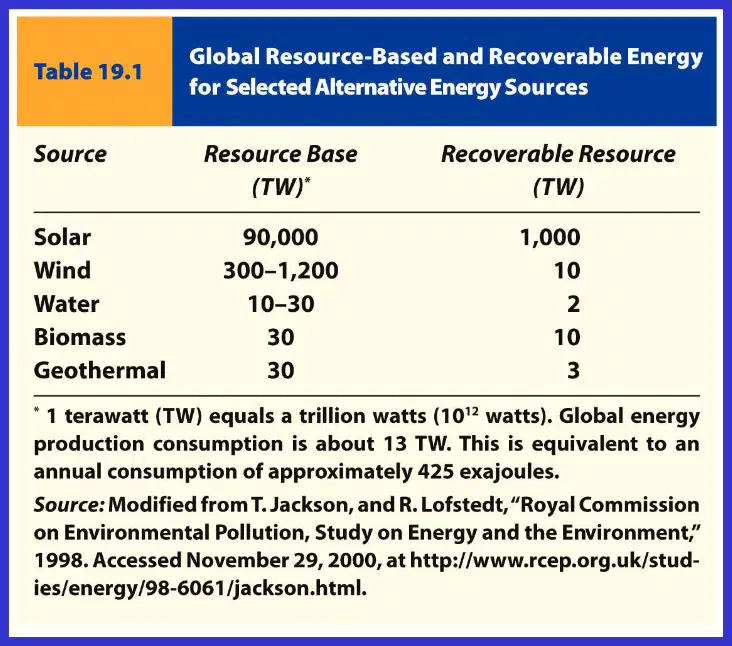
What is the resource base for geothermal energy as shown in the table?
30 TW
10-30 TW
300-1,200 TW
90,000 TW
What is one of the limitations of renewable energy according to the provided material?
It can only be used for transportation.
It is available in all locations equally.
It may not be available when we need it due to daily and seasonal variation.
It is always cheaper than non-renewable energy sources.
Why might solar energy be considered more expensive?
It requires large areas of land.
It has smaller subsidies compared to other forms of energy.
It is less efficient than wind energy.
It cannot be stored for future use.
What does renewable energy compete with, as mentioned in the material?
Non-renewable energy prices
Government regulations
Other land use
Technological advancements
Which of the following is NOT a benefit of alternative energy as mentioned in the material?
It is associated with minimal environmental degradation.
It does not increase atmospheric CO2.
It causes climate change and raises sea levels.
The lead time to build plants is short.
How many weeks of solar energy reaching Earth's surface is equivalent to all known fossil fuel reserves?
5 weeks
10 weeks
20 weeks
50 weeks

According to the map, what is the solar energy potential in kJ/m² for the areas colored in dark green?
Over 26,000
22,000–26,000
18,000–22,000
Under 10,000

What is the corresponding solar energy potential in kWh/m² for the areas with the lowest energy potential, colored in light yellow on the map?
7.22
3.89–5.00
2.78–3.89
2.78
What is one of the purposes of passive solar energy?
To increase energy consumption
To promote cooling in hot weather
To block all sunlight from entering buildings
To generate electricity
Which of the following is NOT a method of passive solar energy?
Overhangs that block summer sun but allow winter sun in
Building a wall that absorbs heat during the day and releases it at night
Planting deciduous trees
Using reflective materials to direct sunlight into a building
What is the function of overhangs in passive solar energy design?
To allow winter sun in while blocking summer sun
To absorb heat during the day and release it at night
To generate electricity from solar panels
To collect rainwater for household use
What is the benefit of building a wall that absorbs heat during the day in passive solar energy design?
It reflects sunlight into the building
It collects solar energy for electricity
It retains heat in cold weather by releasing it at night
It provides structural support for solar panels
Why would someone plant deciduous trees as part of passive solar energy design?
To provide fruit and shade in the summer
To absorb carbon dioxide and produce oxygen
To block winter sun and allow summer sun
To block summer sun and allow winter sun

What is the purpose of landscaping in the context of the diagram?
To provide a habitat for wildlife
For aesthetic purposes only
For shade and wind protection
To increase the property value

According to the diagram, where is heat stored in the building?
In the roof only
In the walls and floor
Outside the building
In the windows

How does the sun's position affect the building differently in summer and winter according to the diagram?
The sun is closer to the building in the summer
The sun's position has no effect on the building
The sun provides more shading in the winter
The sun is higher in the summer, providing shading
What do active solar energy systems require to operate?
Natural convection
Mechanical power
Solar panels only
Batteries
What is used to circulate air, water, or other fluids from solar collectors in active solar energy systems?
Natural convection currents
Manual pumps
Electric pumps
Wind turbines
Where is the heat stored in active solar energy systems before it is used?
In the solar panels
In a location where the energy is used
In batteries
In a location where heat is stored
What is the purpose of solar collectors as mentioned in the text?
To generate electricity
To provide space heating or hot water
To cool down spaces
To collect solar data
What is a characteristic feature of the first type of solar collector described in the text?
It has a complex mechanical system
It uses a series of mirrors to concentrate sunlight
It is usually made of flat glass covered plates over a black background with fluid circulating through tubes
It is a standalone device without the need for a black background
What is unique about the second type of solar collector mentioned in the text?
It uses natural gas as an absorbing fluid
It is an evacuated tube collector where each tube along with absorbing fluid passes through a larger tube
It operates without the use of any fluids
It is primarily used for solar tracking
What is the function of the absorber plate in a flat-plate collector?
To pump fluid through the system
To insulate the collector from the outside
To absorb solar energy and transfer it to the fluid
To release pressure from the system
What is the purpose of the glazing in a flat-plate collector?
To allow sunlight to reach the absorber plate
To store the heated fluid
To circulate the fluid through the system
To cool down the fluid before it enters the collector
Where is the heat for use extracted from in a solar water heating system?
From the copper tube
From the solar tank
From the insulated pipe
From the pressure relief valve
What is the role of the pump in the solar water heating system?
To heat the fluid
To move the fluid through the system
To store excess fluid
To insulate the system
How does the existing water heater integrate with the solar water heater system?
It acts as a backup heater when solar energy is insufficient
It pumps the fluid through the solar water heater
It insulates the solar tank
It collects solar energy
What does photovoltaic technology convert sunlight into?
Heat
Electricity
Chemical energy
Mechanical energy
What are photovoltaic components made from?
Thick layers of metal
Thin layers of semiconductors
Organic materials
Liquids
Do photovoltaic components have moving parts?
Yes, they have many moving parts
Yes, but only a few moving parts
No, they have no moving parts
It is not specified
How is the growth of photovoltaic energy described?
World's slowest growing source of energy
World's stable growing source of energy
World's faster growing source of energy
World's declining source of energy
What happens when sunlight strikes the cells of a solar panel?
It creates a cooling effect.
It produces an electric current.
It generates wind energy.
It causes the cells to break down.
What are the cells of a solar panel made of?
Plastic
Silicon
Carbon
Glass

What is the purpose of the electric current produced by solar panels as shown in the image?
To power vehicles
To heat water
To light a bulb
To produce sound
What is photovoltaic technology emerging as in developing countries?
A minor contributor to the technology sector
A major contributor to off the grid solutions
A replacement for fossil fuels in all sectors
An educational tool for schools
What is one of the challenges that developing countries face which photovoltaic systems help to address?
Lack of skilled labor to operate complex machinery
Inability to build a reliable electrical grid
High costs of importing fossil fuels
Overpopulation in urban areas
Which of the following can photovoltaic systems power in small villages?
Entire cities
Lights and televisions
Heavy industrial equipment
Large-scale transportation systems

