
 Worksheets
Selection Curves, HardyWeinberg and Cladograms
Total questions: 45
Worksheet time: 1hrs 13mins
Starlings produce an average of five eggs in each clutch. If there are more than five,
the parents cannot adequately feed the young. If there are fewer than five, predators may destroy the entire clutch. As a result, five eggs becomes the most common clutch size.
Directional Selection
Stabilizing Selection
Disruptive Selection
Seed cracker birds have either large beaks or small beaks. They do not have medium sized beaks because medium sized beaks do not allow for adequate cracking of seeds.
Directional Selection
Stabilizing Selection
Disruptive Selection
A scientist measures the circumference of acorns in a population of oak trees and
discovers that the most common circumference is 2 cm. There are very few acorns with circumferences of 3 cm or
circumferences of 1 cm. Only the 2 cm circumference acorns survive.
Directional Selection
Stabilizing Selection
Disruptive Selection
_A population of Madagascar hissing cockroaches lives in a woodpile. The
cockroaches are eaten by lizards. Because the lizards have small heads, the lizards are unable to eat the very largest
adult cockroaches, and instead prey upon small and medium sized adults. Over time, only the large headed lizards
survive.
Directional Selection
Stabilizing Selection
Disruptive Selection
Female birds that lay close to the optimum number of eggs have the most surviving offspring. Those that lay fewer or more eggs have lower relative fitness.
Directional Selection
Stabilizing Selection
Disruptive Selection
A population of birds with various size beaks eats seeds. Small seeds can be eaten
by birds with small beaks. Larger, thicker seeds can only be eaten by birds with larger, thicker beaks. During a
drought, only large thick seeds exist so only the large, thick-beaked birds survive.
Directional Selection
Stabilizing Selection
Disruptive Selection
Black rabbits (BB) and white rabbits (bb) are both able to survive because they can camouflage into the white and black rocks in their environment. However, the intermediate gray rabbits (Bb) do not survive. This results in only white and black rabbits.
Directional Selection
Stabilizing Selection
Disruptive Selection
Small lizards have difficulty defending territories so they end up dying out. Large lizards are more likely to be preyed upon by owls. Over time, only medium sized lizards end up surviving.
Directional Selection
Stabilizing Selection
Disruptive Selection
Women often have complications during labor while giving birth to very large babies, whereas very small babies tend to be underdeveloped. As a result, medium sized babies are the ones that end up surviving to adulthood.
Directional Selection
Stabilizing Selection
Disruptive Selection

NAME THAT CURVE!!
Directional Selection
Stabilizing Selection
Disruptive Selection

NAME THAT CURVE!!
Directional Selection
Stabilizing Selection
Disruptive Selection

NAME THAT CURVE!!
Directional Selection
Stabilizing Selection
Disruptive Selection
Which of these is a condition that must be met for Hardy-Weinberg equilibrium?
extremely small population size
no natural selection
gene flow
nonrandom mating
If a population is suffering from genetic drift, which of the Hardy-Weinberg conditions is not being met?
no gene flow
random mating
extremely large population size
no mutations
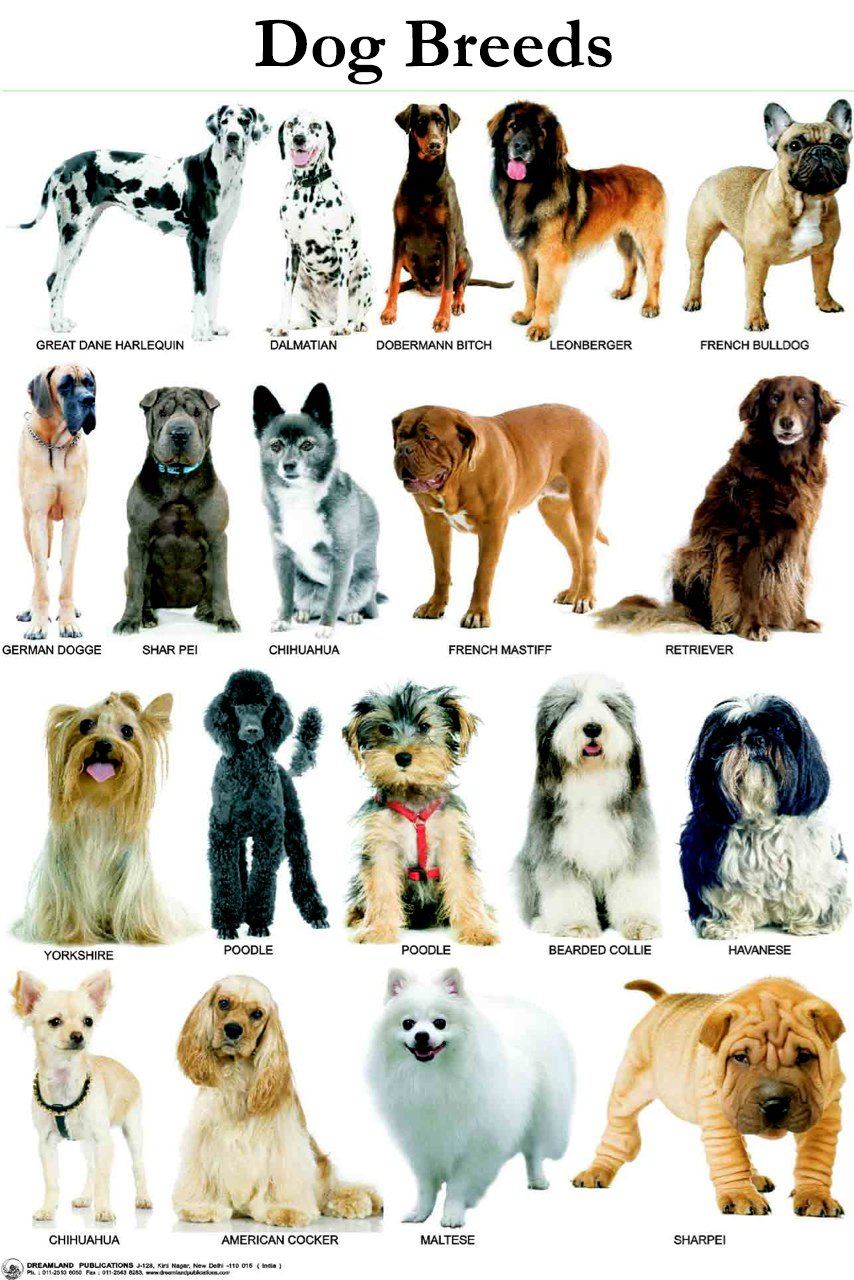
Dog breeding is an example of
natural selection
genetic drift
speciation
artificial selection
If all 5 Hardy-Weinberg assumptions are true, a population is said to be in genetic equilibrium. This means
it is evolving
it is not evolving
The movement of alleles from one population to another is called
genetic drift
the bottleneck effect
the founder effect
gene flow
Small populations are more prone to genetic drift than large populations.
True
False
Why are advantageous traits more likely to be passed onto offspring?
Because they are more likely to survive and reproduce.
Because they come from dominant alleles.
Because they come from recessive alleles.
Because the organism knew it needed that trait, survives, and passes it on.
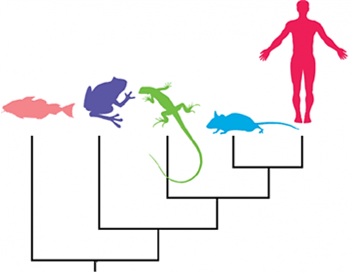
What is the human most closely related to?
Fish
mouse
Salamander
Human

Which group of animals on this tree are most closely related to birds?
Saurischian dinosaurs
Ornithischian dinosaurs
Crocodiles
None of these are related to birds

Where is the alligator and T. rex's common ancestor?
Point A
Point B
Point C
Point D
What is the purpose of a cladogram?
To map the ancestral relationships and shared traits of different organisms.
To trace the inherited traits of a single species over time.
To check the likelihood of an offspring having a particular trait.
To monitor mutations that arise among different populations.

What do both the squirrel and lion have in common that the other animals do not?
They are both vertebrates
They both have lungs
They are both mammals
They both lose their canine teeth.

What do amphibians, birds, prosimians and humans all have in common? Check all that apply.
Hair
Endothermic
Eukaryotic
Tetrapod
Vertebrate

Which letter represents the most recent common ancestor of sponges and mushrooms?
A
B
C
D
E

Which trait should go where A is on the cladogram?
eyes
feet
lips
hat

What is the common ancestor of Letters A, B, C, D, E?
1
2
3
4

Using the cladogram, which two organisms are more closely related Lizards and Newts OR Lamreys and Sharks
Newts and Lizards
Lampreys and Sharks

Which trait(s) do conifers have?
vascular tissue only
vascular tissue and seeds
vascular tissue, seeds and flowers
seeds only
According to this phylogenetic tree, which creature is the least related out of all pictured?
Fish
Frog
Salamander
Human

According to this cladogram, sharks are MOST closely related to which organism?
Amphibians
Ray-Finned Fish
Primates

Who is most closely related to Taxidea taxus?
Lutra lutra
Panthera pardus
Canis latrans
Canis lupus
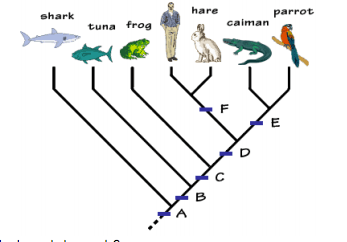
On the cladogram, which organism is the closest relative of the parrot?
Frog
Hare
Caiman
Parrot
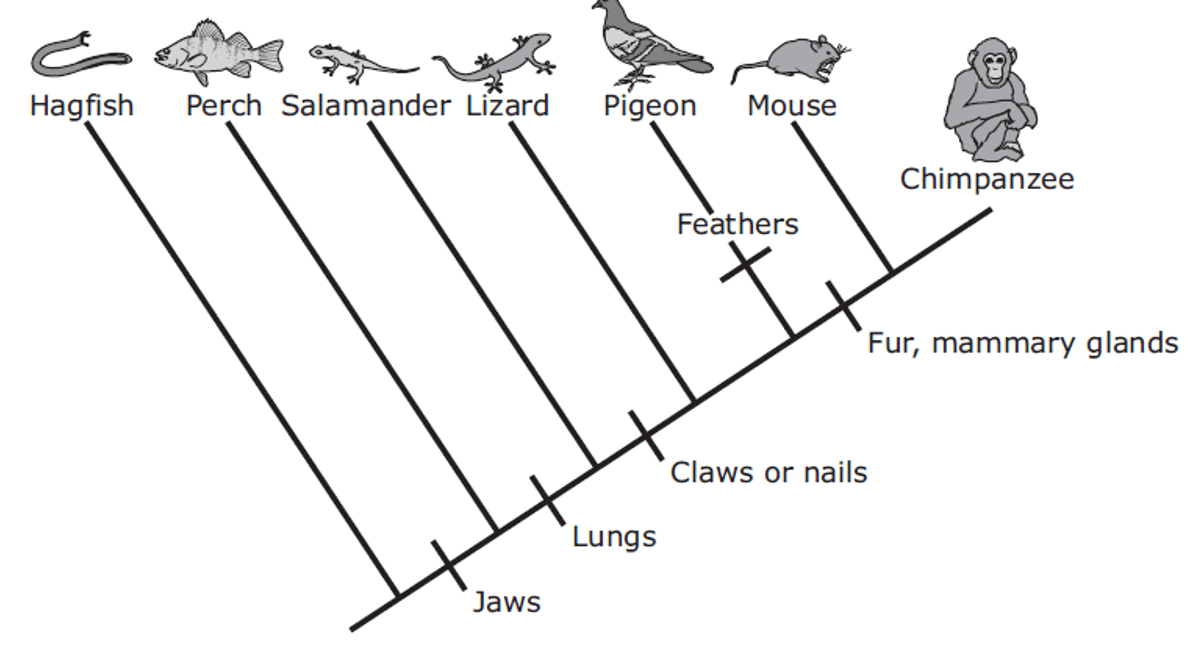
All the animals to the right of the salamander would have the common characteristic of...
Fur
Claws or nails
Lungs
Jaws
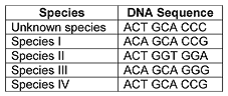

In a phylogenetic tree, the branching points represent common ancestors.
Yes
NO
Each node on a cladogram represents...
the last point at which two groups shared a common ancestor.
the point at which one or more species became extinct.
the most recent point at which a trait was lost in a certain clade.
the point at which two clades joined and became monophyletic.

Which organism is the most distantly related to all the others?
Raccoon
Dog
Giant Panda
Sun Bear


Genetic variation can arise from a random change in the DNA of a gene. This change is called a(n) ___.
mutation
gene pool
gene flow

