
 Worksheets
Blood Review
Total questions: 43
Worksheet time: 45mins
Irregularly shaped cell fragments that help clot blood
Platelets
Lymph
Plasma
White Blood Cells
Contains hemoglobin, supplies body with oxygen
Plasma
Platelet
White Blood Cell
Red Blood Cell
Fight bacteria and viruses by entering infected tissue, destroying bacteria/viruses and absorb dead blood cells
White Blood Cells
Red Blood Cells
Platelets
Plasma
Select all answers that represent a "Blood Type"
O
AO
BO
AB
A
The liquid part of blood made of mostly water; nutrients, minerals and oxygen are dissolved
Marrow
Plasma
Proteins
Urea
Proteins on red blood cells that determine the blood type
antigens
antibodies
Protein Molecules
Marker Molecules
Platelets are cells.
True
False
Where are red blood cells produced?
Bone Marrow
Heart
Lungs
Brain
Red blood cells have a nucleus.
True
False
Which of the following substances are found in blood? Select all that apply.
water
albumins
white blood cells
nutrients
respiratory gases
(a) help to identify blood cells while (b) protect against the wrong type of blood.
Reorder the following for the process of how your body stops bleeding.
vasoconstriction
platelets stick to collagen & form a plug
fibrin traps red blood cells & platelets to form a clot
Match the following blood types to their antibodies.
O
A & B
A
B
B
A
AB
none

How much blood does an adult have?
5 liters
10 liters
8 liters
20 liters

What are the most common blood cells?
red blood cells
white blood cells
platelets
plasma

What can happen if you receive the wrong blood type?
It changes your blood type.
You might need new white blood cells.
your cells will clump together and you could die.
You will get too much oxygen.


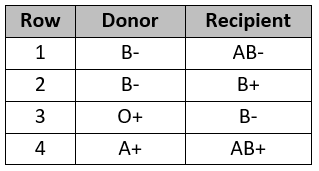
Row 1
Row 2
Row 3
Row 4


Name the proteins on the surface of red blood cells.
Antibodies
Antigens
Plasma
Collagen
Which sample is O+


Which sample is B-


Blood transports...
digested food
excretory products
hormones
oxygen
all of the above
What is the function of a basophil?
Plays a major role in allergic response by producing histamine; also produces heparin to control blood clotting
Functions specifically to combat parasitic infection, they also help to promote inflammation and play a role in allergic reactions
One of the first responders in the immune system, it phagocytoses pathogens and may present the phagocytosed antigens to other immune cells
Helps the blood clotting process by gathering at the site of an injury, sticking to the lining of the injured blood vessel, and forming a platform on which blood coagulation can occur
Functions in transport and gas exchange

What are the functions of blood?
Transports oxygen,waste and hormones
Regulates body temp, PH and fluid volume
Prevents infection and blood loss
All of the above
The hormone responsible for making RBCs
Erythropoiesis
Erythropoietin
The production of blood cells is called
thrombolysis
Thrombocytes

