
 Worksheets
Unit 4 Review
Total questions: 46
Worksheet time: 46mins
What is the layer of gases surrounding a planet called?
Biosphere
Atmosphere
Cryosphere
Hydrosphere
The movement of matter between the atmosphere, land biosphere, hydrosphere, and geosphere is described by the ________.
Water cycle
Biogeochemical cycle
Carbon cycle
Nitrogen cycle
Where do organisms living on Earth's geosphere and in the hydrosphere reside?
Atmosphere
Biosphere
Cryosphere
Lithosphere
What is the ability to do work called?
Energy
Geosphere
Hydrosphere
Radiation
Which of the following is an example of the Geosphere?
Living Organisims
Crystals
The stars in the sky
Hand soap
Which of the following subjects is related to the Geosphere?
Geography
Physics
Literature
Music
What does the prefix 'Bio' mean in Greek?
Earth
Life
Water
Air
The term 'Biosphere' includes the living plants and animals in the many ______ on Earth.
Oceans
Deserts
Biomes
Mountains
What does the term 'Hydrosphere' include?
Only rivers
Only lakes
All water on Earth including rivers, lakes, oceans, and glaciers
Only oceans
How many layers are there in the atmosphere?
3
4
5
6
What is the second layer of the atmosphere from the Earth?
Troposphere
Stratosphere
Mesosphere
Thermosphere
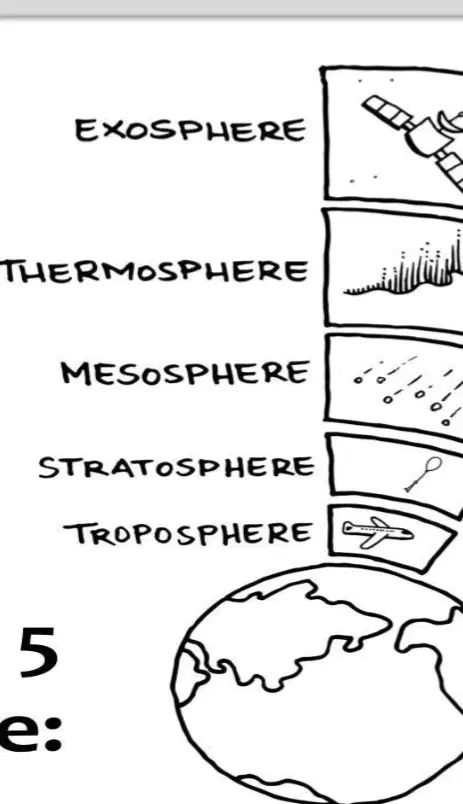
Fill in the blank: The ______ is the layer of the atmosphere that extends from 50 km to 85 km.
Stratosphere
Mesosphere
Thermosphere
Exosphere
Fill in the blank: Water availability impacts plant growth and animals who depend on plants for food in the _______ sphere.
Geo
Bio
Hydro
Atmo
Fill in the blank: The level of the ecological pyramid that includes top predators is called ________.
A) Primary Producers
B) Secondary Consumers
C) Tertiary Consumers
Which of the following is a component of the Biosphere?
Mountains
Rivers
Plants
Clouds
What is the primary source of energy for the Earth's climate system?
Geothermal energy
Solar energy
Wind energy
Nuclear energy
Fill in the blank: The _______ is the outermost layer of the Earth, consisting of the crust and upper mantle.
Atmosphere
Hydrosphere
Lithosphere
Biosphere
Which layer of the atmosphere is closest to Earth?
Stratosphere
Troposphere
Mesosphere
Thermosphere
Fill in the blank: The _______ cycle is crucial for recycling nutrients in the biosphere.
Water
Carbon
Nitrogen
Oxygen
The (a) of Earth is contains all the gasses that surround the planet and protects us from deadly solar radiation.
atmosphere
geosphere
hydrosphere
biosphere
What is the term for the process by which water vapor turns into liquid water?
Evaporation
Condensation
Precipitation
Transpiration
Which of the following is a renewable source of energy?
Coal
Natural Gas
Wind
Oil
What is the process called when liquid water changes into water vapor?
Condensation
Evaporation
Precipitation
Transpiration
Fill in the blank: The _______ is the layer of the atmosphere where weather phenomena occur.
Stratosphere
Troposphere
Mesosphere
Thermosphere
Which of the following is a non-renewable source of energy?
Solar
Wind
Coal
Hydro
What is the main source of energy that drives all weather patterns?
the Sun
oceans
the Moon
mountains
Which is true of energy resource acquisition?
Renewable resources are mostly acquired above Earth’s surface. Nonrenewable resources are mostly acquired below Earth’s surface.
Nonrenewable resources are mostly acquired above Earth’s surface. Renewable resources are mostly acquired below Earth’s surface.
Both renewable resources and nonrenewable resources are mostly acquired below Earth’s surface.
Both renewable resources and nonrenewable resources are mostly acquired above Earth’s surface.
Most energy used in the United States comes from non-renewable sources. List the
ones that are non renewable energy sources:
Word bank: coal, natural gas, petroleum, sunlight, wind, water behind dams
(a)
Match the following
means "Changed"
Convert
78% of Earth's Atmosphere
Nitrogen
Photosynthesis
Releases Oxygen
Cellular Respiration
Oxygen taken in, carbon Dioxide released
Plants take this in
Carbon Dioxide

According to the diagram, geologic activity, such as volcanoes,
Increases the levels of CO2 in the atmosphere.
Decreases the levels of CO2 in the atmosphere.

What is the only process that removes carbon from the atmosphere?
combustion
cellular respiration
photosynthesis
decomposition
Heat travels from the sun to the earth by the process of...
conduction
convection
radiation
insulation
The second law of thermodynamics states that entropy of a system tends to ______________.
increase
decrease
stay constant
fluctuate wildly
What type of organism is a primary consumer?
omnivore
herbivore
carnivore
decomposer
An omnivore eats what?
only plants
only animals
plants and animals
only fish
Which of the following is NOT a decomposer?
Caterpillar
Earthworm
Mushroom
Bacteria
An organism that breaks down dead material is known as a what?
Herbivore
Omnivore
Decomposer
Producer
A deer is eating grass. This makes the deer a what?
Autotroph
Omnivore
Carnivore
Herbivore

Pick the best name for the picture.
Food Web
Food Chain
Ecosystem
Habitat
What does the arrow in a food chain or food web mean?
A series of steps in which organisms transfer (move) energy by eating and being eaten.
An organism that breaks down wastes and dead organisms.
Shows what eats what and consists of many food chains in an ecosystem
The transfer (movement) of energy.
Energy can be created.
True
False
Energy cannot be destroyed.
True
False
The Law of Conservation of Energy states:
Energy can created or destroyed but not transformed
Energy cannot be created or destroyed, it can only transformed
Energy can't be created, destroyed or transformed

The level in an Ecological pyramid that includes all the organisms that share the same place in a food chain.
Trophic Levels
Toxic Levels
KeKe Levels
Environmental Systems

Matter is passed up the ecological pyramid in a similar way to energy but recycled by decomposers and detritivores. This Biomass pyramid roughly follows the 10% rule as well.
Flow of energy
Flow of matter
Ecological Hysteria
Producers
2nd law of thermodynamics
Every time energy changes form, some of it is lost to the environment
Energy can't be created or destroyed
All energy generates heat

