Wayground logo

Free Printable Worksheets

Font size

S
M
L
XL
Worksheets

PHYSICS-Waves and Harmonic Motion

Total questions: 25

Worksheet time: 2hrs 5mins

Name
Class
Date
1.
For a system in simple harmonic motion, which of the following is the time required to complete a cycle of motion?
a)
amplitude
b)
period
c)
frequency
d)
revolution
2.
For a system in simple harmonic motion, which of the following is the number of cycles or vibrations per unit of time?
a)
amplitude
b)
period
c)
frequency
d)
revolution
3.
A simple harmonic oscillator takes 4.8 s to undergo five complete vibrations. What is the frequency of 1cycle? 
a)
1.04 s
b)
4.8 s
c)
1/4.8 s
4.
A simple harmonic oscillator takes 4.8 s to undergo five complete vibrations. What is the period (T) of 1 cycle?
a)
4.8 s
b)
.96 s
c)
9.8 s
5.
The period of a pendulum may be decreased by
a)
Increasing the mass of the bob
b)
moving the equilibrium point
c)
decreasing the mass of the bob
d)
shortening the length of pendulum
6.

Define amplitude.

a)

maximum displacement from equlibrium position

b)

total displacement

c)

maximum distance from where the object is released

7.
Is the following an example of harmonic or linear motion?
 
A clock's pendulum.
a)
Harmonic
b)
Linear
8.
Is the following an example of harmonic or linear motion?
 
The moon orbiting the Earth.
a)
Harmonic
b)
Linear
9.
A unit of one cycle per second is known as a ____________.
a)
Herz
b)
Cycle
c)
Frequency
d)
Period
10.
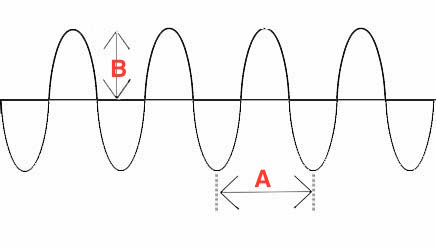
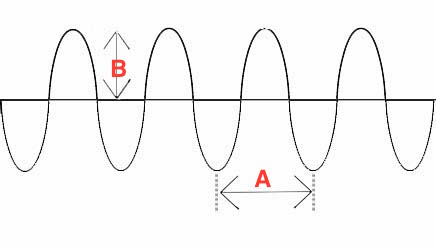
What property of this wave is represented by the letter "A"
a)
amplitude
b)
crest
c)
trough
d)
moanawavelength
11.
What property of the wave is represented by the letter "B"?
a)
amplitude
b)
crest
c)
trough
d)
wavelength
12.
When the frequency of a wave increases, what happens to the wavelength?
a)
The wavelength is not directly affected by the frequency of a wave.
b)
The wavelength increases.
c)
The wavelength decreases.
d)
More specific information is needed to form a conclusion about the wavelength.
13.
1.  A wave has frequency of 5 Hz and a speed of 25 m/s. What is the wavelength of the wave?
a)
25 m
b)
125 m
c)
5 m
d)
25 m/s
14.
A wave carries...?
a)
energy only
b)
matter only
c)
energy and matter
d)
neither
15.
When a wave's amplitude increases it means
a)
it's carrying more energy
b)
its wavelength gets longer
c)
its frequency increases
d)
its wavelength decreases
16.

What type of wave has oscillations that are NOT in the same direction as its motion?

a)

longitudinal

b)

transverse

c)

antioscillators

d)

oscillatorfakers

17.

What type of wave has oscillations in the SAME direction as its motion?

a)

longitudinal

b)

transverse

c)

convex

d)

transiberian

18.

The speed of a wave is determined solely by the wave’s ____________________.

a)

amplitude

b)

medium

c)

period

d)

velocity

19.
A part of motion that repeats over and over with a set series of events.
a)
Herz
b)
Cycle
c)
Frequency
d)
Period
20.

What happens to the frequency of a wave when the amplitude is tripled?

a)

the frequency is tripled

b)

the frequency is a third of what it was

c)

amplitude does not affect frequency

21.

What is the wavelength of this wave?

a)

3

b)

10

c)

4

d)

8

22.

What would happen to the wavelength if the frequency was doubled?

a)

the wavelength would be halved

b)

the wavelength would be doubled

c)

the wavelength would stay the same

d)

frequency does not affect wavelength

23.

What would happen to the frequency is the wavelength was tripled?

a)

the frequency would be a third of what it was

b)

the frequency would be 3 times larger

c)

the frequency would stay the same

d)

the wavelength does not affect the frequency of a wave

24.

The note A in the musical scale has a(n) _________ 220 Hz.

a)

period

b)

frequency

c)

amplitude

d)

cycle

25.
λ = 4 meters
v = 10 m/sec
Determine the frequency.
a)
14 Hz
b)
40 Hz
c)
0.4 Hz
d)
2.5 Hz